This is a transparency release before it is a product
X Algorithm publishes the core logic behind the For You feed, where the useful question is not merely which posts are popular, but which posts should be eligible and useful for one viewer. The repository separates candidate discovery, ranking, and visibility decisions clearly enough to make a complicated feed understandable. It is most useful for study, since reuse assumes X's surrounding services and data.
The request path starts with query hydration, including recent engagements, follows, blocks, mutes, muted keywords, and already served posts. Candidate retrieval then combines 2 broad pools: Thunder supplies recent in-network posts, while Phoenix retrieval and SimClusters find out-of-network material. A common model ranks those candidates, after which the blending pipeline adds material outside model ranking, including ads, prompts, and Who to Follow suggestions. The August 13, 2026 update also published Phoenix training code and synthetic-data generation for a proof-of-concept run.
What happened when we ran it
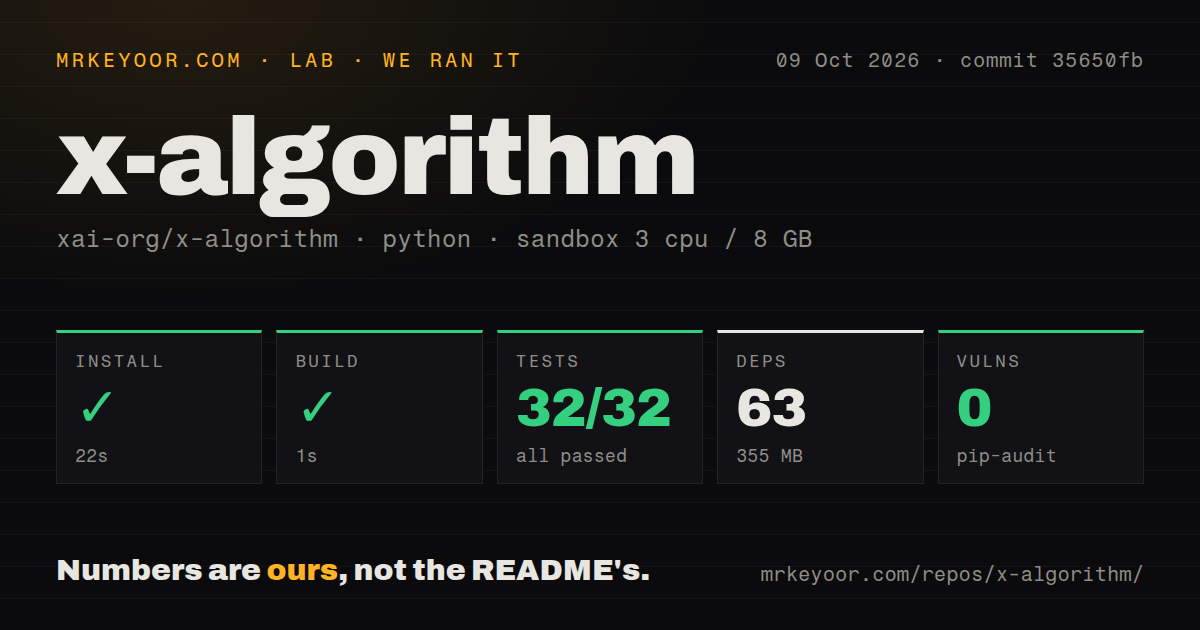
Our run covered the Python project in ./bdsm/, not every service in this large repository. Installation succeeded in 42 seconds, adding 62 packages and consuming 354 MB on disk. The build then succeeded in 5 seconds. Tests completed in 7 seconds, with pytest reporting 32 passed, 0 failed, and 3 skipped of 32. Pip-audit found 0 known vulnerabilities. These results came from commit e4dcedd in a fresh, unprivileged Debian container with 3 CPUs, 8 GB of RAM, no secrets, and a Python 3.12 uv image.
It does not establish performance, model quality, or end-to-end feed behavior. We measured a repository containing 2,045 files, about 288,391 lines of source, and a 14 MB checkout, yet the runnable target was one subproject. There were 0 CI workflow files and no Dockerfile, although a tests directory exists. Anyone assessing adoption should regard the lab result as a component-level reproducibility check, not a production deployment rehearsal.
The architecture explains decisions instead of hiding them
The strongest design choice is the explicit separation of ranking from eligibility. Phoenix predicts a viewer's likelihood of taking actions on a post, and code-held weights combine those predictions into a score. Visibility filtering separately decides whether content can appear, be dropped, or sit behind an interstitial. That distinction matters because a highly ranked candidate can still be ineligible due to viewer actions or labels. The repository names the systems feeding those labels, including BotMaker rules, Scarecrow, Agatha, media analysis components, user credibility scoring, and abuse enforcement.
The documentation also corrects an easy but consequential misunderstanding. As clarified on August 14, 2026, an action weight scales a predicted probability for that viewer, not the raw count of likes, shares, reports, or other actions. Therefore, comparing two weight values does not tell you that one observed report cancels a fixed number of observed likes. Comments were added to the parameter and ranking-scorer code to reduce that misreading.
The Brazil election filter shows the other side of that transparency. It removes posts from accounts reported to Brazil's Electoral Court for the 2026 election unless the viewer follows the account, and the README says its account list was updated on August 27, 2026. Whether you agree with the policy or not, the code exposes that such a rule exists and where it acts. The Under the Hood tool is presented as a related way for people to inspect aggregate label statistics that may limit the visibility of their accounts and posts.
Missing infrastructure limits direct reuse
The repository itself says that some things are not included, and the published code plainly depends on context beyond source files. A useful feed requires live behavioral data, candidate stores, labeling pipelines, policy inputs, trained artifacts, and service operations. Synthetic Phoenix data can support a proof of concept, but it cannot reproduce the distribution or feedback loops of X traffic. The absence of a tagged release also leaves adopters without a stable version boundary, upgrade notes, or a packaged artifact they can pin with confidence.
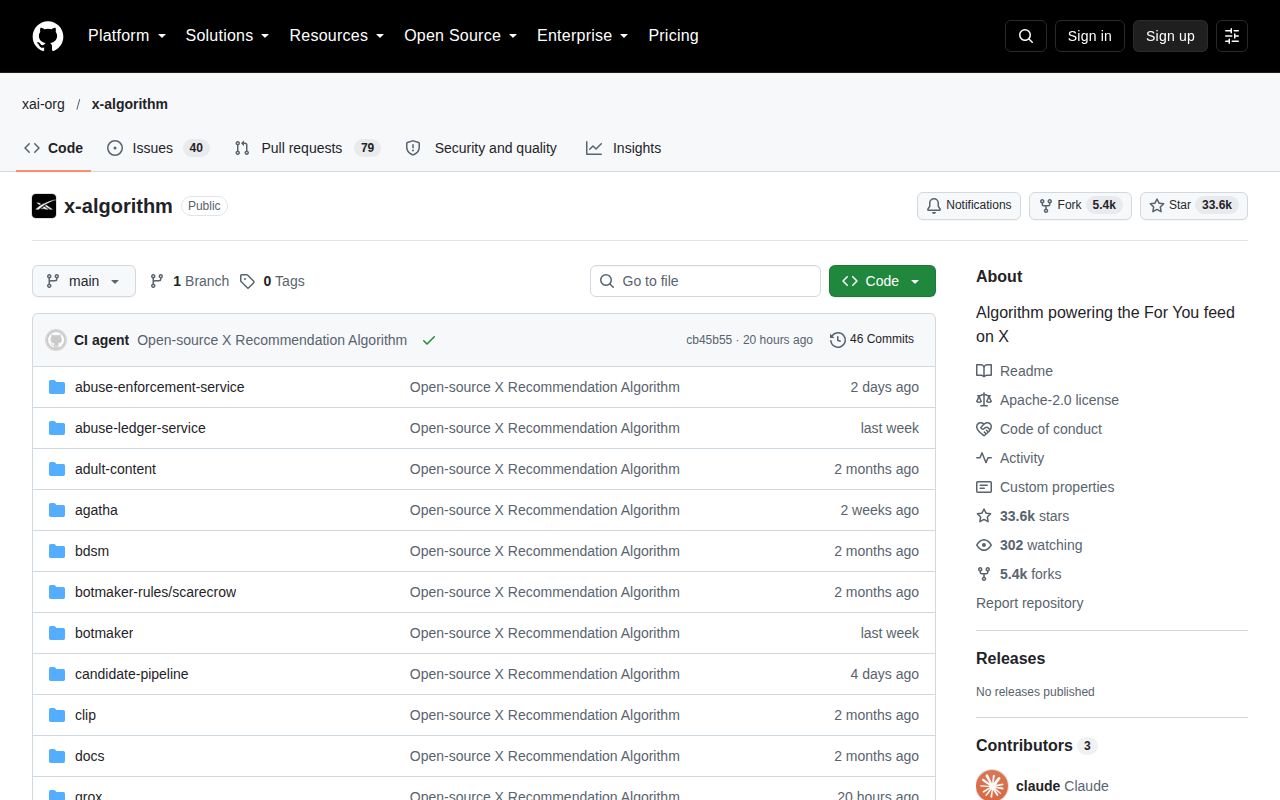
Operational polish is the clearest rough edge. With 0 GitHub Actions workflow files and no Dockerfile in our inspection, the repository does not provide an obvious automated path from checkout to consistently verified full-system build. The successful ./bdsm/ test run helps, but Rust is the repository's listed primary language and our measurement does not cover every Rust service. Documentation is detailed about request flow and policy components, yet a platform team still has to determine which pieces are independently runnable and which are coupled to internal equivalents.
Active code matters more than the absent release list
Project health looks strong on activity and attention, but mixed on supportability. The repository had 32,581 stars, 87 open issues, and a last push on September 3, 2026, one day before this review. GitHub Trending also recorded 37 stars that day. Those signals show current interest and recent work. They do not tell us how quickly maintainers answer issues, and the lack of listed releases means there is no visible cadence of stable checkpoints. It would be wrong to call the project abandoned, but equally wrong to equate popularity with a supported developer product.
It belongs beside your recommender, not at the center of deployment
In a real stack, this repository fits best as a reference and source of patterns. Teams can study its parallel candidate sources, shared ranking stage, separate visibility gate, and configuration-driven action scoring while keeping their own data contracts and policy layer. Individual components may also inform experiments, provided engineers isolate dependencies and validate behavior against local requirements. For a fresh recommendation service, RecBole or Microsoft Recommenders offers a more adaptable starting point; for historical comparison, twitter/the-algorithm is the direct counterpart. Choose X Algorithm when fidelity to X's published design is the point, not when the goal is the shortest route to shipping a feed.