Six web variants share one global monitoring codebase
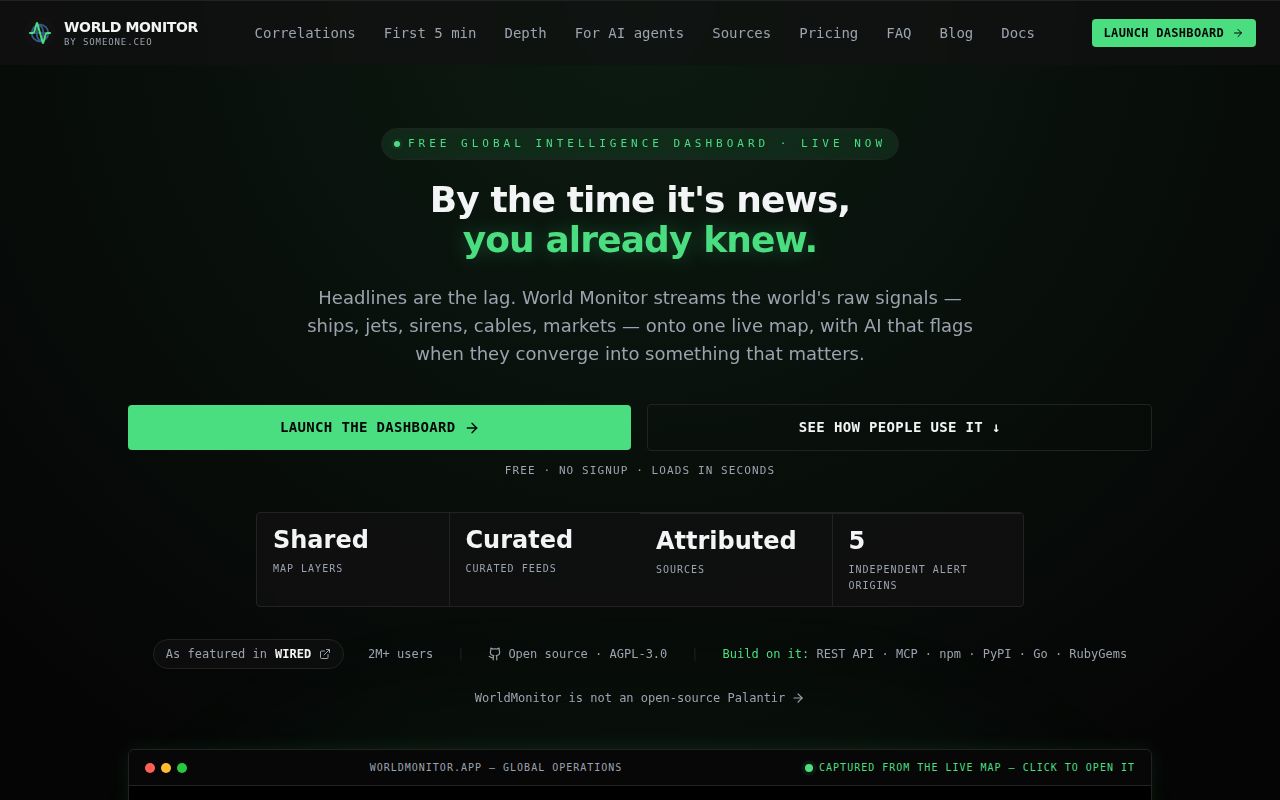
World Monitor collects several kinds of public information into a map-and-panel workspace. The main view covers geopolitics, news, military activity, disasters, aviation, infrastructure, markets, and cross-stream signals. The same codebase also produces tech, finance, commodity, happy, and energy variants. A user can move from a broad world view to a specialist desk without learning a different interface or assembling each feed manually.
The application is more than a frontend over RSS. Its stack includes a dual 3D and flat-map engine, edge functions, a Railway relay, Redis caches, a PWA, and a Tauri 2 desktop app. Our checkout contained 6,078 files, about 1,070,009 source lines, and occupied 115.6 MB before npm dependencies. That scope explains the feature range, and it should stop anyone from budgeting this as a weekend dashboard deployment.
The base app is keyless, while useful feeds have their own credentials
The README says npm install followed by npm run dev starts the base interface with no environment variables. Local AI can run through Ollama without a hosted model key. Feature-specific sources are different: the example environment lists credentials for providers, and the production architecture can include Redis, Vercel, Railway, and external AI services. Each enabled panel brings its own quota, failure modes, licensing posture, and cache policy.
Programmatic access is unusually broad. A hosted MCP endpoint lists tools publicly, while tool calls use an API key or OAuth. There is also a REST API, an npm CLI, and clients for Python, Ruby, and Go. The MCP surface makes the mcp tag mandatory here. Agents can request risk and intelligence data without scraping the interface, but callers still need to preserve source attribution and distinguish a missing feed from a normal reading.
What happened when we ran it
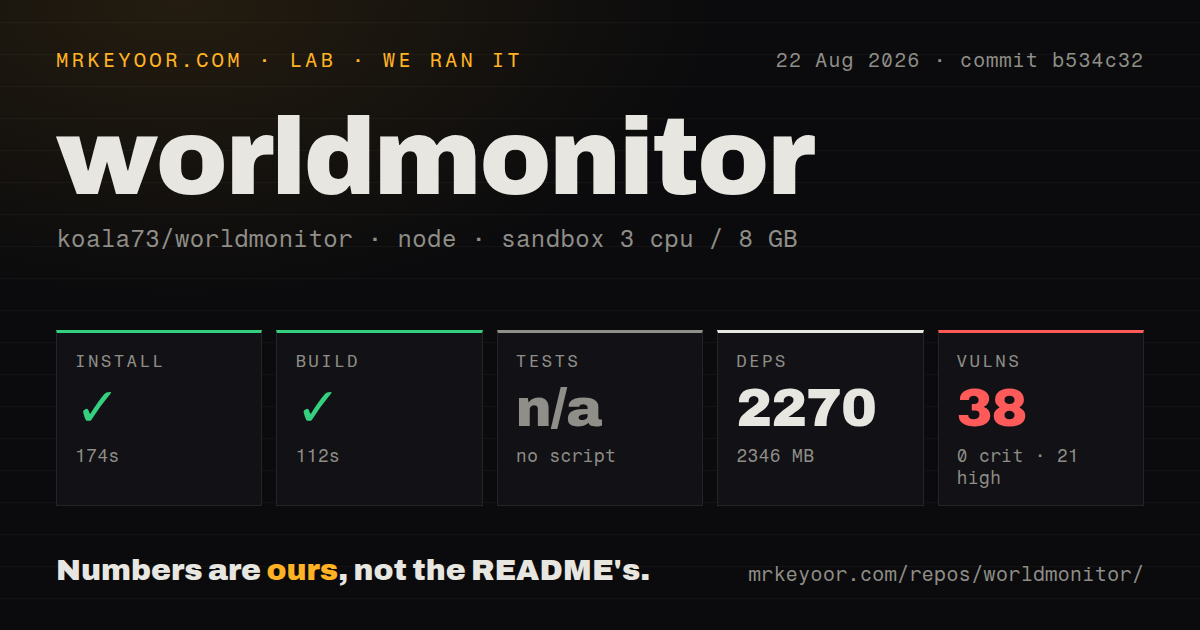
Our sandbox installed 2,270 npm packages in 174 seconds and used 2,346 MB on disk. The production build then succeeded in 112 seconds at commit b534c32. We ran it in a fresh unprivileged Debian container with 3 CPUs and 8 GB of RAM. The repository includes a Dockerfile, a compose file, 38 CI workflow files, and a tests directory.
There was no test script or target, so the harness skipped tests and produced no pass count. Npm audit reported 38 known vulnerabilities: 21 high, 16 moderate, 1 low, and 0 critical. A successful 112-second build confirms that assets compiled in our environment; it does not settle those dependency findings or exercise feed accuracy. Before deployment, identify each advisory's package, reachability, and available upgrade instead of accepting the aggregate count alone.
A green status can still hide missing provider coverage
World Monitor's value depends on honest absence. If a provider does not cover an airport, market, region, or time window, the interface must say unavailable rather than infer normal conditions. Pull request 7148 fixes a concrete case where two watched airports were absent from the AviationStack fetch list, yet missing fields defaulted to zero and the API reported normal flight-delay severity. The overall cache was healthy even though those airports had no data.
That distinction matters more in an intelligence product than in an ordinary dashboard. Another August issue describes digest storage with millions of members outside its documented retention window and incomplete category coverage. Current pull requests also work on source retry behavior and health timestamps. These records show maintainers investigating data contracts, but they also tell adopters to test stale, partial, forbidden, timed-out, and never-covered states for every feed they rely on.
AI briefs are useful leads, not primary evidence
AI synthesis can compress a noisy set of headlines into a brief and correlate military, economic, disaster, and escalation signals. The interface also offers local Ollama use, which keeps that model path under the operator's control. A generated summary can still inherit duplication, delay, regional gaps, translation errors, or a bad upstream claim. Source links and freshness metadata are therefore part of the answer, not decoration around it.
For serious work, open the cited item and record when it was published, when World Monitor fetched it, and which other sources confirm it. Market data, aircraft observations, official alerts, social reports, and news articles have different evidentiary value. The dashboard is strongest at noticing that several streams deserve attention. It cannot determine intent, verify an anonymous claim, or turn a correlated map marker into a confirmed event by itself.
AGPL and active development shape the deployment decision
The source is AGPL-3.0-only. The README permits commercial use when the license obligations are met and offers separate commercial terms for private-source proprietary use or branding rights. A company exposing a modified network service should have counsel review its source-availability obligations before launch. This is especially relevant when custom connectors, private analysis, or branded variants become part of the deployed service.
GitHub showed 84,404 stars, 391 combined issues and pull requests, and a last push on August 27, 2026. The latest tagged release was v2.5.23 on March 1, while repository activity continued heavily in August. The older release tag is not evidence of abandonment. It does mean self-hosters must decide whether to follow a release, a moving commit, or their own pinned fork. With 2,270 installed packages, casual updates are a poor policy.
The 38 audit findings keep this in evaluation territory
World Monitor offers an impressive amount of attributed situational data, and the MCP plus SDK paths make it useful beyond the browser. Our 112-second build shows the large workspace can compile in a plain container. The missing test target and 38 audit findings keep the checked commit short of an uncomplicated production recommendation, especially for a public service that holds provider keys.
Start with the web variant you need, enable only sources you can monitor, and build a source-health page before adding AI summaries. Pin dependencies, review the 21 high-severity audit findings, and define what the interface shows for stale or absent data. If the goal is a research desk that helps humans decide where to look, World Monitor is compelling. If the output itself must be authoritative, it is the wrong layer to trust alone.