The catalog is best used to make a shortlist
Awesome Neovim collects projects that target Neovim rather than every plugin that happens to run in it. The README says Vim-compatible plugins are excluded, then sorts candidates into jobs such as plugin management, LSP, completion, AI, colorschemes, debugging, Git, and pre-made configurations. That boundary is useful. If you need a completion engine, you can scan one relevant section instead of guessing GitHub search terms or copying a stranger's entire dotfiles repository.
The list is broad enough to expose choices that rarely appear in the same tutorial. commit a05873c, the snapshot used for our sandbox review, includes full editor distributions beside smaller tools, plus external resources for search and training. Each entry usually gets one sentence. That compact format makes discovery quick, though it transfers the difficult part to you: checking compatibility, dependencies, configuration shape, and maintenance in every candidate's own repository. Treat the page as a map of doors, with no promise about what is currently behind each one.
Acceptance rules filter submissions without comparing products
The maintainers require a proposed plugin to be specific to Neovim, functional, openly licensed, documented, active, and at least one week old. Contributors must add one plugin per pull request and follow a fixed title and description format. Those rules screen out obvious list spam and give reviewers a repeatable process. Colorschemes receive tags for Tree-sitter, semantic tokens, light and dark variants, Lua, and Fennel, which is more useful than an unstructured wall of theme names.
Passing those checks does not answer whether one completion engine is a better fit than another. The entries do not carry supported Neovim versions, last tested dates, dependency summaries, or security findings. Open issue 2489 raises plugin scanning as work worth considering as the catalog grows. At commit a05873c, inclusion meant that a project cleared the list's acceptance bar. It did not mean the maintainers audited its code or reproduced its setup on your machine.
What happened when we ran it
We did not run Awesome Neovim at commit a05873c on 2026-09-25. Our sandbox had 3 CPUs and 8 GB of RAM, but the repository has no supported package ecosystem and no Dockerfile, so the harness had no install, build, or test command to execute. There was no failing log to interpret. The result says something precise about the repository's form: it is content plus maintenance scripts, not an application with a user runtime.
Cloning the list is unnecessary for ordinary use. You can read its Markdown on GitHub, follow a candidate link, and then use that project's instructions. Contributors have a different path. The repository asks them to run ./scripts/readme-check.sh, while the maintainer guide documents Git, jq, GitHub CLI, and authenticated review commands. None of that validates the listed plugins inside the 3-CPU sandbox we used, and the catalog should not be read as if it did.
A same-day push shows activity, while taxonomy debt remains
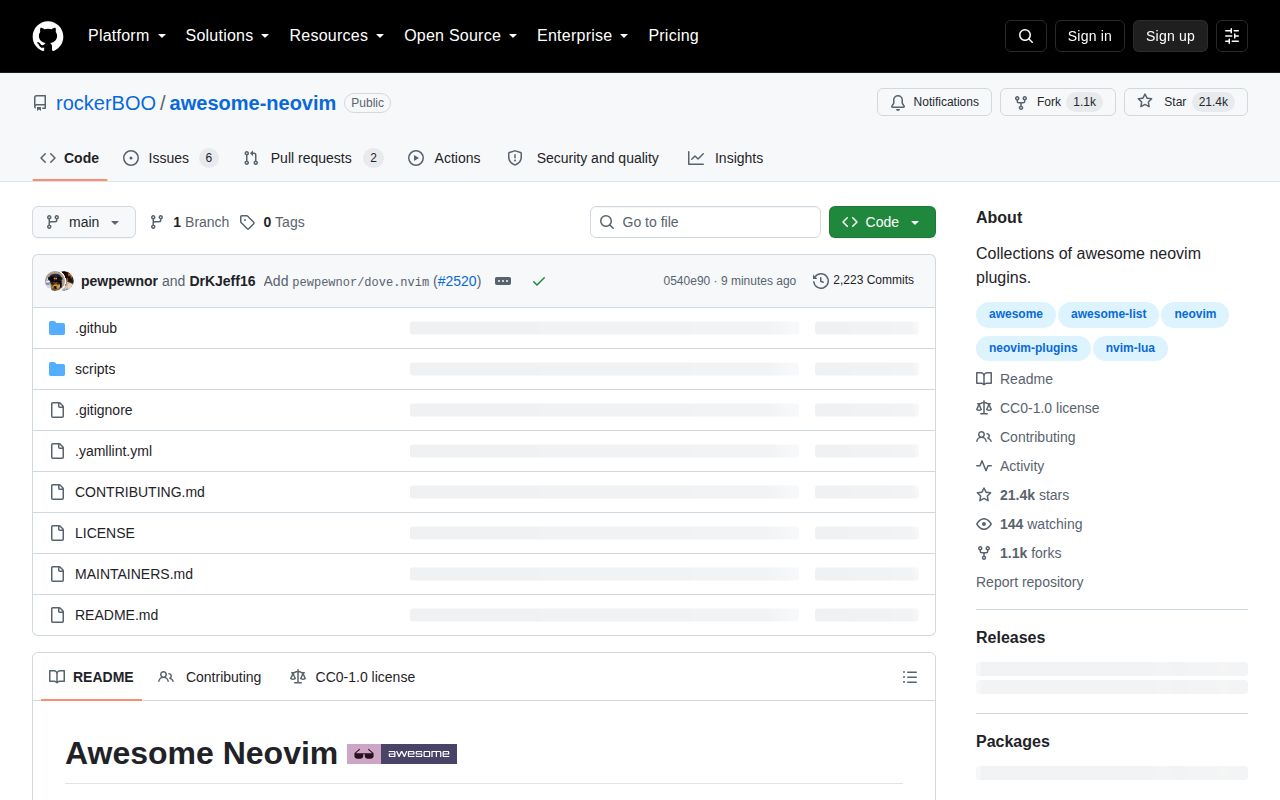
GitHub recorded the last push on 2026-09-25, the date of our review, and the repository summary showed 21,415 stars with 8 open issues and pull requests. Recent open pull requests were adding individual plugins, while an automated quality report from 2026-09-21 tracked review work. That is live maintenance rather than a list preserved untouched. The project also publishes a maintainer guide and names 3 maintainers, which makes its review process easier to inspect.
Activity does not make every category clean. Issue 2336 says the Neovim Lua Development and Fennel sections mix libraries, language tooling, integrations, and misplaced entries. Issue 2290 asks whether plugins under Lines and Bars belong there at all. Both discussions remained open on 2026-09-25, when we cloned commit a05873c. Search within the page helps, but it cannot make an ambiguous label express one clear user need.
Pick a runnable starting point when discovery is not the job
Awesome Neovim is the right first stop when you can name a need and want several candidates. A user looking for a file explorer, status line, test runner, or database client can get useful names quickly, then inspect 2 or 3 repositories in depth. Check the candidate's current README, open issues, recent commits, license, and Neovim version support before adding it to a configuration you depend on. The catalog's presence is one input, not the decision.
Choose something else when the desired outcome is a working editor. nvim-lua/kickstart.nvim gives you a configuration to run and modify. alex-popov-tech/store.nvim brings search and installation into Neovim. akrawchyk/awesome-vim is a shorter route when Vim support matters. For commit a05873c, Awesome Neovim earns its place before those choices, when you are turning a vague feature request into a shortlist. Its one-line entries should start your research rather than end it.