Five output formats track a moving game binary
cs2-dumper attaches to a running Counter-Strike 2 process, inspects Source 2 structures, and writes offsets, interfaces, button data, and schema information. The default output covers C#, C++, JSON, Rust, and Zig. That saves downstream projects from maintaining five hand-written representations of the same addresses. It also defines the tool's limit: cs2-dumper produces data for other software. It is not a library that keeps a consumer correct after Valve changes the game.
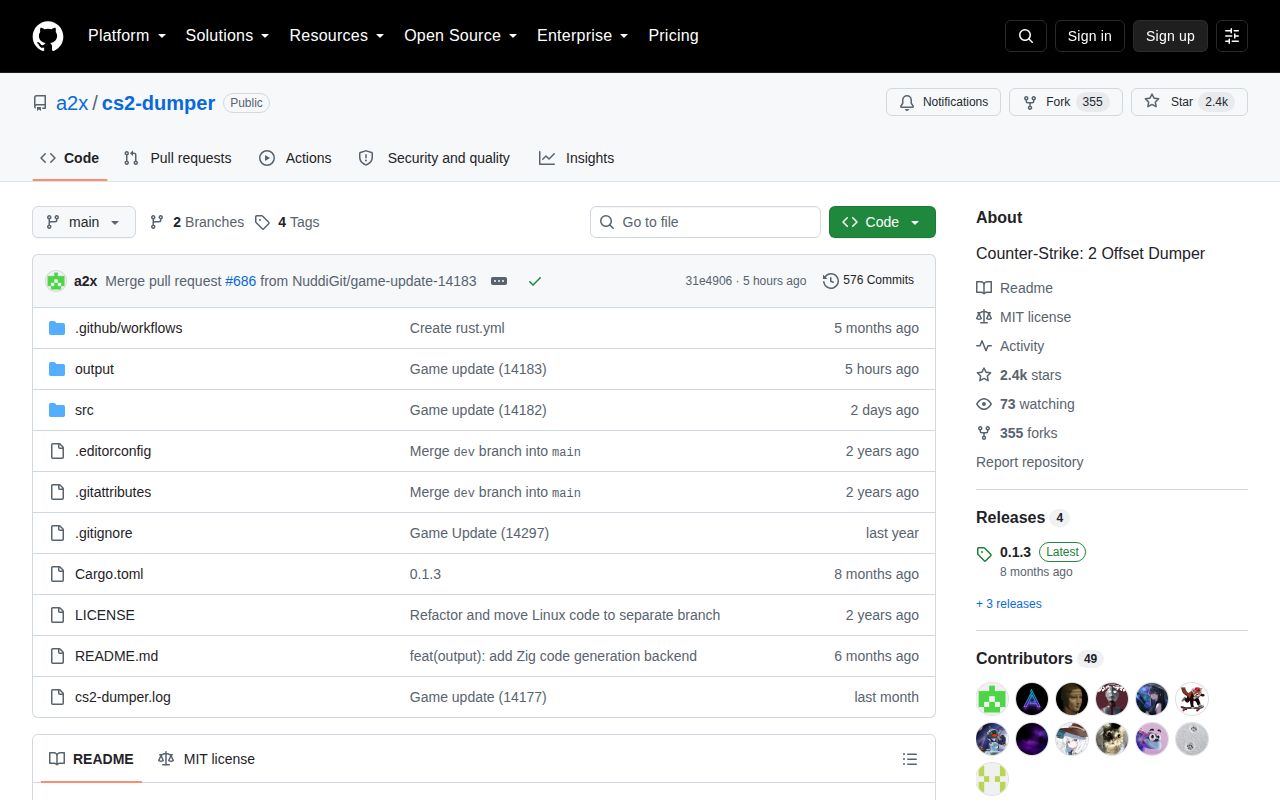
The checked-in output directory makes the repository useful even before you run the executable. It contains generated files for modules such as client, engine, schemas, rendering, physics, and audio. Recent pull requests are mostly titled for specific game updates, which shows the maintenance pattern plainly. Consumers can pin a commit or copy one generated format, but they still need a process for deciding when those values are stale and when a new dump is trustworthy.
Windows gets the direct path; Linux needs a connector
The README says Windows and Linux are supported, then adds an important qualification: the native Linux branch is outdated. On Windows, running without a connector uses the memflow-native OS layer. On non-Windows builds from main, the source panics when no connector is supplied. Linux users therefore need an installed memflow connector such as KVM, while hardware-assisted setups can use PCILeech and pass their own connector arguments.
That is operational work, not a cosmetic flag. The program must find a running process named cs2.exe by default and read its loaded modules. The README says some KVM, PCILeech, and WinIO routes require sudo or administrator rights. A team should decide which host can safely hold those privileges, how connector plugins are installed, and where generated files are written. There are no cloud credentials, but there is a meaningful local-security decision.
What happened when we ran it
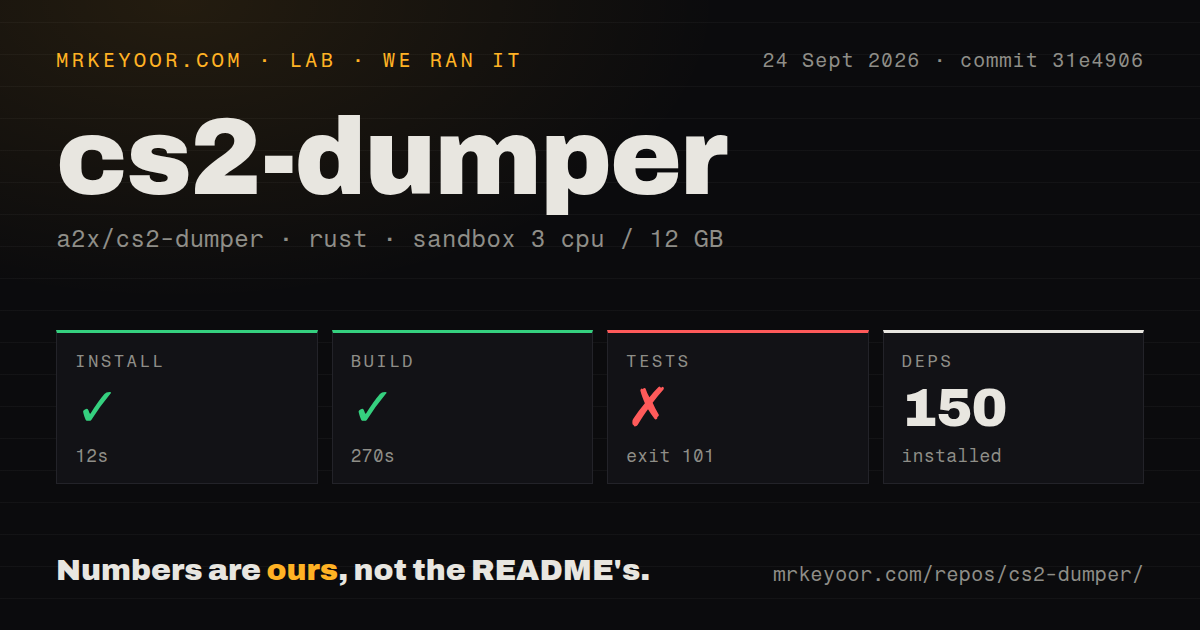
Our sandbox installed 150 Rust packages in 12 seconds. The build completed successfully in 270 seconds on commit 31e4906, using an unprivileged Debian container with 3 CPUs and 12 GB of RAM. The checkout held 149 files, about 135,407 source lines, and 10.2 MB before dependencies. We found 1 CI workflow, no Dockerfile, and no tests directory. The last point does not mean there are no tests, because some test functions live beside the Rust source.
cargo test failed with exit code 101 after 8 seconds during compilation. The compiler reported that memflow_native could not be found at line 297 of src/analysis/offsets.rs, where a test setup function calls create_os. The manifest declares memflow-native under Windows-target dependencies, and the failing run was Linux. The log gives no completed test summary, so this result says the test binary did not compile in our environment. It does not establish whether the memory analysis itself is correct.
The difference between build and test matters here. A 270-second successful build proves that the main Linux target compiled in our sandbox. Eight seconds later, the test target exposed a reference the normal build did not need. Anyone adding this project to a Linux release gate will meet that failure before exercising a running game or connector. The repository's single GitHub Actions workflow avoids the conflict by building a release on windows-latest; it does not run cargo test.
Version 0.1.3 is old; the generated data is current
Release 0.1.3 was published on January 25, 2026 with a two-word description: bug fixes. Judging the project only by that tag would be wrong. The last push was September 24, 2026, and pull requests 685 and 686 covered game builds 14182 and 14183 across September 23 and 24. GitHub reported 2,367 stars and 11 open issues and pull requests in repository metadata. Those signals describe an actively refreshed feed with sparse release notes.
The recurring game-update work is both the reason to use cs2-dumper and the reason to keep it behind review. A fresh commit can be more relevant than the latest release, yet pinning that commit gives you no guarantee that tomorrow's game binary will match. Store the source commit next to generated artifacts, compare diffs after each update, and test the consuming application before distribution. For teams already doing that work, the five default formats remove repetitive translation.
The project is strongest as a specialized generator
The command line is small enough to understand quickly. You choose a connector, its arguments, output types, indentation, output directory, process name, and log verbosity. Rust 1.74 or newer is the documented compiler floor, while the manifest now uses edition 2024. There is no daemon, database, or service account to operate after generation. Most of the complexity lives where the README puts it: obtaining memory access and keeping pace with the game.
Use cs2-dumper for that exact job. The 12-second dependency install is painless, and the repository's update rhythm is useful. The failed Linux test compilation and Windows-only CI make a broader endorsement hard. If you need offline analysis, the author points to a2x/cs2-analyzer. If you need a foundation for a different target, start with memflow. This repository earns its place when generated CS2 offsets are the deliverable, not when you need a general reverse-engineering platform.