A graphics layer, not a game engine
wgpu gives Rust programs one graphics API across Vulkan, Metal, Direct3D 12, and OpenGL. The same crate can also target WebGL2 or a browser's WebGPU implementation through WebAssembly. That is its main job: application code talks to a WebGPU-shaped Rust API while wgpu handles the backend boundary. Firefox, Servo, and Deno use it as part of their WebGPU support, which places the library in demanding software rather than only sample projects.
The scope stops below the conveniences people often associate with game development. There is no scene graph, asset pipeline, physics system, or editor in the pitch. You create buffers, textures, pipelines, command encoders, and surfaces. For a renderer or creative application, that control is useful. For a small game whose author mostly wants to place sprites and play audio, it is a large amount of graphics plumbing to own.
Its WebGPU basis is a sensible compromise. The API is less exposed than raw Vulkan and maps across modern platform backends, yet it remains close enough to GPU concepts for custom rendering and compute. Rust types and validation catch many mistakes before they become driver crashes. They cannot make different drivers, shader compilers, and hardware behave identically, so the project has an unusually detailed test setup for backend behavior.
Platform support has visible boundaries
The support table is worth reading before choosing wgpu. Vulkan on Windows and Linux, Metal on Apple platforms, Direct3D 12 on Windows, and browser WebGPU receive the clearest routes. OpenGL and WebGL2 are marked downlevel or best effort. ANGLE is required for some OpenGL ES paths, while Vulkan on Apple systems goes through MoltenVK. A green build on one laptop does not establish that another backend will render the same workload correctly.
Backend selection can be controlled with WGPU_BACKEND, and adapter selection can be narrowed by name. Direct3D 12 users can choose among shader compiler routes, with separate requirements for DXC. Those controls help support and CI work, but they also show the operational reality: a multi-platform graphics product needs a device matrix and a way to capture which adapter, backend, and driver produced a defect.
The WGSL story has another moving edge. wgpu follows the WebGPU and WGSL specifications, which the README describes as working drafts. Native and WebGL routes use Naga to translate WGSL into platform shader languages. Browser WebGPU passes shaders to the browser instead. The README says there is no concise summary of every difference between Naga and the current WGSL specification. Teams using recent shader features should pin wgpu and verify the exact targets they ship.
What happened when we ran it
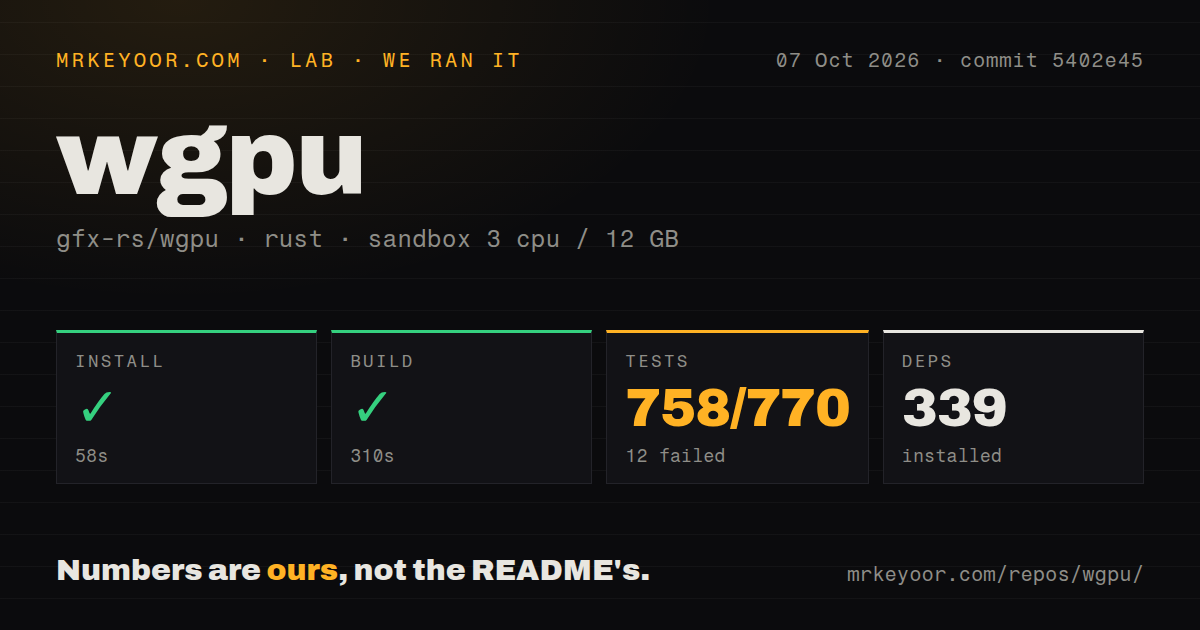
We cloned commit d4359d7 into an unprivileged Debian container with 3 CPUs and 12 GB of RAM. The checkout contained 2,498 files and about 371,478 lines of source, occupying 36.3 MB. Installation succeeded in 48 seconds and installed 331 packages. The build completed successfully in 198 seconds.
The test command ran for 147 seconds, with 357 tests passing and 6 failing out of 363. The final output names two snapshot conversions and four SPIR-V debug-info cases in Naga. In each shown panic, the immediate error was that spirv-val could not be executed because the file was missing. That is as far as the log proves; it does not show a shader translation defect.
The repository's testing guide fills in the setup expectation. It requires the Vulkan SDK, with its bin directory available in PATH, and directs contributors to run the full suite through cargo-nextest and the project's xtask. Our plain cargo test run therefore confirmed that the workspace builds and most discovered tests pass, while also exposing a system-tool dependency that a clean Rust image did not provide.
Testing is part of the product
The test documentation separates shader snapshots, parser and validator cases, compile failures, dependency checks, trace replay, GPU integration cases, examples, and the WebGPU conformance suite. GPU tests run across the adapters present on a machine and can record expected failures for device-specific bugs. Image comparisons are used for examples. This is the right shape for a library that sits between applications and several driver stacks.
Contributors pay for that coverage in setup and run time. Some tests need the Vulkan SDK, some need a real default GPU, and the conformance runner uses Deno. The workspace also has two Rust version expectations: the published wgpu and core crates list Rust 1.87 as their minimum, while tests and examples require Rust 1.93. A developer using an older distribution toolchain can consume the crate before they can work on the full repository.
Project health and the choice
The repository was pushed on August 26, 2026, four days after release v30.0.1. That patch fixed specific Vulkan, Metal, and browser WebGPU defects. Open work was still receiving updates on August 27 across issues and pull requests. GitHub.s combined count is large at 1,258 issues and PRs, but recent movement and a same-day patch release matter more than the raw queue for judging maintenance.
Documentation is spread across API docs, runnable examples, a wiki, a testing guide, and external learning material. The README is candid about weaker backends, translation layers, toolchain versions, and specification drift. New graphics programmers will still need Learn Wgpu or WebGPU Fundamentals because the main README is a map, not a rendering course.
Choose wgpu when Rust is central and you need a portable, low-level graphics foundation. Choose Dawn for a C++ and Chromium-oriented WebGPU stack, ash for direct Vulkan access, or a full engine when renderer ownership would distract from the application. The deciding cost is not adding the crate. It is maintaining shaders and testing the combinations of operating system, backend, adapter, and driver that your users actually run.