Eight Claude Code commands manage a serial's working memory
Webnovel Writer organizes a Chinese web novel through 8 plugin commands for initialization, planning, chapter writing, review, querying, learning, a dashboard, and diagnostics. The central idea is persistent story state. Accepted chapter commits feed a state file, search indexes, summaries, long-term memory, and a projection log. Before drafting another chapter, agents can retrieve those records rather than relying only on whatever prose fits in the current prompt.
This is a workflow system with strong opinions about project structure. A generated book gets directories for story contracts, internal state, manuscript chapters, outlines, setting material, and review reports. The write command performs preflight checks, builds a context brief, drafts, reviews, extracts facts, records a chapter commit, updates projections, and backs up the chapter. That may help a long serial, but authors must accept the plugin's idea of when a chapter is complete and what becomes canonical.
The 19-second install led to a 900-second test timeout
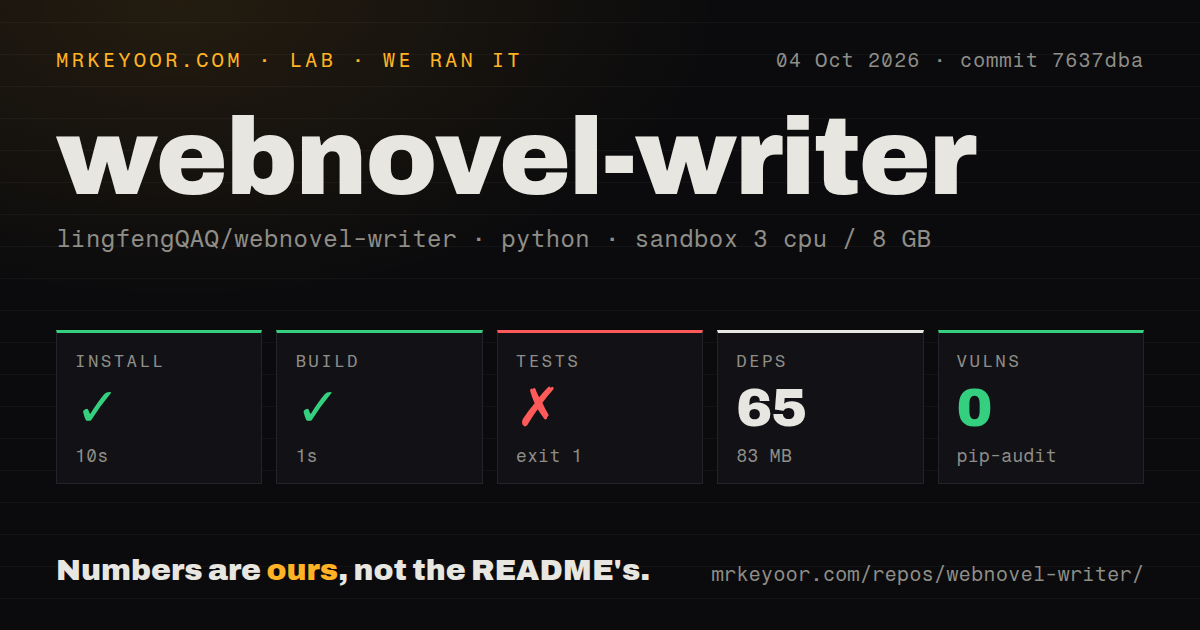
Our sandbox cloned commit 2041aba into an unprivileged Debian container with 3 CPUs and 8 GB of RAM. The Python install succeeded in 19 seconds, adding 64 packages and using 81 MB. The build completed in 5 seconds. Pytest did not finish before the 900-second cap. Its final progress output reached 64%, with dots continuing to appear and no failure line in the supplied tail.
The checkout was substantial: 449 files, about 56,597 lines of source, and 4.8 MB before dependencies. Our scan found 2 CI workflow files, no Dockerfile, and no top-level tests directory. Pip-audit reported 0 known vulnerabilities in the installed packages. The clean audit is useful, while the timed-out suite leaves the complete test outcome unknown on our box. It should not be described as a pass or a failure.
What happened when we ran it
Our Python setup installed 64 packages in 19 seconds and occupied 81 MB. The build passed in 5 seconds. The test command ran for 900 seconds before the harness stopped it. The visible progress markers advanced through 9%, 18%, 27%, 36%, 45%, 55%, and 64%, followed by more dots. The log tail did not name a failing case or explain why completion took longer than the cap.
That distinction matters for adoption. A suite still making visible progress at 64% may contain many slow tests, a slow case, or simply more work than the sandbox window allows, but the log does not prove which explanation is correct. Run the same commit on the intended host, preserve pytest's duration report, and let it finish before setting a CI timeout. Our 5-second build says little about the cost of validating the full state and projection system.
RAG is optional, while Claude Code is required
The plugin requires Python 3.10 or newer and installs through the Claude Code marketplace. Semantic retrieval uses OpenAI-compatible embedding and reranking endpoints. The sample configuration names Qwen3-Embedding-8B through ModelScope and jina-reranker-v3 through Jina. Writers must supply the relevant API keys. If the embedding key is absent, the README says search falls back to BM25, which keeps the system usable with weaker semantic recall.
The distinction between optional retrieval and required authoring host is important. Claude Code runs the skills and agents; this is not a standalone desktop editor. The dashboard is read-only and its frontend is shipped prebuilt, so it does not replace the command workflow. Issue 43 describes a community OpenCode adaptation as an experimental attempt with possible bugs. That does not make OpenCode an officially supported path in this repository.
Open issues show cost and continuity risks
Issue 5 reports using 1 million tokens to produce a first-volume outline and first chapter. Issue 74 reports 500 million tokens for 300,000 Chinese characters during bulk writing, along with outline drift, missed review, and incomplete vector coverage. Those numbers are user reports from particular workflows, not controlled measurements. They still tell a buyer to test one representative chapter and inspect provider usage before committing a long book.
Issue 135 is more specific. The reporter traced an explicit 仙侠 genre selection to a fallback row for a different subgenre, which then placed unrelated guidance into each chapter. The issue includes a reproduction, affected fields, source locations, and a proposed regression test. For a system designed to preserve continuity, a wrong canonical genre is serious. Check whether that issue is resolved in the commit you install and inspect the generated master setting before drafting.
v6.2.1 is current, while v7 remains an RFC
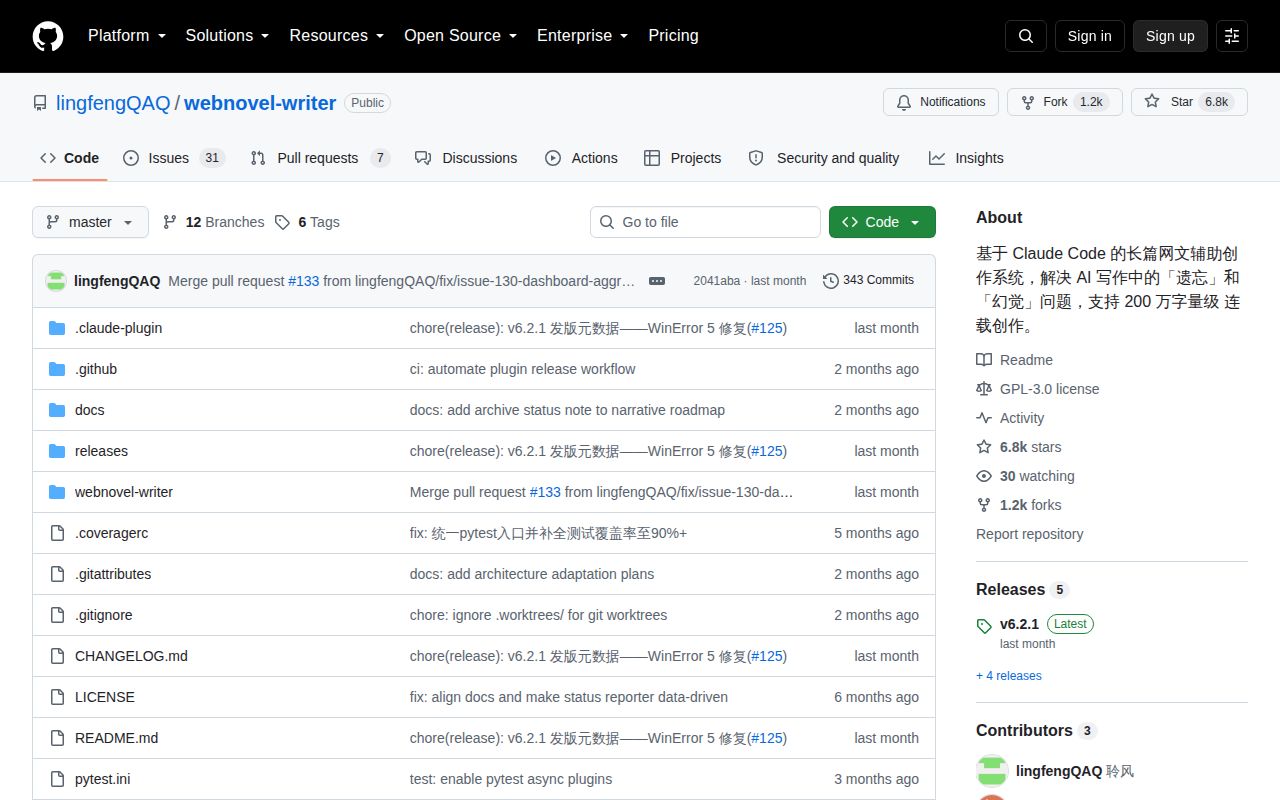
GitHub recorded 6,844 stars, a last push on August 2, 2026, and 38 combined open issues and pull requests. Separate searches found 31 open issues and 7 open pull requests. Release v6.2.1 shipped on July 7 with a fix for intermittent Windows file-replacement failures during chapter commits. The repository is active, and the open queue contains detailed reports rather than only feature wishes.
The README says the v7 redesign is in public RFC discussion. That is an invitation for feedback, not a promise that the next architecture has shipped. Buyers should judge v6.2.1 on its current commands, state contracts, recovery tools, and known issues. A tagged release is available, which is preferable to installing an unpinned branch when a novel's state files may live with the project for months.
Choose it for managed Chinese serials
Webnovel Writer makes the most sense for a technical Chinese-language author who already trusts Claude Code with manuscript context. Its chapter contracts, accepted commits, projections, diagnostics, and backups address real continuity work that a chat window does not. The trade is process: more files, external model calls, review gates, and a suite that exceeded 900 seconds in our environment.
NovelWriter is the calmer choice for offline manuscript organization without AI. KoboldAI Client suits interactive story generation with different model options, while SillyTavern fits character-driven roleplay and lorebooks. Choose Webnovel Writer when persistent serial state is worth adopting its entire Claude Code workflow, then verify costs and generated canon on a small project first.