Hybrid attention is the reason this model exists
VDN-H3 adds a frame-wise linear-attention branch and small LoRA adapters to the MiniMax H3 backbone. A softmax branch stays in the design to preserve visual consistency. The same checkpoint handles text-to-video with audio, first-frame input, last-frame input, both endpoint frames, and a reference-image mode that the authors carefully call Ref2VA-like rather than full Ref2VA.
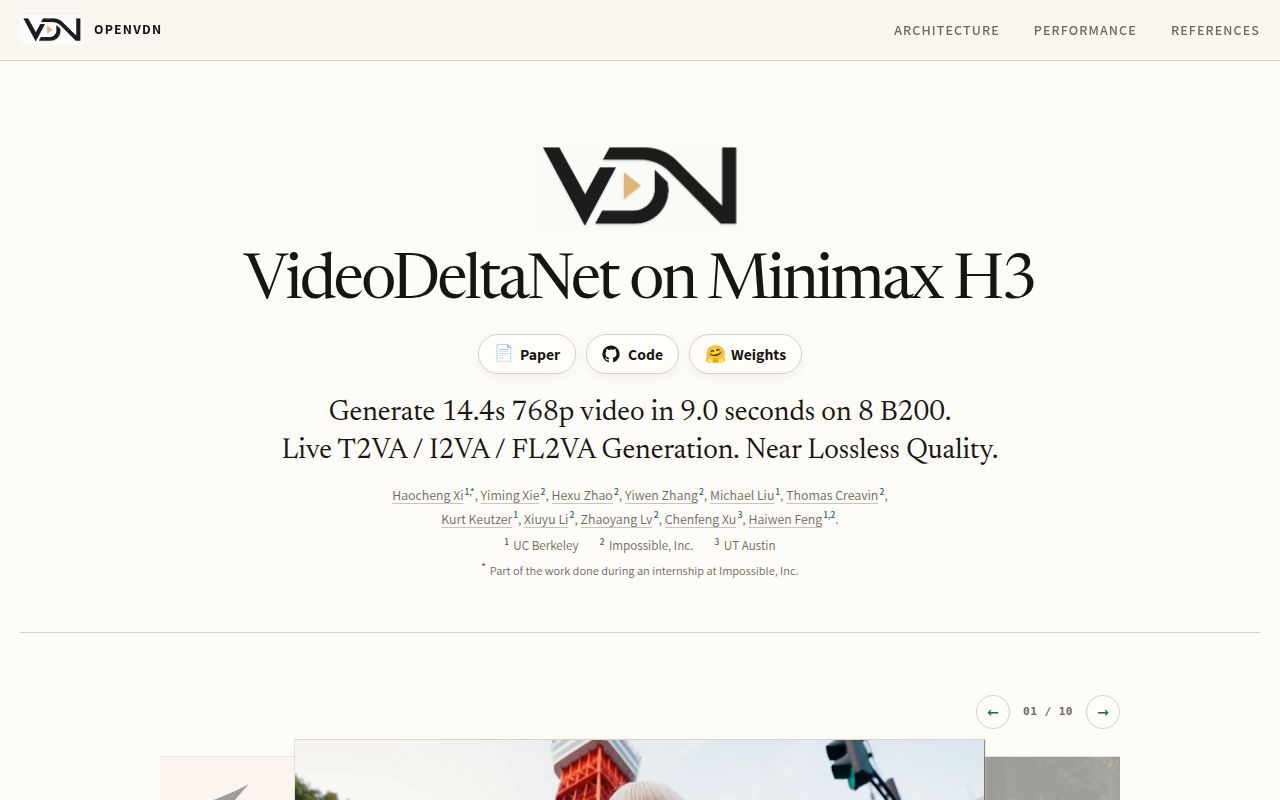
The authors report a 14.4-second, 768p clip in about 9.0 seconds end to end after warm-up on 8 B200 GPUs through SGLang, with 6.9 seconds spent denoising. Their tables separate steady-state denoising from loading, warm-up, VAE decoding, and MP4 encoding. That distinction matters. The headline result describes an expensive, tuned serving layout, not what one ordinary workstation will reproduce. We did not benchmark generation in our sandbox.
The weight license excludes four major markets
The MiniMax H3 Community License defines its permitted territory as worldwide except the United States, European Union, United Kingdom, and South Korea. VDN-H3 is a derivative, and its README says the model weights use that agreement. People in those excluded territories need another license from MiniMax before deploying the model. This is a legal and procurement gate, so confirm the terms with your own counsel.
Commercial terms add another threshold. Products or services earning more than $20 million a year need prior written authorization from MiniMax. A commercial interface must prominently display the MiniMax H3 name. Hosted services must bind users to specified restrictions and maintain safeguards plus a reporting process. The agreement also bars using the model or its outputs to improve an unrelated AI model.
The repository's Apache-2.0 badge therefore tells only half the story. That license covers the VDN training and inference code in GitHub. It does not cover the separately downloaded model weights. A team that checks only the repository metadata could approve code it still cannot legally run where its users or infrastructure are located.
A 24 GB card works through aggressive offloading
The documented weights total about 82 GB: 72 GB for the H3 base, 4.3 GB for the 50-step branch and adapter, and 5.1 GB for the 8-step variant. The Diffusers path can render 345 frames on a 24 GB card by streaming transformer blocks, with a stated 22 GB peak, or 20 GB in fp8. That makes a single-GPU experiment possible, but it does not make the model small.
The recommended environment is Python 3.12, PyTorch 2.13 with CUDA 12.9, and FlashAttention 4 on supported Hopper or data-center Blackwell hardware. Ampere, Ada, and consumer Blackwell use other attention kernels. The repository also installs a patched Diffusers version. Its own tuned path encodes prompts with Qwen3-VL-32B before rendering, so the workflow includes a second large model and precomputed prompt data.
SGLang provides the serving path for text and endpoint-frame generation. The sample command targets 8 B200 GPUs, although it can be reduced to 1, 2, or 4. First runs compile kernels and may take several minutes according to the README. Capacity planning should include checkpoint storage, compile caches, prompt encoding, VAE decoding, and final video conversion, not only denoising VRAM.
What happened when we ran it
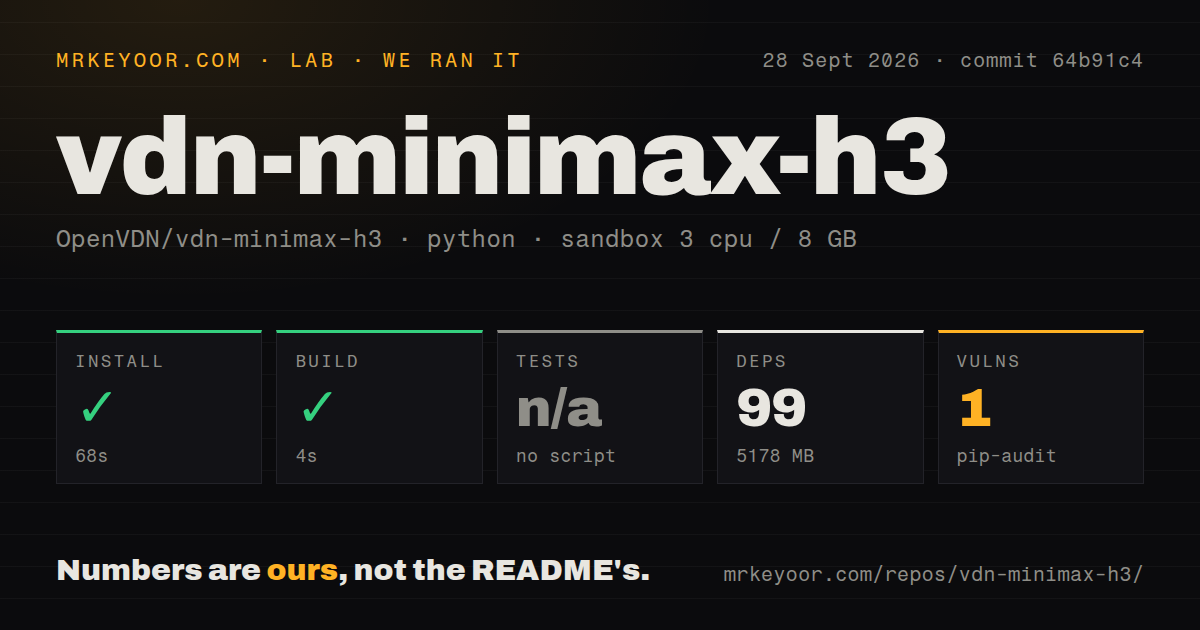
Our sandbox installed 99 packages in 68 seconds and occupied 5,178 MB before downloading the 82 GB model checkpoint. The project build completed in 4 seconds. This was commit 64b91c4 in an unprivileged Debian container with 3 CPUs and 8 GB RAM, so it checked repository setup rather than CUDA inference.
There was no test script or target, and our scan found no tests directory. The test step was therefore skipped rather than passed. We also found 0 CI workflow files and no Dockerfile. Those absences leave adopters without a visible repository-owned baseline for checking the many supported GPU, kernel, precision, and attention-backend combinations.
Pip-audit reported 1 known vulnerability in the installed environment. The measurement supplied to this review does not name the dependency, advisory, or severity, so we will not guess. Before using the stack on shared infrastructure, reproduce the audit against the pinned environment, identify the affected package, and decide whether an available fix is compatible with the model's narrow CUDA and PyTorch requirements.
September activity has not produced a release yet
GitHub recorded 551 stars, 5 combined issues and pull requests, and a last push on September 24, 2026. Four open issues were still active through September 26, including questions about RTX A6000 support, non-fp8 options, DMD training choices, and multi-reference conditioning. That is healthy early discussion for code first published during September.
There is no GitHub release yet. The README provides dated news, detailed inference notes, training stages, data preprocessing, and links to the paper and weights, but adopters must currently pin a commit. With 0 repository CI workflows and no test target, a moving branch is a weak deployment boundary. Record the commit, dependency locks, checkpoint hashes, GPU model, and license version together.
Licensing and hardware decide the purchase
The 82 GB checkpoint and 8-B200 headline path make hardware screening easy. The territorial exclusion is even simpler: if your planned use touches the United States, EU, UK, or South Korea, stop and obtain a suitable license before spending time on CUDA setup. A company above the $20 million revenue threshold has a separate authorization step.
Researchers who clear those gates get more than weights. The repository includes the hybrid-attention implementation, tuned inference, training stages, preprocessing format, fp8 paths, and several conditioning modes. That is useful material for studying video diffusion efficiency. Production buyers should wait for a tagged release, a visible regression suite, and a resolved dependency audit unless they are prepared to create those controls themselves.