mrkeyoor.com_
Mon 28 Sept 07:46 UTC
AI Toolsevaluationupdated 28 Sept 2026

image-to-3d-pipeline review

Image to 3D Pipeline is a published reconstruction experiment built around one fictional submersible. It compares several image-to-mesh models under a fixed Blender inspection routine, then displays the selected GLB in a Three.js explorer.

Verdict

Our build of the 70 MB web explorer passed in 14 seconds with 0 audit findings, but the complete reconstruction stack has no unified install or test target. Use this repository as an unusually candid experiment record and a starting point for mesh inspection. Choose an upstream model directly if you need a maintained reconstruction product rather than this submersible-specific case study.

We ran it

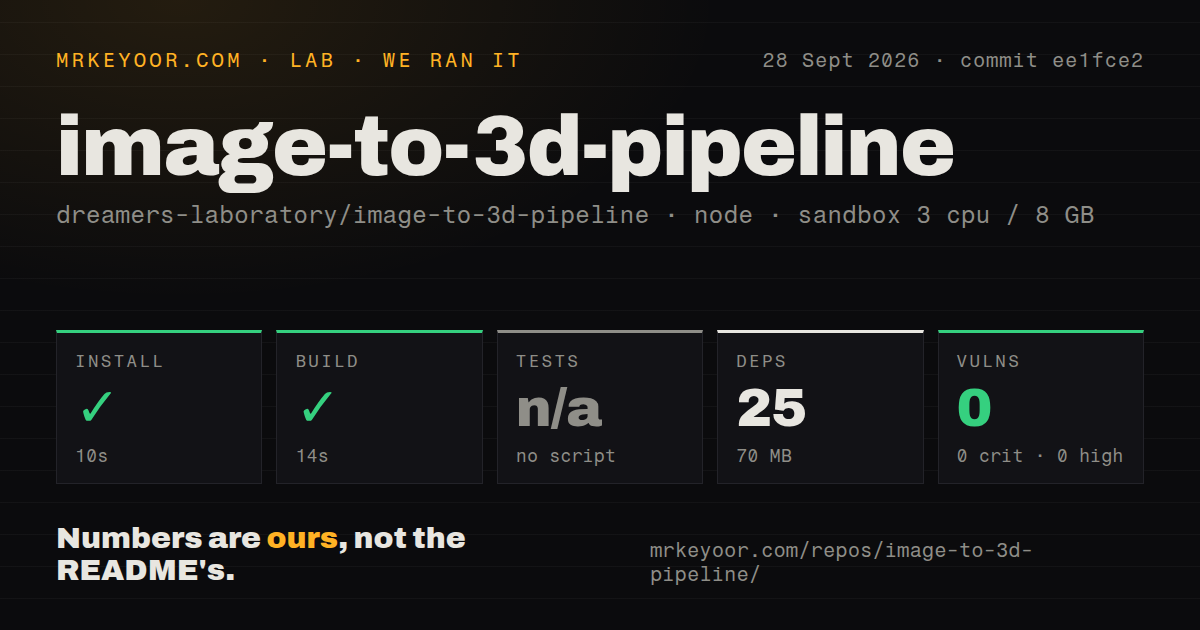
Lab card: what happened when we ran image-to-3d-pipeline
Install✓ · 10s25 packages · 70 MB
Build✓ · 14s
Testsn/ano test script
Known vulns00 critical · 0 high · 0 moderate · 0 low (npm audit)
Repo41 files~2,115 lines of source · 10.5 MB · 0 CI workflows · tests dir

Answers from our run

Does image-to-3d-pipeline build from source?

Dependencies installed in 10 seconds (25 packages), and the build succeeded in 14 seconds. We cloned commit ee1fce2 into a clean Debian container with 3 CPUs and no project-specific setup.

Does image-to-3d-pipeline have tests you can run?

Not through a standard command: the project exposes no test script or target that our harness could run.

Does image-to-3d-pipeline have known vulnerabilities in its dependencies?

npm audit found none in the dependency tree at the time of our run.

Who should not use image-to-3d-pipeline?

Anyone expecting one command to install and run the complete reconstruction stack: setup.sh only clones 4 upstream tools, while their Python environments and model weights remain separate.

What are the alternatives to image-to-3d-pipeline?

TRELLIS, TripoSR, Stable Fast 3D. Our build of the 70 MB web explorer passed in 14 seconds with 0 audit findings, but the complete reconstruction stack has no unified install or test target.

Setup2/5Web build is easy; the 4-model reconstruction stack is manual
Docs4/5Clear method and limits, with environment steps left upstream
Community2/5277 stars, no issue queue, and only weeks of public history
Maturity2/5No release or CI workflow, and the package has no test target

Who it’s for

3D developers who want a concrete method for comparing generated meshes under the same cameras and lighting.
Researchers who can run GPU-heavy upstream models and value pinned commits and recorded experiment settings.
Web developers looking for a small Three.js scene with GLB loading and BVH hull collision.
Artists who want an inspectable case study before building their own image-to-3D workflow.

Who it’s NOT for

Anyone expecting one command to install and run the complete reconstruction stack: setup.sh only clones 4 upstream tools, while their Python environments and model weights remain separate.
CPU-only users attempting the main TRELLIS runner: the script reads CUDA device data and moves the pipeline to CUDA.
Engineering, scanning, or training work that needs accurate hidden geometry: the evaluation calls its winner a plausible visual reconstruction rather than a faithful digital twin.
Teams needing a complete production web asset bundle: the explorer omits its large runtime assets, and its README says touch navigation is not implemented.
Buyers who require automated coverage in the package command: a Playwright file exists, but our sandbox found no test script or target to run.

Setup reality

Our sandbox installed the 05-web-explorer project in 10 seconds, adding 25 packages and using 70 MB. Its build passed in 14 seconds. There was no tests script or target, so tests were skipped. Npm audit found 0 known vulnerabilities.

The built explorer still needs GLB and scene assets under public/assets/; the repository includes one sample mesh but excludes the full runtime set. Node.js 22.12 or newer is documented. GA4 is optional and off unless a measurement ID is supplied at build time.

Running reconstruction is a separate job. setup.sh clones 4 model repositories at pinned commits, while Python environments, checkpoints, CUDA, Blender, and intermediate outputs remain outside the checkout. Two upstream models carry additional commercial or territorial license restrictions.

This repository compares meshes instead of hiding the misses

Image to 3D Pipeline documents one attempt to turn synthetic views of a fictional submersible into a browser-ready mesh. It feeds comparable source images to several reconstruction models, renders the results under the same Blender inspection orbit, ranks visible defects, and places the chosen GLB in a Three.js scene. The useful product here is the method: hold inputs and inspection steady, then look at the backs, undersides, thin fins, and texture seams a flattering front view can conceal.

The repository is compact at 41 files, about 2,115 lines of source, and 10.5 MB checked out. It includes 3 sample source images and one reconstructed mesh, while the written evaluation covers a larger 15-view run. The current winner is TRELLIS V2 stochastic after 20 sampling steps. The authors still describe it as a plausible visual reconstruction, because stern machinery, fine seams, and other unseen details remain inferred.

The full pipeline is a recipe assembled from 4 upstream projects

A root setup script clones TRELLIS, TripoSR, Stable Fast 3D, and Hunyuan3D 2 at exact commits. Local scripts remove backgrounds, run multi-image TRELLIS, inspect GLB files, render fixed Blender turns, and build contact sheets. This is good experimental hygiene. It also means the repository is an orchestration record rather than a packaged runtime with one dependency file and one supported hardware profile.

The separation becomes obvious in the scripts. The TRELLIS runner imports Torch, reads the active CUDA device, loads microsoft/TRELLIS-image-large, and calls .cuda(). The evaluation shell script defaults to a macOS Blender application path and a Python environment elsewhere in the project. You can override both paths, but you must build those environments and obtain model checkpoints yourself. setup.sh only fetches source code, so cloning its 4 vendors does not finish installation.

What happened when we ran it

Our sandbox test covered the Node project under 05-web-explorer, which is the repository's buildable web package. Npm installed 25 packages in 10 seconds and used 70 MB on disk. Vite built the explorer in 14 seconds. Npm audit reported 0 known vulnerabilities, giving the browser half of the project a clean dependency result at commit ee1fce2.

Tests were skipped because the package exposed no tests script or target. A Playwright spec does exist under 05-web-explorer/tests, and the explorer README tells users to invoke Playwright directly after starting the preview server. That documented manual command was not an available package target in our harness. The repository had a tests directory, 0 CI workflow files, and no Dockerfile, so automated browser coverage is not wired into a visible continuous check.

The evaluation states where visual plausibility stops

The selected TRELLIS mesh uses 15 masked views and is reported at 11,866 faces and 1.56 MB. The fixed review looks at silhouette, source feature retention, texture continuity, novel-view credibility, and asset integrity. TripoSR's single-view output ranked last because unseen surfaces became thin, blank, or invented. That comparison is more useful than a hero render because it shows exactly which input assumptions break each result.

The limits are equally specific. Source images lack registered camera metadata, so the scores are structured visual inspection rather than photogrammetric error. The web collider follows mesh geometry, including generated holes. Production training scenes may need an authored collision proxy, retopology, and texture correction. Mobile layout is supported, while touch navigation is absent. Full panorama, floor texture, and comparison meshes are excluded from the repository and must be supplied under public/assets/.

A new repository can still be well documented

GitHub shows a September 2, 2026 last push, 277 stars, and 0 combined open issues and pull requests. The project was created on that same date and has no tagged release. That short history does not prove neglect, especially when there is no unanswered issue queue. It does limit evidence about upgrades, outside contributors, or compatibility across model releases. The absence of CI also leaves the checked-in browser test dependent on someone running it manually.

Licensing is split along the same boundaries as installation. This repository's own code is Apache 2.0. TRELLIS and TripoSR are MIT, while the README warns that Stable Fast 3D and Hunyuan3D 2 have additional commercial-use or territorial restrictions. A team cannot treat the root license as permission for every model cloned by the setup script. Review the selected model's terms before producing customer assets.

Use the protocol when you need evidence, and the model when you need output

TRELLIS is the direct choice if you want the same model that produced the repository's preferred mesh. TripoSR offers a simpler single-image baseline. Stable Fast 3D and Hunyuan3D 2 provide other paths to textured assets under different licenses. This repository earns its place beside them by recording why one candidate won on one object, then preserving the inputs and camera routine needed to challenge that decision.

The 14-second web build makes the explorer easy to inspect, yet it should not be confused with a turnkey image-to-3D service. Borrow the pinned-source setup, fixed Blender orbit, and explicit rejection notes for your own asset class. If your job is simply to generate a mesh, install one upstream model and avoid carrying a 4-model experiment around it.

Alternatives

ProjectWhat it isPick it when
TRELLISThe upstream image-to-3D model used for this repository's selected mesh.pick this instead when you want the reconstruction model itself and will design your own evaluation and browser delivery.
TripoSRA single-image 3D reconstruction model used here as a fast baseline.pick this instead when one-image inference matters more than the repository's multi-view comparison process.
Stable Fast 3DAn image-to-mesh model that also produces UV-unwrapped, textured assets.pick this instead when you want a direct reconstruction package and its community license fits your use.
Hunyuan3D 2A higher-resolution asset generator with separate shape and texture stages.pick this instead when its multi-view workflow and license terms fit your hardware and territory.

What people are saying

  1. [velocity-scout] dreamers-laboratory/image-to-3d-pipeline

Sources

  1. Image to 3D Pipeline README
  2. Web explorer setup and verification
  3. Submersible reconstruction evaluation
  4. Pinned upstream setup script
  5. TRELLIS multi-view runner
  6. Hunyuan multi-view experiment protocol

More ai tools reviews

awesome-ai-agent-platforms · guizang-yingzao-skill · vdn-minimax-h3 · nature-skills · image-story-video-wizard · BrowserKitten · the whole board →