It turns native dependency work into shared infrastructure
vcpkg addresses a stubborn C and C++ problem: obtaining the same libraries, options, and transitive dependencies on several operating systems without every team inventing its own scripts. Launched in 2016 and maintained by Microsoft with community contributions, it now presents itself as a cross-platform package manager for Windows, macOS, and Linux. Its value is less about replacing a compiler and more about making dependency acquisition repeatable enough to belong in source control and CI.
The basic workflow is unusually legible for native tooling. A project can create a manifest with vcpkg new --application, add a dependency with vcpkg add port fmt, and connect the result to CMake, MSBuild, or another build system. That 2-command introduction is honest as far as it goes: vcpkg gives developers a recognizable package-management surface while still respecting the build systems used by the underlying libraries.
Our install and build completed, but no tests ran
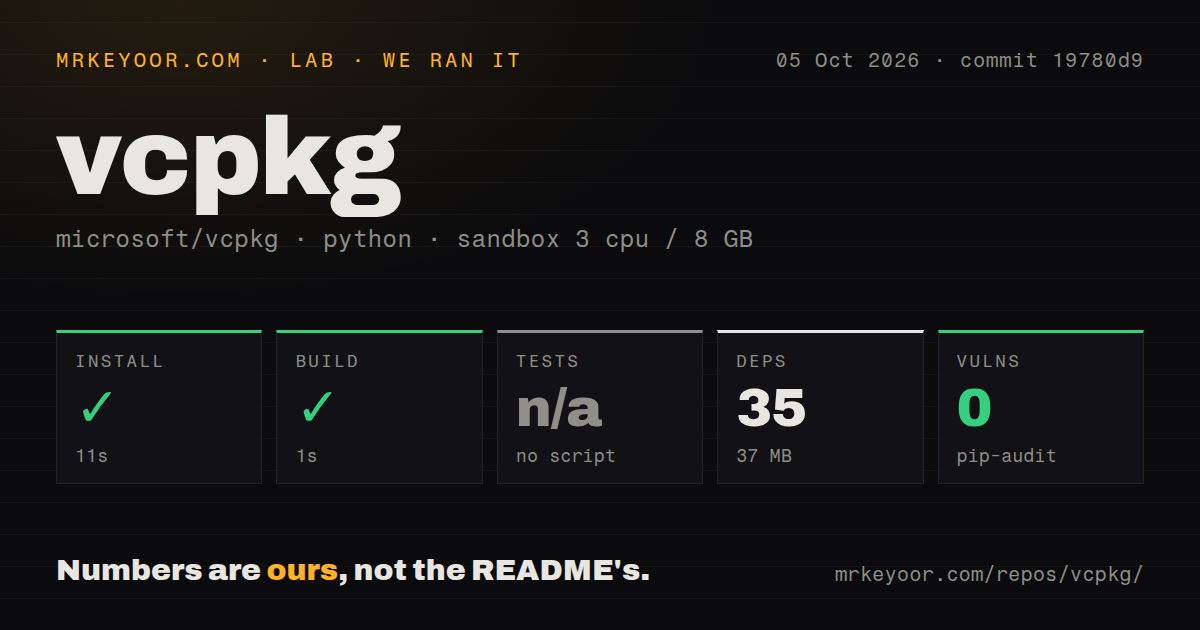
In our sandbox run at commit 8babd6f, installation succeeded in 22 seconds. It installed 35 packages and occupied 37 MB on disk in a fresh, unprivileged Debian container with 3 CPUs and 8 GB of RAM. The build also succeeded, taking 12 seconds. Those are useful signs that the checked-out repository could complete the measured setup and build path without secrets or privileged container access.
The test result needs equally direct treatment: there was no test script or target, so our run skipped tests. We therefore measured 0 executed tests, not a passing test suite. The repository contained 14,240 files, about 8,248 measured lines of source, 5 CI workflow files, no Dockerfile, and no tests directory. That combination shows automation is present, but our box did not independently exercise functional behavior after the build.
The measurement pipeline also reported a successful pip-audit with 0 known vulnerabilities. That finding belongs specifically to the installed Python environment in this run. It does not prove that vcpkg ports, downloaded source archives, build tools, or resulting C and C++ binaries are vulnerability-free. Native dependency managers sit near the software supply chain, so teams should keep their normal source verification, baseline review, license review, and artifact scanning controls.
Versioning and caches are the reasons to choose it
vcpkg's strongest features appear after the first installation. Manifests let a repository declare dependencies, versioning gives teams a way to control changes, and registries support publishing internal packages rather than placing every recipe in a public catalog. Binary caching can avoid rebuilding identical artifacts on each CI worker, while asset caching supports offline or restricted-network scenarios. These 4 capabilities turn it from a convenience command into dependency infrastructure.
Its integration range is another concrete advantage. The README links separate starting paths for CMake, MSBuild, manual build-system integration, Visual Studio, Visual Studio Code, CLion, and Qt Creator. That does not guarantee every port behaves identically everywhere, but it reduces the documentation gap for mixed-tool organizations. The MIT license is permissive for the manager itself, while each library installed through a port retains its original license, a distinction procurement teams must track.
The project also exposes practical escape hatches. Teams can add missing libraries by contributing ports, publish packages through their own registries, reuse built artifacts, and populate asset caches before entering an air-gapped environment. Telemetry can be disabled during bootstrap, with a command-line flag, or through 1 environment variable. Those controls matter because package management often runs in CI, developer laptops, and restricted production build networks with different privacy and network requirements.
The port ecosystem saves work and creates obligations
The central rough edge is that vcpkg usually builds libraries through each upstream project's preferred system and downloads sources and tools from their official distribution locations. A single command can therefore hide a varied set of compilers, scripts, patches, licenses, and network endpoints. When a port breaks on an uncommon triplet or after an upstream release, the user may need to read build logs, pin versions, patch a recipe, or wait for maintainers rather than simply retrying.
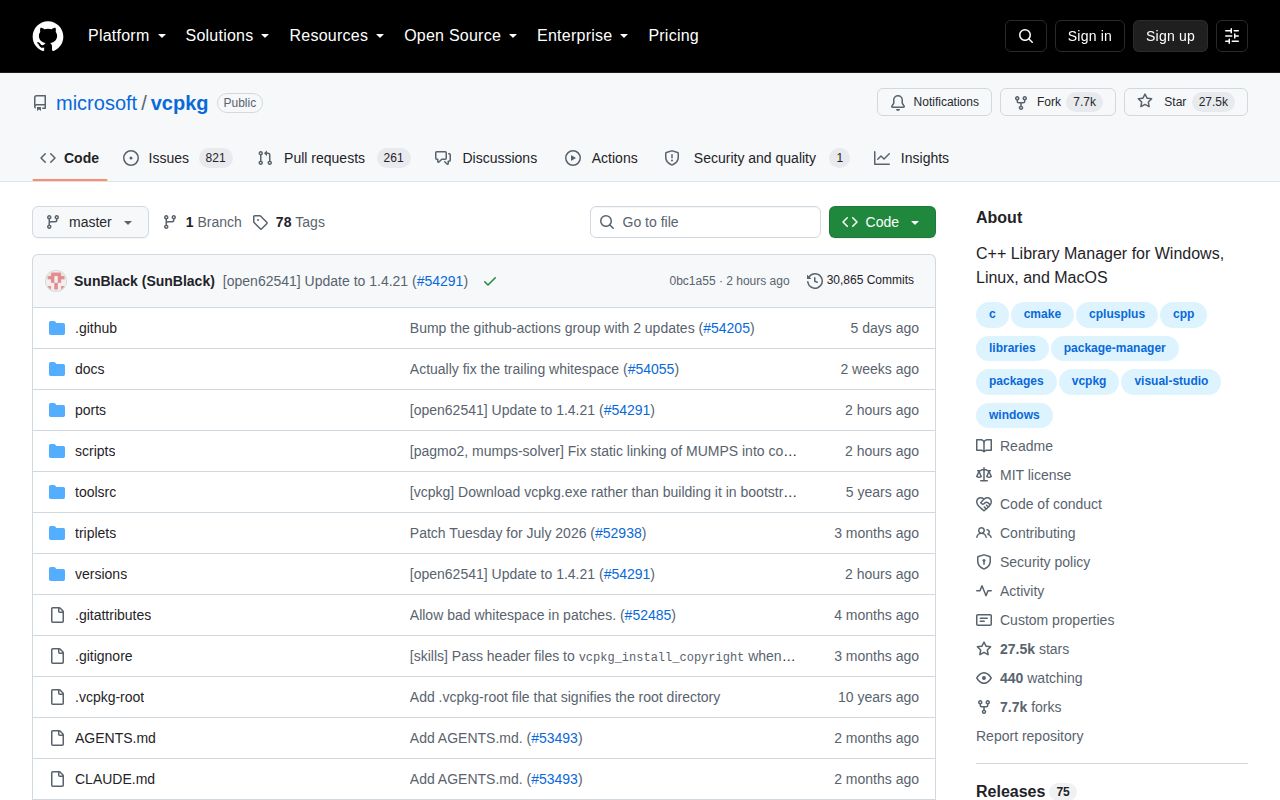
The issue tracker reinforces that expectation. The repository reports 1,174 open issues, too many to interpret as a promise of quick individual support. Yet the latest release, 2026.07.29, was published on July 31, 2026, and the repository was pushed again on August 31, 2026. Combined with 27,415 stars, those dates describe an actively maintained and widely adopted project with a substantial support surface, not an abandoned tool with an old tag.
Documentation is a major counterweight to that complexity. The README routes users to Microsoft Learn for quick starts, manifest mode, classic mode, build integration, versioning, registries, caching, privacy, and contribution guidance. It also explains how to locate installed license files and how firewall needs vary by port. The docs cannot remove native-build failures, but they give a team specific operating models instead of leaving policy to scattered examples from 2016.
It belongs beside the build system and artifact cache
In a real stack, commit the manifest and version baseline with the application, invoke vcpkg before CMake or MSBuild configuration, and place binary or asset caches near CI workers. These 3 layers let private registries hold company packages while the public registry supplies open-source ports. Treat generated binaries as build artifacts, scan them, and promote them through environments under the same controls used for any other third-party component.
Choose Conan when profiles, remote repositories, and its recipe ecosystem are already organizational standards. Choose CPM.cmake when a small CMake-only project wants dependencies declared close to CMakeLists.txt and can accept source fetching during configuration. For a multi-platform product with 3 or more build environments, vcpkg's documented integrations, registries, version controls, and caching usually justify the extra machinery. It is mature infrastructure, but it works best when someone explicitly owns dependency policy.