Valkey keeps the familiar server model under a permissive license
Valkey is a high-performance data structure server aimed mainly at key/value workloads. Its defining context is not a novel API pitch, but project governance and licensing: it was forked from Redis immediately before Redis moved to source-available licenses. Valkey uses BSD-3-Clause, and release 9.1.2 arrived on September 1, 2026. For teams already comfortable with this class of in-memory server, that makes it a practical infrastructure choice rather than an experimental rewrite.
The scope goes beyond plain string caching. The README promises a range of native structures plus an extensible plugin system for new structures and access patterns. Platform coverage is broad: Linux, macOS, OpenBSD, NetBSD, and FreeBSD are supported, across big-endian and little-endian machines and both 32-bit and 64-bit systems. Solaris-derived systems are explicitly best effort, which is useful honesty and a boundary operators should take seriously.
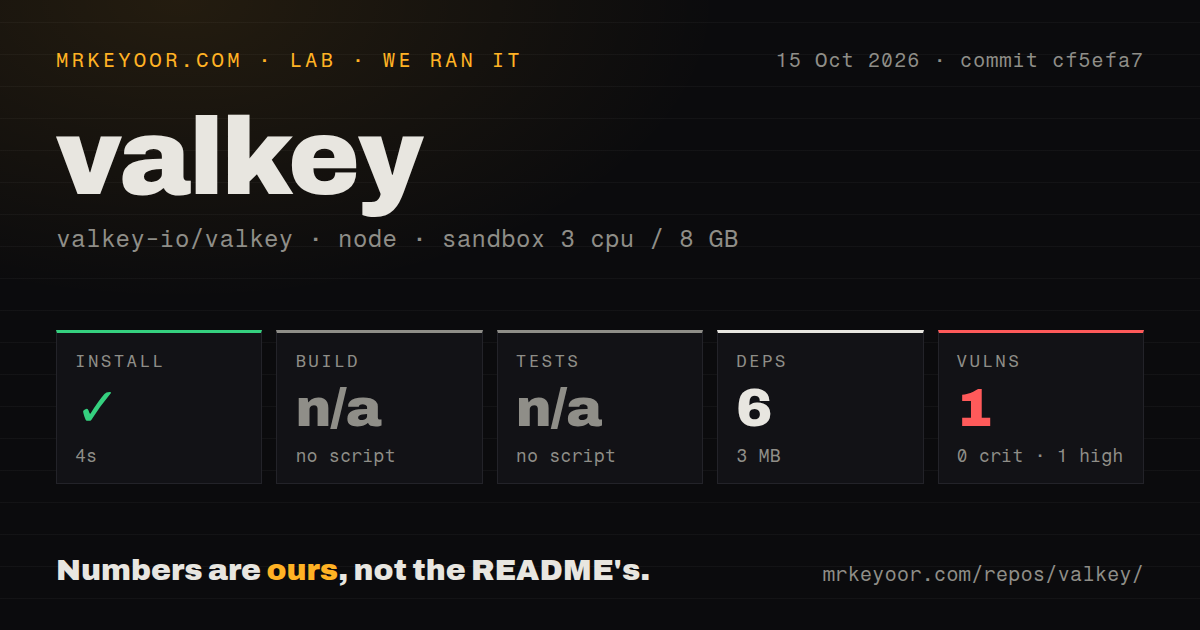
Our run tested a helper, not the C server
Our run cloned commit 85d02f6 into an unprivileged Debian container with 3 CPUs and 8 GB of RAM. The checkout held 2,002 files, roughly 404,390 lines of source, and occupied 22.3 MB. The detected Node project lives in ./utils/reply-schema-linter/, where installation succeeded in 10 seconds, adding 6 packages and consuming 3 MB on disk. The npm audit reported 0 known vulnerabilities at every severity.
There was no npm build script and no npm test script, so our harness skipped both stages. That is not evidence that Valkey has no build or tests. It means the measured ecosystem was a nested utility while the actual product is a C server built from the repository root with make. We did not measure server startup, throughput, memory use, cluster behavior, or a passing C test count, so none should be inferred from the 10-second helper installation.
The source instructions expose the controls operators actually need
The basic path is pleasingly direct: run make, then start ./valkey-server, optionally passing a configuration file or command-line settings. The same configuration names can be supplied as flags, and the README gives a concrete replica example on port 9999. TLS can be compiled in with BUILD_TLS=yes or produced as a module, while systemd and libbacktrace have explicit build switches.
Testing is also broken into useful operational surfaces. Beyond the main integration command, the README identifies separate unit, module API, Sentinel, and Cluster suites. The repository has a tests directory and 20 CI workflow files, signals of substantial engineering activity, but our run did not execute those workflows or validate their current status. Production adopters should run the relevant suites on their target architecture.
The documentation contains unusually concrete low-level guidance. It explains that dependency builds and forced options can remain cached until make distclean, covers switching between 32-bit and 64-bit targets, and documents allocator selection between libc and jemalloc. On supported x86_64 Linux and aarch64 systems, the processor clock path is described as approximately 3 times faster than POSIX clock_gettime, with cited access ranges of about 10 to 30 ns versus roughly 100 ns. Those are README claims, not benchmarks from our box.
Optional features carry real constraints
The quick-start tone understates the native setup work. TLS needs OpenSSL development libraries, RDMA needs its own development packages, systemd integration needs systemd headers, and enhanced stack traces need libbacktrace. A Dockerfile was not present in the measured repository, so operators looking for a repository-supplied container path will need to consult the wider project resources or maintain their own packaging. With 2,002 files in the checkout, this is infrastructure software that deserves a repeatable build pipeline, not a casual npm-style install assumption.
Several sharp edges are documented rather than hidden. Sentinel mode does not support TLS as a module. RDMA is experimental and may change or disappear, while Solaris support is best effort. The 32-bit instructions may require libc6-dev-i386 or g++-multilib, and switching target width calls for a full clean. None of these is disqualifying, but each can turn the apparent one-command build into platform work when an organization needs a less common feature.
Current activity is strong, but 887 issues require triage
Project health looks active when the signals are read together. The repository had 27,141 stars, its latest push was September 7, 2026, the same day as this review, and version 9.1.2 shipped only 6 days earlier. A community snapshot also recorded 27,113 stars and a creation date of March 22, 2024.
The counterweight is 887 open issues. Issue volume can reflect usage and contributor interest as much as neglect, and the supplied data does not show response times, closure rates, or maintainer staffing. Codecov and OpenSSF Scorecard badges are present, and 20 CI workflows indicate broad automation, but badges are not substitutes for reviewing policies and recent workflow results. Buyers should inspect the specific issue areas relevant to clustering, persistence, TLS, and modules before migration.
It belongs in the data tier, with operations around it
In a real stack, Valkey sits behind application services as a low-latency data-structure server, not as an all-purpose database layer. Its documented replication, Sentinel, Cluster, TCP, and TLS controls give operators the pieces to design availability and transport security. A default local start is easy, but production requires explicit choices for configuration, persistence behavior, topology, certificates, monitoring, upgrades, and recovery. Port 6379 examples are a starting point, not an operations plan.
Choose Redis when that specific upstream product and its licensing are acceptable. Choose Memcached when the job is a narrower object cache and richer structures are unnecessary. Evaluate Dragonfly when a different implementation is on the table and you can test compatibility on your own traffic. Valkey is most convincing for teams that want Redis lineage, BSD-3-Clause terms, current releases, and enough systems experience to verify the root build instead of extrapolating from our 6-package utility install.