Redis 8 is a data-structure server, search engine, and cache
Redis starts with strings and key expiration, then goes much further. Lists, sets, sorted sets, hashes, streams, transactions, Lua scripts, geospatial indexes, probabilistic structures, JSON documents, full-text search, time series, and vector sets all live behind one protocol. That breadth lets an application replace several small state services with one system. It also raises the cost of treating Redis as a disposable cache with default settings.
The strongest fit is shared state that benefits from atomic server-side operations. Counters, rate limits, queues, consumer groups, leaderboards, sessions, and expiring cache entries map directly to commands rather than read-modify-write code in an application. Our checkout contained 1,858 files, about 387,044 source lines, and measured 21.7 MB. Redis is mature infrastructure, yet the present repository includes far more than the compact server many developers first learned.
The official container is easier than the full source build
A first trial can be one official Docker command on port 6379, followed by redis-cli or a supported client library. The README links starters for Python, C#, Go, JavaScript, and Java, plus client guidance for several other languages. That path avoids the compiler matrix and is the sensible way to test commands, persistence behavior, and application integration before deciding whether a custom build has any value.
Building every bundled data type and query feature is heavier. Redis 8.10 calls for GCC or Clang, LLVM 21, Rust 1.94, Python 3, and CMake no newer than 3.31.6. The repository's make bootstrap can install missing prerequisites, but the README warns that it may replace versions of shared tools. Our measured 3-second build did not exercise this path; it built only the nested Python validator selected by the harness.
What happened when we ran it
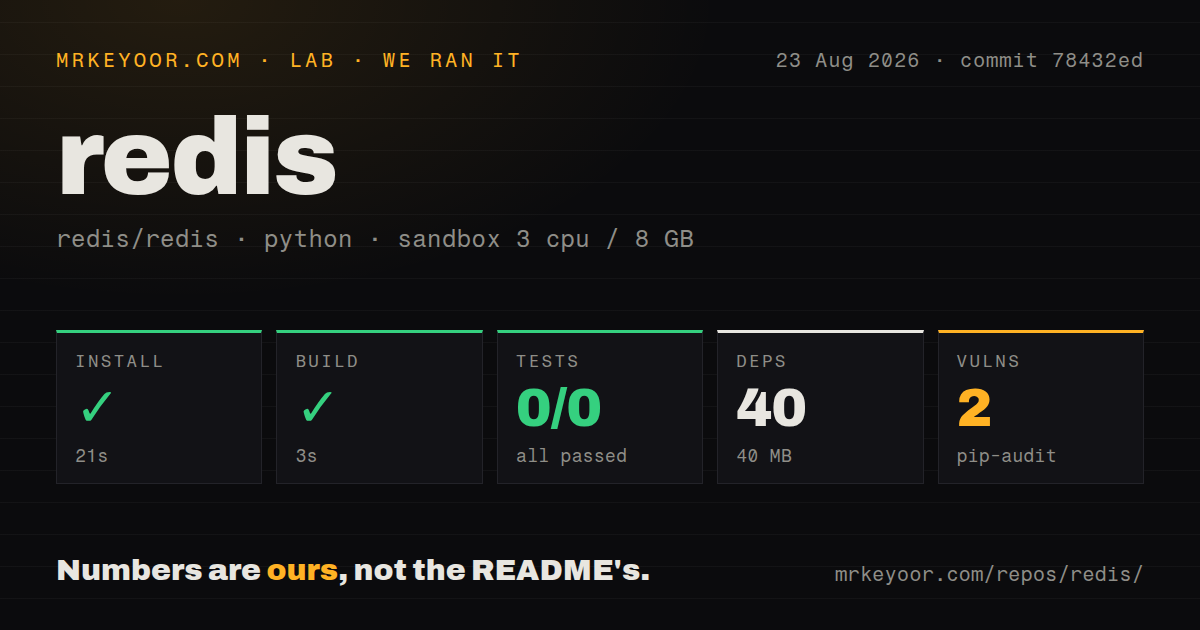
Our sandbox entered utils/req-res-validator at commit 78432ed. Its install succeeded in 21 seconds, adding 40 Python packages and using 40 MB on disk. The utility build completed in 3 seconds. These are valid measurements for that subproject in a fresh unprivileged Debian container with 3 CPUs and 8 GB of RAM, not measurements of compiling or starting redis-server.
Pytest exited with code 5 after 5 seconds because it collected 0 tests; the log said only no tests ran in 0.00s. There were therefore 0 passes and 0 failures out of 0, which is a failed test step rather than a green suite. Pip-audit reported 2 known vulnerabilities in the installed Python environment. The lab block does not name those advisories, so this review does not guess which packages or severities were involved.
Persistence and failover decide whether Redis is safe for your data
Putting Redis between an application and its primary database is different from making Redis the system of record. Teams must choose snapshotting, append-only persistence, replication, backup, restore testing, and failover behavior according to what can be lost. Memory limits and eviction policy matter just as much. A cache can discard keys; a queue, session store, or vector index may have a different tolerance.
The repository offers clustering and a large command set, but deployment topology is still an operator decision. One open issue reports slow replica-state propagation in a cluster of more than 300 nodes, a scale and scenario far outside our 5-second validator test. That report should not be generalized to small clusters. It does show why a production acceptance plan needs node failure, resynchronization, network partition, persistence recovery, and client retry cases.
Redis 8 licensing needs an explicit review
The README says releases through 7.2 use BSDv3, versions 7.4 through 7.8 offer RSALv2 or SSPLv1, and 8.0 onward offer RSALv2, SSPLv1, or AGPLv3. It also warns that Intel Leanvec and LVQ binaries cannot be combined with the AGPLv3 or SSPLv1 options because of license compatibility. This is a legal and packaging choice, not a footnote for procurement to discover after deployment.
Valkey is the obvious comparison when a team wants a Redis-compatible direction under permissive licensing. Memcached remains attractive for disposable caching with a smaller operational and semantic surface. Dragonfly is worth a trial when a different server architecture is the point of the evaluation. None is a drop-in decision for every Redis 8 feature, so inventory commands, modules, persistence requirements, and client behavior before moving production data.
Release 8.10.1 makes patch speed part of the verdict
GitHub showed 76,116 stars, 2,916 combined issues and pull requests, and a last push on August 27, 2026. Release 8.10.1 was published on August 17 with SECURITY urgency. Its notes list buffer errors, out-of-bounds access, use-after-free cases, a TLS client-certificate authentication bypass, and an RDB-loading memory-corruption path that may lead to remote code execution. That makes an exact supported release more important than the Redis name alone.
Redis is still an easy recommendation for teams that need its data structures and can run a stateful service carefully. The supplied lab run cannot validate the server, and saying otherwise would turn a 0-test utility result into false confidence. Use the official server artifact, test your persistence and failover choices, monitor memory, restrict network access, and keep security releases moving. A cache hit is useful; a clear recovery story is what makes the deployment dependable.