What this project actually is
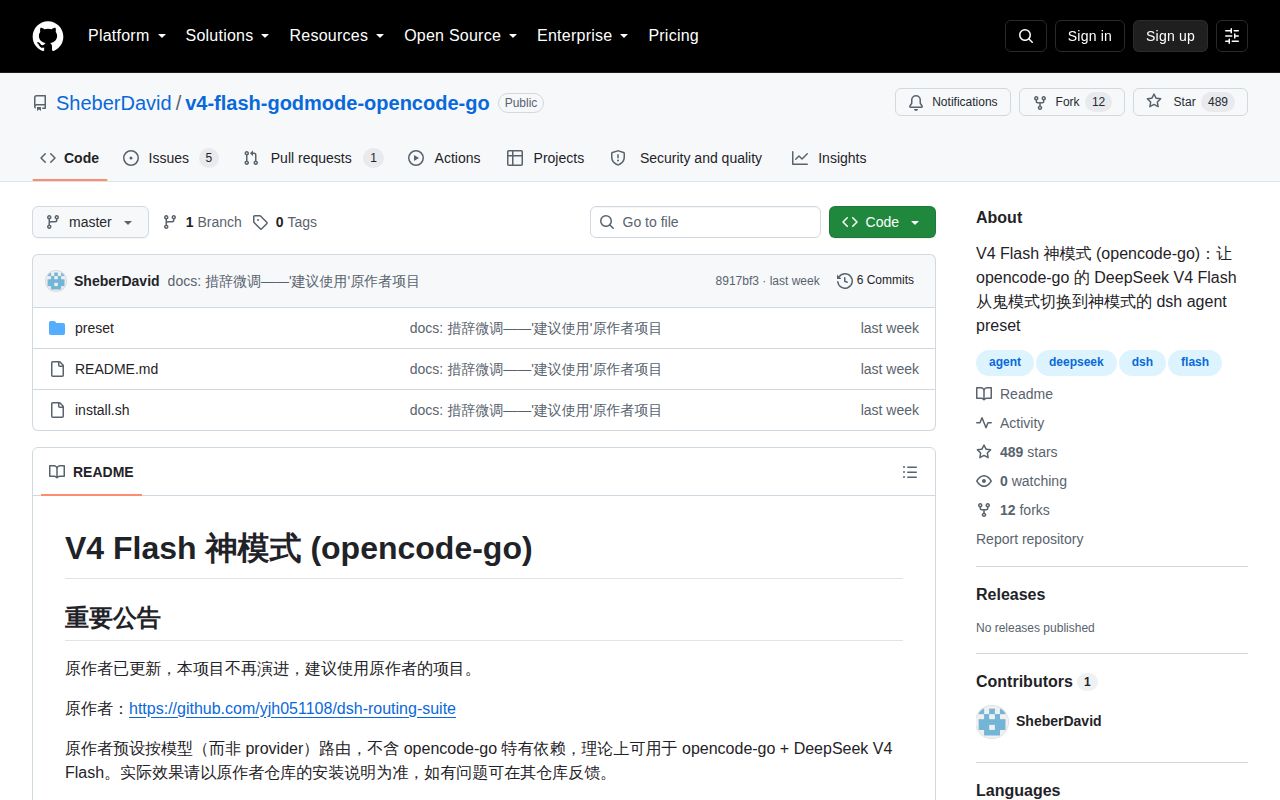
V4 Flash 神模式 is best understood as a preserved experiment, not a current product. The supplied README, written in Chinese, says it adapted an early version of another maintainer's routing approach for opencode-go. Its narrow purpose was to test whether guided conditions could improve the behavior of DeepSeek V4 Flash. That context matters because the repository name and roughly 498 stars can make it look like a ready-made performance upgrade. The maintainer's own description is much more restrained: this was a temporary adaptation, it completed its historical mission, and it will not continue evolving.
The project now points readers to yjh051108/dsh-routing-suite, the original work on which it was based. According to this fork's README, the upstream design was subsequently reworked and no longer carries the opencode-go-specific dependency. Routing is described as happening by model rather than provider, which should make the concept applicable across a wider range of configurations. The README says the upstream project is theoretically usable with opencode-go and DeepSeek V4 Flash, but it also correctly tells readers to rely on the upstream installation guide and report problems there. That is a referral, not a compatibility guarantee.
What it gets right
The strongest part of this repository is its unusually direct status notice. Many experimental repositories quietly stop changing while leaving newcomers to infer whether they are abandoned. Here, the maintainer explains why the fork existed, what changed upstream, and where future users should go. That honesty prevents people from mistaking a recently popular repository for the preferred installation path.
The README also gives a useful conceptual snapshot of the newer upstream approach. It distinguishes a standard mode, described as execution-oriented and able to correct course while acting, from a spec mode that analyzes and plans before implementation. Those descriptions are short, but they establish the practical difference: one favors quick delivery, while the other favors more deliberate work on complex tasks. Just as importantly, the README states that this fork does not include either update. That boundary is concrete and should stop readers from assuming the fork inherited later features merely because it shares the original idea.
There is also value in preserving an opencode-go-specific adaptation. For someone comparing early and later routing designs, the fork can serve as a fixed historical artifact. Its 498-star count, with a community item recording 479 stars soon after creation on August 15, suggests the experiment attracted substantial attention quickly. Popularity does not prove effectiveness, but it does show that the problem and proposed direction resonated with users.
Weaknesses and rough edges
As a tool to adopt today, the repository has serious gaps. The provided material contains no installation instructions, dependency list, configuration example, troubleshooting section, or test procedure. There is no homepage and no listed release. The license is unknown at the repository level, even though the README credits an MIT-licensed upstream project. Those are not equivalent facts: users should not assume that the fork's licensing is settled merely because its source inspiration uses MIT. That uncertainty alone is a problem for organizations considering redistribution or internal deployment.
The lack of releases means there is no obvious stable checkpoint, upgrade policy, or changelog to anchor an installation. A source checkout may be the only practical route, but the supplied evidence does not tell us which commit should be trusted or how success should be measured. Because the maintainer says development is over, these documentation gaps are unlikely to be filled here. Users who encounter breakage could spend time diagnosing an adapter whose recommended successor has already moved in a different direction.
Language is another access constraint. The supplied README is Chinese, and no English documentation is evidenced. Translation is manageable for experienced developers, but subtle setup and routing details are exactly where ambiguity becomes expensive. English-only teams should factor that friction into any evaluation.
Project health and community
The health signals are mixed but ultimately point away from adoption. The last push was August 17, only two days before this review, so the repository is not stale in the ordinary sense. It has six open issues, a modest queue rather than clear evidence of neglect, and it accumulated hundreds of stars very quickly. Yet maintainer intent outweighs raw recency: the README explicitly says the project will not evolve and redirects feedback to the original repository. A recent final cleanup or notice can coexist with a discontinued roadmap.
There are no listed releases, so there is no release cadence to evaluate. The star count reflects attention, not a sustained support community, and the issue count alone says nothing about response quality or resolution time. Community prospects are better judged at the upstream repository, where the maintainer says the redesigned work now lives. For this fork, expect archival value and perhaps occasional clarification, not an ongoing feature or compatibility program.
Where it fits in a real stack
This repository fits at the research and migration edge of a stack. It can help an engineer understand an early guided-routing idea, compare an opencode-go-specific implementation with the redesigned upstream version, or document why an existing setup should move. If a team already runs this fork, the sensible next step is to inventory its configuration, read the upstream installation instructions, and test the replacement in a non-production environment. The two upstream modes imply different operating styles, so that migration should preserve the team's preferred balance between direct execution and specification-first planning.
It does not belong as a new production dependency. An unknown license, absent releases, sparse setup evidence, and an explicit end-of-development notice create too much avoidable risk. Start with dsh-routing-suite if this routing concept is what you need. Keep this fork bookmarked only as a historical reference or as evidence for untangling an existing opencode-go deployment.