mrkeyoor.com_
Mon 05 Oct 07:15 UTC
AI Toolsevaluationupdated 05 Oct 2026

uplifting-biomolecular-modeling review

Uplifting Biomolecular Modeling is a reference collection of 36 optimization kits for protein and genomics model inference. Each kit pins one upstream tool, adds faster or lower-memory execution modes, and documents the exact software, GPU, weights, and patches needed to compare its optimized path with stock behavior.

Verdict

Our af2ig/opt/ run installed 36 packages in 27 seconds and built in 4 seconds, but it ran 0 tests and exercised no GPU inference. Treat this repository as a detailed reference archive for experts who can adopt and maintain one pinned kit, not as a supported acceleration product. Start with the stock model and add a kit only after reproducing output and failure behavior on the exact GPU and input shapes you use.

We ran it

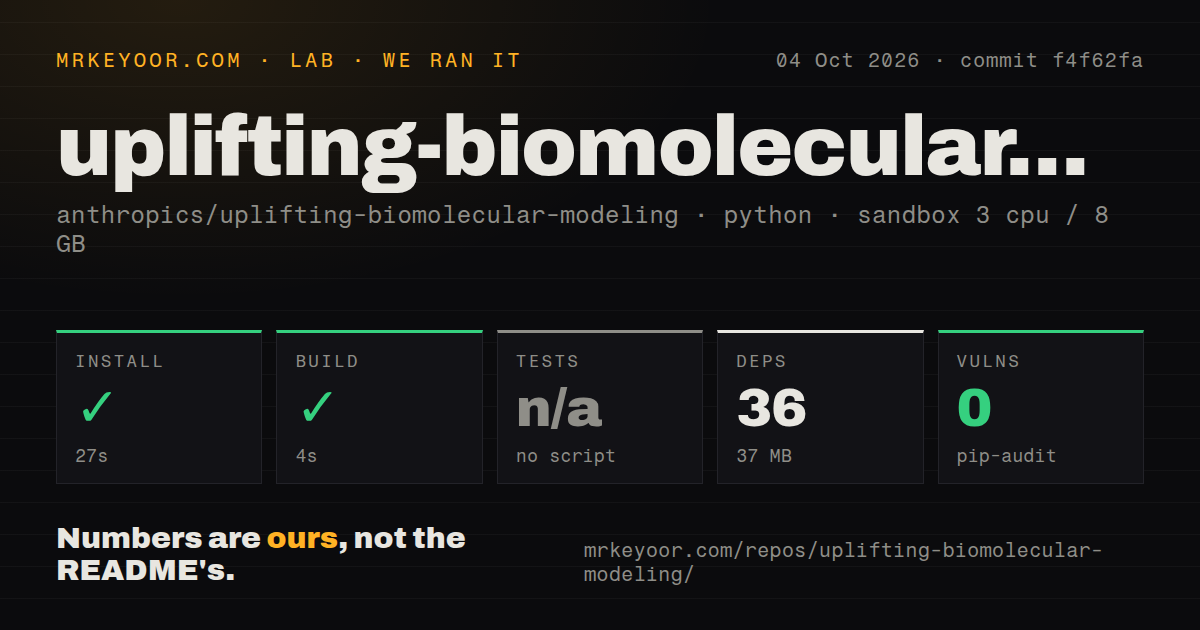
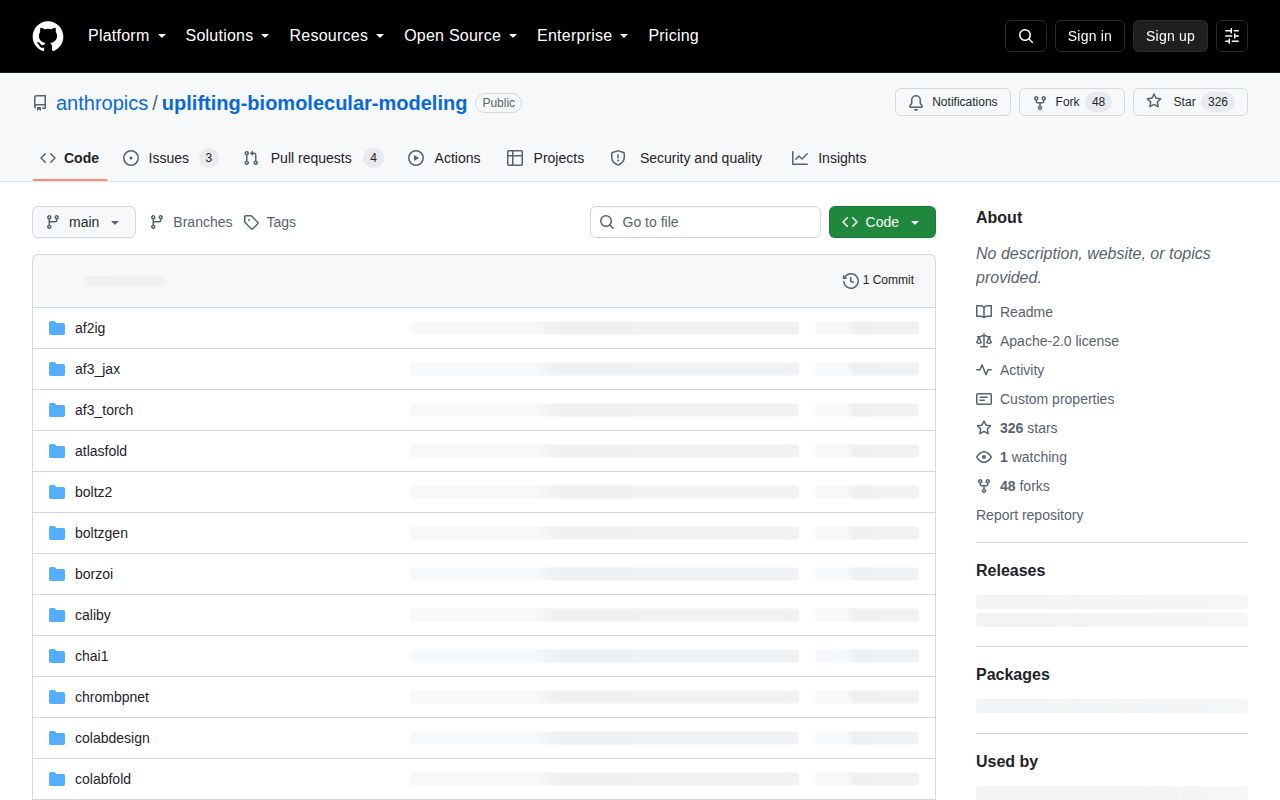
Lab card: what happened when we ran uplifting-biomolecular-modelingScreenshot of uplifting-biomolecular-modeling (github.com/anthropics/uplifting-biomolecular-modeling)
Install✓ · 27s36 packages · 37 MB
Build✓ · 4s
Testsn/ano test script
Known vulns0(pip-audit)
Repo8055 files~1,358,065 lines of source · 787.4 MB · 0 CI workflows

Answers from our run

Does uplifting-biomolecular-modeling build from source?

Dependencies installed in 27 seconds (36 packages), and the build succeeded in 4 seconds. We cloned commit f4f62fa into a clean Debian container with 3 CPUs and no project-specific setup.

Does uplifting-biomolecular-modeling have tests you can run?

Not through a standard command: the project exposes no test script or target that our harness could run.

Does uplifting-biomolecular-modeling have known vulnerabilities in its dependencies?

pip-audit found none in the dependency tree at the time of our run.

Who should not use uplifting-biomolecular-modeling?

Teams that require upstream support or ongoing fixes: Anthropic labels this a reference release, says it is not maintained, and does not accept contributions.

What are the alternatives to uplifting-biomolecular-modeling?

The stock upstream model, Transformer Engine, Triton. Our af2ig/opt/ run installed 36 packages in 27 seconds and built in 4 seconds, but it ran 0 tests and exercised no GPU inference.

Setup1/5Package build is small; a real kit needs a pinned GPU stack and weights
Docs5/5Each kit documents pins, modes, hardware, changes, and security
Community1/5Reference release is explicitly unmaintained and rejects contributions
Maturity3/5Deep pinning and checks, but no lab tests and known fallback issues

Who it’s for

Biomolecular ML researchers already running one of the pinned upstream tools on supported NVIDIA hardware.
Performance engineers who want source, kernels, patch sets, and stock comparisons they can inspect.
HPC teams prepared to build a separate pinned environment for each selected kit.
Researchers willing to fork and maintain the kit after validating its outputs on their own workload.

Who it’s NOT for

Teams that require upstream support or ongoing fixes: Anthropic labels this a reference release, says it is not maintained, and does not accept contributions.
CPU, macOS, Windows, or general cloud users: the common target is Linux x86-64 with an NVIDIA H100 80 GB, with limited alternate-card configs on some kits.
Buyers looking for one installable biomolecular platform: this is 36 separate kits with their own upstream pins, environments, weights, and licenses.
Multi-user services handling untrusted models: the README says the kits assume trusted inputs and weights, and some paths load pickle data or install Python startup hooks.
Operators who need silent-fallback guarantees already proven across every kit: open issues 5 and 6 document paths that can run stock while a kit mode is set.

Setup reality

Our sandbox scoped the Python project at af2ig/opt/. It installed commit f4f62fa in 27 seconds, adding 36 packages and using 37 MB. The package built in 4 seconds. No test script or target was available, so tests were skipped; pip-audit found 0 known vulnerabilities.

That build did not install the AF2 upstream stack, fetch weights, compile GPU kernels, or run inference. AF2IG itself requires a pinned Python and JAX stack, Linux x86-64, an NVIDIA driver, model parameters, and one of Docker, Apptainer, or a carefully matched virtual environment.

The full checkout was 787.4 MB across 8,055 files and about 1,358,065 source lines. There is no root Dockerfile or CI workflow; container definitions and setup instructions live inside individual kits. Expect each chosen kit to be its own reproducibility project.

Thirty-six kits are bundled, not one universal optimizer

The repository contains 36 separate kits for structure prediction, cofolding, binder design, sequence design, and genomic models. Each directory carries a pinned upstream release, its own optimization package, environment definitions, GPU settings, change notes, and stock documentation. The shared vocabulary makes them look uniform, but choosing AF2IG does not install Boltz-2, Chai-1, ColabFold, or the other 35 kits.

That design is sensible for reproducibility. An optimization tied to one model version, framework build, and GPU kernel should not pretend to be generic. It also makes adoption selective. Pick the one upstream tool you already trust, read its STOCK.md and CHANGES.md, then reproduce stock output before enabling an optimized mode. Cloning the whole 787.4 MB tree is the easy part.

Four modes separate fidelity from memory pressure

The common mode names are off, exact, fast, and big, though each kit ships only a subset. Off runs the pinned stock path. Exact is intended to preserve its output while running faster. Fast permits documented numeric movement, and big prioritizes fitting larger inputs in GPU memory. Every kit is supposed to print an ACTIVE line naming the engaged mode or refuse with exit code 3.

Those contracts are more useful than a vague speed claim because they tell a scientist what may change. They still require local verification. Input shapes affect compilation and memory. Framework and driver pins matter. A statement that numeric differences fit normal seed variation does not prove your downstream ranking, structure, or design decision remains unchanged. Keep representative fixtures and compare the biological outputs you use, not only process exit codes.

What happened when we ran it

Our measurement setup targeted af2ig/opt/ at commit f4f62fa in an unprivileged Debian container with 3 CPUs, 8 GB of RAM, Python 3.12, and no secrets. Installation finished in 27 seconds with 36 packages and 37 MB on disk. The Python package build then completed successfully in 4 seconds. Pip-audit found 0 known vulnerabilities.

No test script or target was available to the lab, so 0 tests ran. The repository scan found 8,055 files, about 1,358,065 source lines, no CI workflow, no root Dockerfile, and no designated tests directory. Individual kit folders do contain their own artifacts and container recipes, but our result cannot be stretched into validation of all 36 optimization paths.

Most importantly, the sandbox did not have the model stack or supported GPU. It did not fetch parameters, compile CUDA or XLA kernels, compare stock with exact output, measure speed, or check peak memory. The 4-second build proves that one lightweight Python package can be assembled. It says nothing about the performance claim that gives the collection its purpose.

AF2IG needs its full pinned environment after the package builds

AF2IG targets AlphaFold2 initial-guess scoring for designed binder and target complexes. Its kit expects Python 3.11, a pinned JAX and CUDA stack, model parameters, Linux x86-64, and a supported NVIDIA card. Docker, Apptainer, and a host virtual environment are documented as separate routes. Each route still runs the kit's install and pin checks before inference.

The af2ig_opt package itself declares no runtime dependencies because it checks the model stack when activated. That explains why our 36-package lab environment stayed small relative to the real workload. A successful wheel build can coexist with a missing JAX stack, absent weights, or unsupported GPU. Run the kit's dry check on the target host and treat any pin mismatch as a stop, not an invitation to loosen versions blindly.

Startup hooks and model files expand the trust boundary

Many kits install a Python startup hook that runs whenever an interpreter starts in that environment. Other paths use sitecustomize, patch upstream modules in memory, or overwrite a fixed set of upstream files after making backups. The README also warns that model files loaded through pickle can execute code. These mechanisms are common in performance work, but they make an isolated environment mandatory.

The documentation includes digest checks for weights, binaries, caches, generated kernels, and upstream archives. It also states that containers run as root by default and advises normal isolation. Open issue 5 reports that a find_spec probe can disarm autoloading in several kits, allowing a later import to run stock silently. Issue 6 describes a separate silent stock fallback in Evo 2. Both remain open and directly challenge the stated activation contract.

An October push does not reverse the no-maintenance notice

GitHub recorded a push on October 2, 2026, and listed 7 open issues and pull requests on October 5. One recent item is an automated dependency update. The top-level README is explicit that Anthropic does not plan further updates, does not accept pull requests, and may leave issues unanswered. There is no GitHub release. The repository should therefore be judged as a dated reference snapshot.

For the right lab, that snapshot can be valuable: it shows concrete optimizations, pinning discipline, and hardware-specific implementation work across many important models. Ownership transfers to you the moment you adopt it. Our packaging result is enough to inspect AF2IG's Python layer, not enough to recommend its inference path. Fork the chosen kit, reproduce stock and optimized outputs, and budget for maintaining every pinned layer yourself.

Alternatives

ProjectWhat it isPick it when
The stock upstream modelThe original pinned model path avoids optimization patches and gives the baseline behavior its authors support.pick this instead when maintainability and upstream comparability matter more than squeezing the target GPU.
Transformer EngineNVIDIA's library supplies optimized transformer primitives across supported frameworks and GPUs.pick this instead when you want maintained low-level acceleration rather than a full pinned application kit.
Triton gh↗A language and compiler for writing custom GPU kernels in Python.pick this instead when your team wants to own and maintain model-specific kernels directly.
Hugging Face OptimumA maintained toolkit for accelerating supported transformer inference and export paths.pick this instead when your model fits its supported integrations and ongoing library support matters.

What people are saying

  1. [velocity-scout] anthropics/uplifting-biomolecular-modeling

Sources

  1. Uplifting Biomolecular Modeling repository
  2. Inference optimization kits README
  3. AF2IG optimization kit guide
  4. AF2IG pinned stock environment
  5. Autoload silent fallback issue

More ai tools reviews

jev-experiments · OrcaBonsai-27B-Uncensored · NanoJev · procedural-film · jev-review · Dream-RSI · the whole board →