Five risk dimensions feed a staged review
Jev Review screens each file for 5 dimensions: correctness, security, reliability, compatibility, and test gaps. Signals at or above a 0.7 probability move into a ranked queue. The workflow then profiles a small set of files, asks the model to locate evidence, scores severity, and assigns an owner when a finding merits review. This is more disciplined than sending an entire repository in one prompt.
The code keeps thresholds and orchestration outside the model. Severity uses a 0-to-3 rubric, evidence location needs at least 0.55 confidence, and 3 model calls can run concurrently. The final report records the matrix, selected profiles, followed signals, findings, and configuration. Those numbers help a reviewer see what the workflow considered. They do not show whether a discarded signal contained a defect.
The 8-signal cap can erase codebase-scan coverage
After screening, workflow.ts sorts every above-threshold signal and slices the list to MAX_FOLLOW_UPS, currently 8. That fixed budget may be sensible for a small branch diff. It is a poor match for a large repository because the command name promises a complete codebase scan while most signals can stop before evidence selection. The saved report counts the gap, but an empty findings array is easy to misread.
Open issue 7 supplies a concrete failure mode. In the reporter's 1,471-file scan, 1,609 signals crossed the threshold, only 8 were inspected, and 0 became findings. The remaining 1,601 were silently left out. Open pull request 8 proposes a configurable cap and a warning when it binds. That fix is not on the default branch we reviewed, so buyers should treat the limit as current behavior.
What happened when we ran it
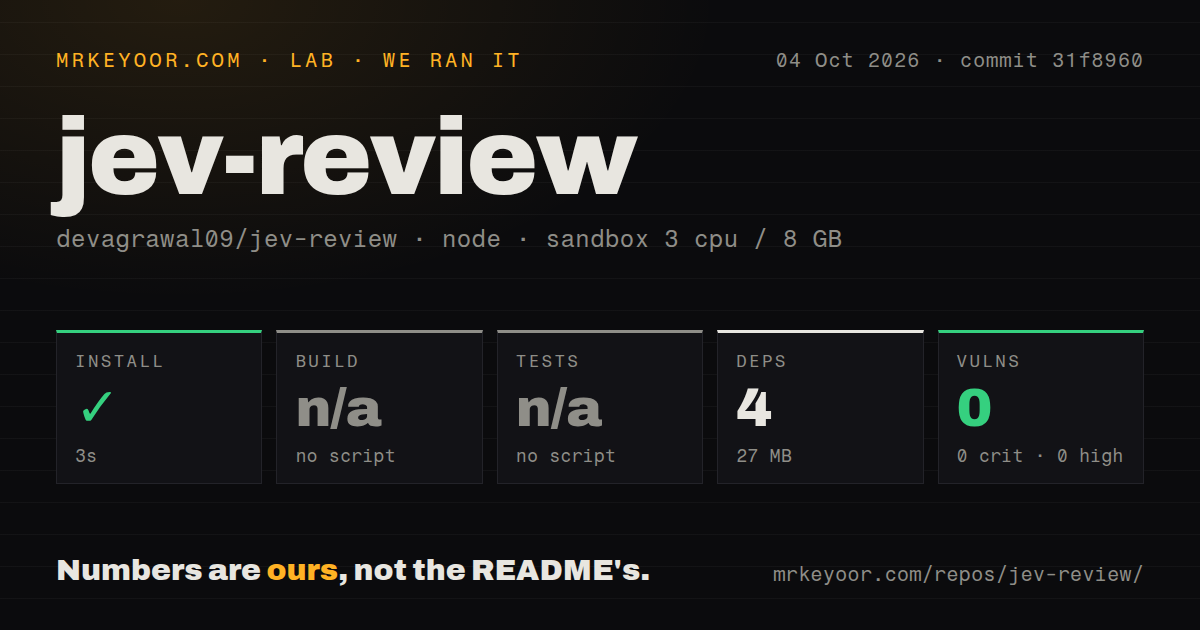
Our measurement setup cloned commit 31f8960 into an unprivileged Debian container with 3 CPUs, 8 GB of RAM, Node 22, and no secrets. Installation succeeded in 3 seconds, adding 4 packages and occupying 27 MB. Npm audit reported 0 known vulnerabilities across critical, high, moderate, and low severities.
There was no build script or target, so the lab skipped that step. There was also no test script or target, and the repository had no tests directory, so no tests ran. Our scan found 0 CI workflow files and no Dockerfile. These absences fit the README's description of an experiment, but they leave changes to orchestration, file access, and report serving without an automated regression net on the reviewed commit.
The check command is useful, though narrower. It runs TypeScript type checking, verifies the intended dependency direction between folders, and syntax-checks the dashboard client. That can catch invalid imports or syntax. It does not exercise Git discovery, model failures, threshold behavior, report writes, or HTTP requests as end-to-end tests.
Node 24 and one hosted key are mandatory
The quick start requires Node.js 24 or newer, Git, and a TYPESAFE_API_KEY. There are separate commands for current-branch changes and all discovered source files. Saved variants write a report for the dashboard, which listens on 127.0.0.1:4317. The package is private, versioned 0.1.0, and has only one runtime dependency: the TypeSafe AI SDK.
There is no model-provider abstraction on the default branch. Open issue 9 asks for local open-weight model support, and open pull request 1 proposes an alternative gateway. Neither is shipped behavior. Teams with data residency rules should check what source leaves the machine, how the provider retains it, and whether secrets have been removed before sending a diff or full file.
Only JavaScript and TypeScript files enter the scan
SOURCE_FILE matches JS, JSX, TS, TSX, MJS, CJS, MTS, and CTS files. Full-codebase discovery uses Git to collect tracked and unignored files under the chosen scope. Files in Python, Go, Rust, Java, configuration formats, templates, and infrastructure definitions never reach the screening matrix. The current README says every non-ignored source file, which can overstate that boundary for a mixed repository.
File safety also has an open patch. Pull request 10 proposes protections against symbolic-link escapes, special files, and path swaps while reading a repository, plus atomic report writes. Those changes are not merged into commit 31f8960. Run the tool only on repositories you trust, under a user that cannot read unrelated secrets, until equivalent protections land and are tested.
Seven open threads show useful review but no shipped follow-up
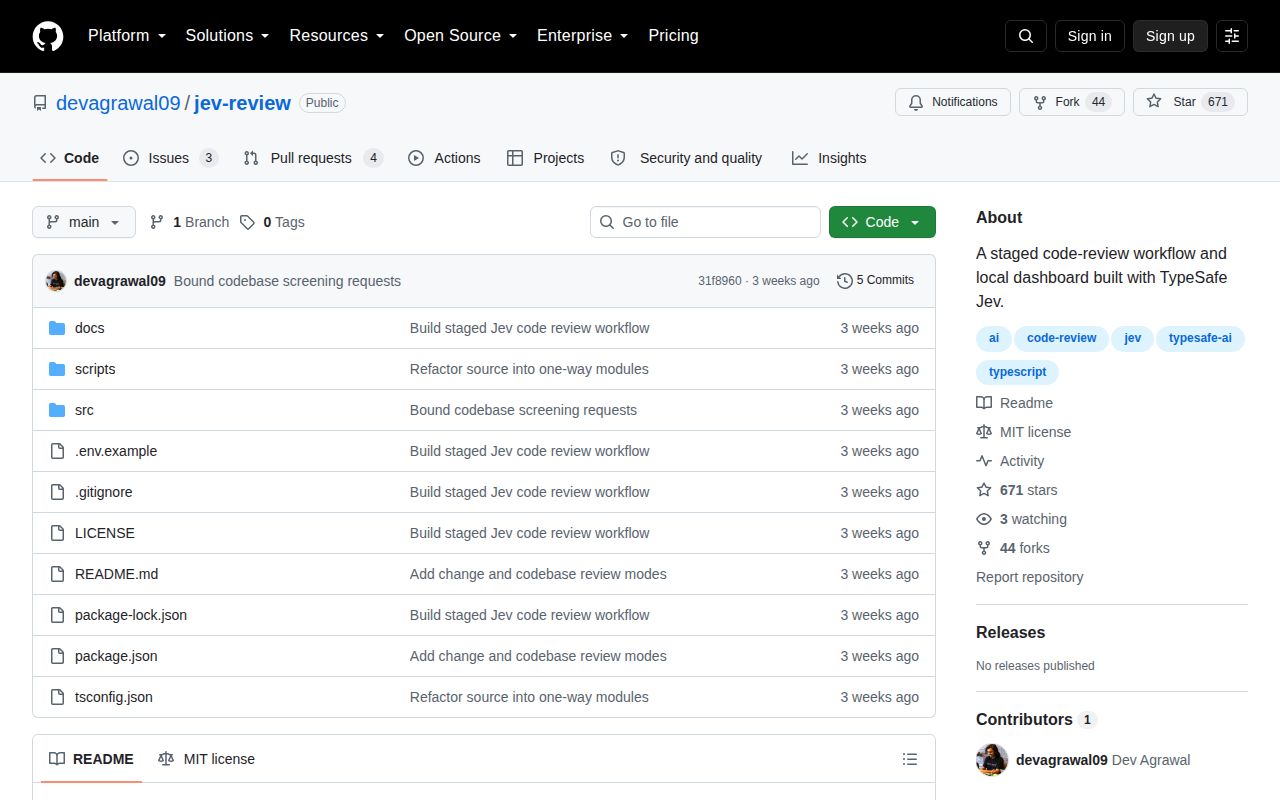
GitHub listed 7 open issues and pull requests on October 5, 2026, including the scan cap, local model support, dashboard Host checks, and file-read hardening. The repository was created on September 16 and last pushed on September 17. It had 671 stars but no GitHub release. Recent discussion is active, while the default branch remains the initial v0.1.0 experiment.
Jev Review is worth reading for its staged prompts, explicit thresholds, and quiet local report. Its current operational result needs a narrower claim: it reviews a budgeted subset of JavaScript and TypeScript signals through one hosted provider. A 0-finding report can mean no defect survived the pipeline, or it can mean the relevant signal never entered the top 8. Human review must resolve that ambiguity.