UniLM is a research shelf, while PFPO is the project we installed
The root UniLM README is an index of Microsoft work on language models, vision, speech, document understanding, model architecture, and multimodal systems. It links projects such as E5, LayoutLM, WavLM, BEiT, Kosmos, and BitNet, many with separate code, dependencies, checkpoints, and papers. Treating the repository as one product would give a false picture. Our lab's detected Python project lives under PFPO/, so that is the setup we can judge directly.
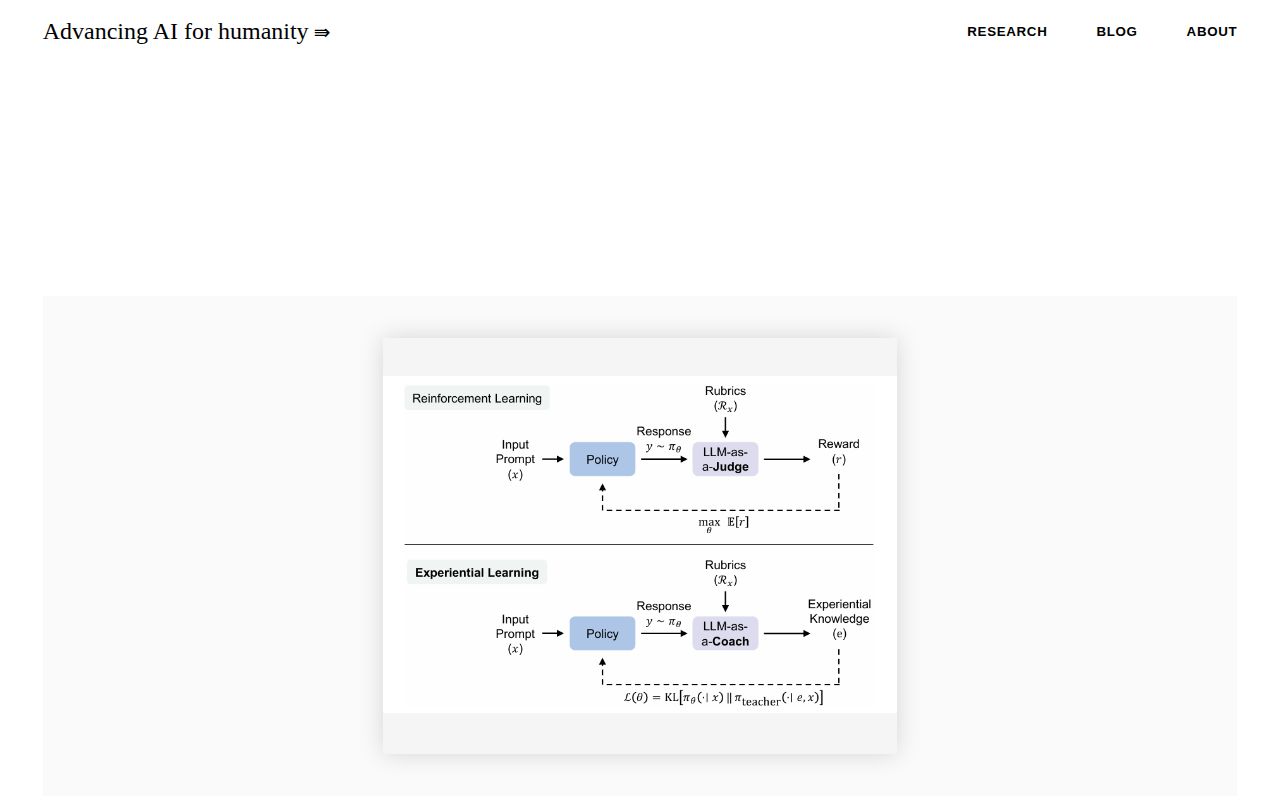
PFPO means Preference Optimization for Reasoning with Pseudo Feedback. Its ICLR 2025 code turns candidate answers into preference data by evaluating them against test cases. One path gets tests from a frontier model; another uses multiple generated tests and self-consistency. The supplied recipes cover mathematical reasoning and code tasks, with scripts for sampling answers, constructing preference pairs, running evaluations, and training with SFT, DPO, or process-level DPO.
A 22-second install does not make this an ordinary Python package
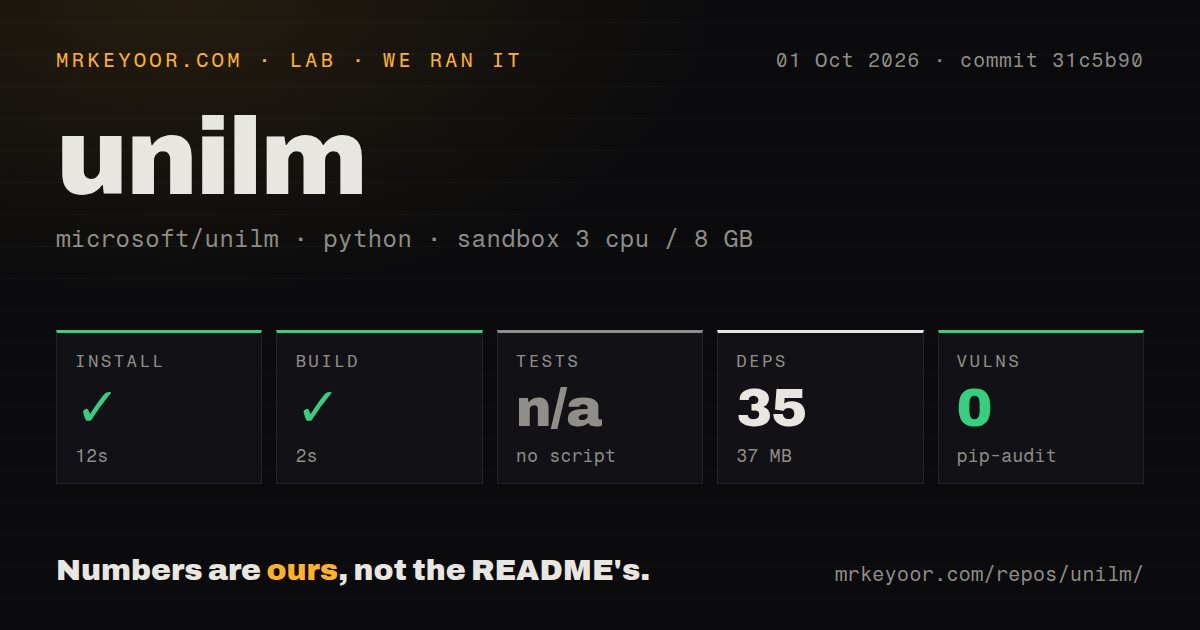
Our fresh Debian sandbox installed the PFPO project in 22 seconds. It added 35 packages and used 37 MB on disk. The build completed in 10 seconds, and pip-audit reported 0 known vulnerabilities among the installed Python dependencies. Those are clean repository mechanics for commit ca43e4c, particularly given the size of the surrounding monorepo.
The checkout contained 9,360 files, roughly 1,357,350 lines of source, and occupied 214.2 MB before the installed environment. Our scan found no CI workflow file, no Dockerfile, and no tests directory. There was also no test script or target, so the harness skipped tests. The successful build tells us the selected project could be packaged in our Python 3.12 image. It does not tell us that training, inference, data preparation, or evaluation is correct.
What happened when we ran it
Our PFPO run installed 35 packages in 22 seconds and built in another 10 seconds on 3 CPUs with 8 GB of RAM. Installation ended at 37 MB, and the dependency audit found 0 known vulnerabilities. No install or compiler error appeared in the supplied results.
Tests were skipped because the project exposed no test script or target. The measured signals also showed 0 CI workflow files and no tests directory. That is the main setup finding: the lightweight package path worked, but no automated check exercised the research pipeline. We did not run model training, download checkpoints, provision GPUs, call a model service, or reproduce the paper's evaluation tables.
The documented recipes assume clusters, data, and manual edits
The PFPO README asks users to install FlashAttention separately after the listed requirements. It mentions a prebuilt external image, although the repository has no Dockerfile for rebuilding that environment from source. The math SFT example uses 2 nodes with 8 V100 GPUs each. A DPO configuration uses 8 A100-80G GPUs, and one process-level DPO recipe names 48 nodes with 8 V100 GPUs per node.
Those are research-scale defaults, not minimum requirements. The authors tell users with fewer GPUs to change gradient accumulation and tensor parallel settings, but they do not turn the examples into a small-machine recipe. Several commands also assume checkpoint directories, globbed JSON outputs, config names, and environment-specific paths. One documented command contains an internal-looking msranlpintern path, a detail you should expect to replace rather than copy.
Data availability is part of the reproduction burden
For math SFT, the README says to prepare your own data or download MathScale-4o, then labels that dataset 'to be released soon.' Code experiments use APPs, generated solutions, annotated tests, pseudo test inputs, and repeated sampling stages. Some pseudo-feedback generation calls general model services such as GPT-4o or Mistral Large, which adds API access, cost controls, and output-format handling to the local training stack.
The broader UniLM repository shows why durable artifacts matter. Open issue 1750, updated August 13, 2026, reports an unreachable ReadingBank dataset with no official mirror. That issue concerns LayoutReader rather than PFPO, so it does not prove a PFPO link is broken. It does show the maintenance problem created when many research releases and external assets share one long-lived repository. Mirror permitted inputs and record checksums before betting a reproduction on them.
Active commits do not create one support boundary
GitHub recorded a last push on August 26, 2026, and 22,194 stars. It listed 684 combined issues and pull requests, with issue activity continuing in August. The latest GitHub release was YOCO from May 2024, but that tag belongs to another project inside the monorepo. It says nothing useful about whether PFPO is abandoned, current, or release-ready. Folder-level commits and paper-specific documentation are the better signals.
The repository is useful when your unit of adoption is a paper implementation. You can inspect exact configuration files and scripts, compare the authors' process with your own, and reuse parts under the MIT license. If your unit of adoption is a maintained post-training platform, TRL, OpenRLHF, or verl gives you a clearer product boundary. PFPO is source for an experiment, and our 22-second install should not be mistaken for reproduction of that experiment.