UCP.s August 25 release is a specification, not a checkout server
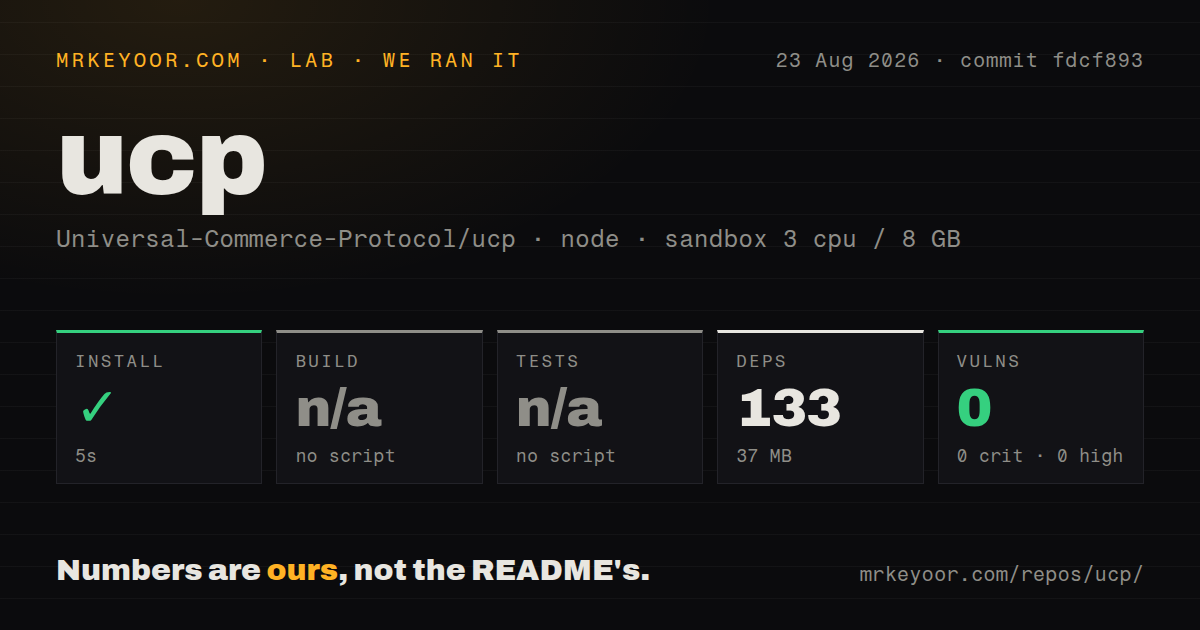
Our checkout contained 312 files, roughly 4,572 lines of source, and 5.6 MB at commit fdcf893. That small repository size is consistent with a schema and documentation project. The README sends implementers to separate repositories for SDKs, samples, and conformance tests. A merchant cannot clone ucp, set an API key, and receive a working storefront. The value appears when multiple businesses and platforms agree to implement the same contracts.
What happened when we ran it
Our Node 22 sandbox installed 133 npm packages in 5 seconds and used 37 MB on disk. Npm audit reported 0 known vulnerabilities across critical, high, moderate, and low severities. We used Debian, 3 CPUs, 8 GB of RAM, no secrets, and an unprivileged container. The repository had 8 CI workflow files, no Dockerfile, and no tests directory.
The harness found no build script or target, so it skipped the build. It also found no test script or target, so it skipped tests. We did not run a checkout, payment, schema conformance suite, or protocol server. The README explains that schema authors also install the Rust ucp-schema command for linting, while documentation developers use Python, uv, and MkDocs. The npm result covers the detected package manifest, not every tool in the documented contributor workflow.
Capabilities let each business declare a smaller surface
UCP organizes the protocol around capabilities rather than one fixed commerce API. Checkout, identity linking, orders, and payment token exchange are initial primitives. Extensions can add discounts or fulfillment. A business profile tells platforms which combinations and versions are available, so an agent can discover support instead of assuming every merchant behaves alike. This is a better fit for a heterogeneous commerce network than forcing one backend design on every participant.
The latest release, v2026-08-25, expands that model across shopping, payment, and common verticals. It adds location search, grocery quantities, payment schedules, split payments, loyalty, delegated identity providers, 3DS2 actions, and request constraints. Release notes also list breaking changes to fulfillment objects, buyer consent, signing keys, schema locations, namespaces, and cart updates. Independent capability versioning helps negotiation, but adopters still need migration code and fixtures for old messages.
MCP support does not settle retry and signing semantics
Transport independence is one of UCP's most interesting choices. A business may expose capabilities through REST, MCP, or A2A while keeping the same domain concepts. MCP makes the protocol callable by agents that already discover tools. The protocol still has to define which bytes are signed, how versions are selected, what retries mean, and how a client proves authority. A transport adapter cannot guess those commerce rules safely.
Issue #664 identifies a concrete conflict. The idempotency contract hashes raw HTTP body bytes, while an MCP retry normally changes the JSON-RPC id. Two logically identical requests can therefore produce different hashes and be rejected as mismatched payloads. The issue remained open when we checked. This matters most for completion and cancellation operations, where a retry must not create a second financial action. An MCP implementer should resolve the current specification discussion and add duplicate-delivery tests before processing real payments.
Open proposals show the protocol is still finding domain edges
The issue tracker is doing standards work in public. Proposals discuss bulk product discovery, cart terminal status, list prices in later funnel objects, payer identity for regional payment rails, fulfillment events, selected product options, and persistence-sensitive extension state. These are not minor UI requests. Each can change whether an agent displays the right price, understands that a cart was purchased, or carries authorization-relevant state into checkout.
GitHub reported 164 open issues and pull requests combined, 3,328 stars, and 448 forks. The repository was pushed on August 25, 2026, the same day as the latest release. That is active specification work, not evidence of neglect. It also means adopters cannot assume an open proposal is committed behavior. Implement only published schemas, record the exact capability version, and keep vendor extensions isolated so a future standard field does not collide with local data.
Conformance lives outside this 37 MB checkout
The README links a dedicated conformance repository rather than placing transaction tests here. That separation makes sense for a specification used by several SDKs and transports, but it changes what a source review can prove. The 8 CI workflows in this checkout can validate repository work without exercising a merchant's deployed API. A production claim should name the conformance version, capability versions, transport, and any extensions tested.
Our run only established that 133 npm packages installed and the audit found 0 vulnerabilities. It produced no pass count for protocol behavior. Before launch, replay authoritative examples, test schema negotiation, sign and verify requests, deliver webhooks more than once, simulate timeouts at checkout completion, and verify that money remains in integer minor units. Add fixtures for the previous release if a rolling migration will put old and new participants on the network together.
UCP is for an ecosystem with an integration multiplication problem
A single merchant with one storefront may gain little from UCP. Its existing backend API is already under one team's control, and Medusa or Saleor can provide working commerce services. UCP becomes interesting when many agent platforms must communicate with many merchants, payment services, and identity systems. A shared profile and capability vocabulary can reduce the number of custom adapters each pair maintains.
The decision is therefore organizational as much as technical. Our 5-second install says the documentation workspace is light; the August 25 breaking-change list says adoption is not. Start with one published capability and one transport, pin every schema identifier, and run the separate conformance tests. Keep a human approval boundary around purchases until identity, consent, totals, retries, and payment-token behavior have been tested with the actual parties that will exchange messages.