mrkeyoor.com_
Tue 22 Sept 06:43 UTC
Dev Toolsevaluationupdated 22 Sept 2026

h4cker review

H4cker is an English-language cybersecurity reference library maintained by Omar Santos. It gathers domain guides, certification notes, lab instructions, scripts, notebooks, presentations, and links for offensive security, defense, AI security, and related study rather than packaging them as one runnable application.

Verdict

Our H4cker checkout occupied 131.7 MB and installed 35 packages, yet its build failed in 3 seconds and it offered no test target, confirming that this is a reference collection rather than one installable tool. Use it as a map when you already know the security topic you want to study. Choose a narrower guide if you need a course sequence, a reproducible lab, or software with one supported runtime.

We ran it

Lab card: what happened when we ran h4ckerScreenshot of h4cker (hackerrepo.org)
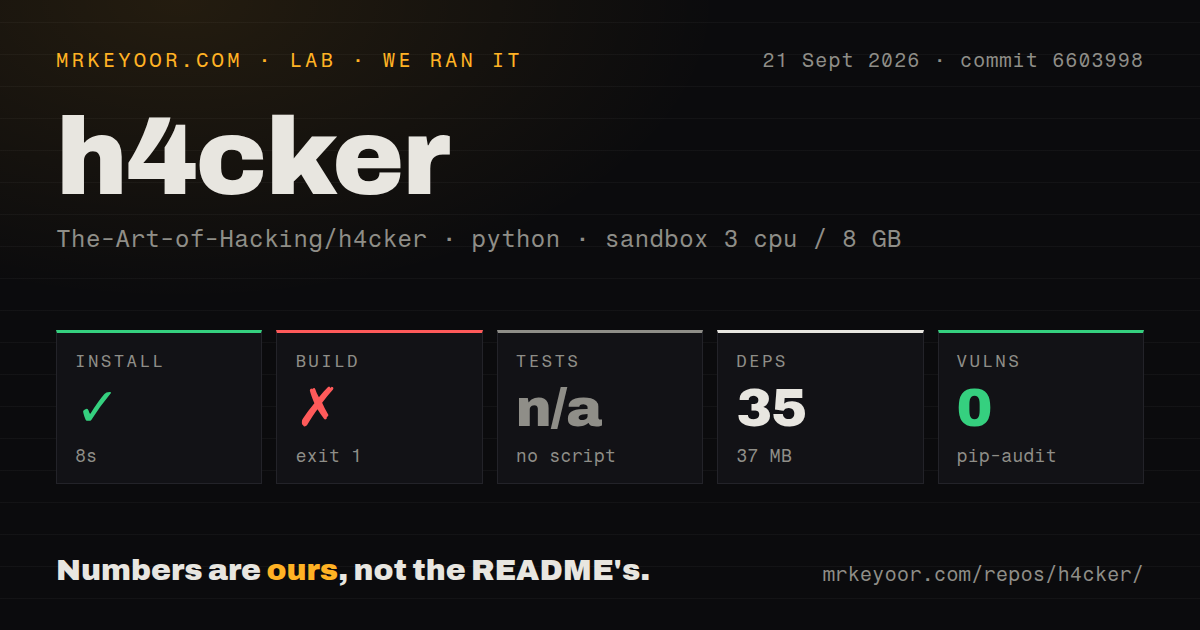
Install✓ · 8s35 packages · 37 MB
Build✗ · 3s
Testsn/ano test script
Known vulns0(pip-audit)
Repo719 files~5,660 lines of source · 131.7 MB · 3 CI workflows

Answers from our run

Does h4cker build from source?

Dependencies installed in 8 seconds (35 packages), and the build failed. We cloned commit 6603998 into a clean Debian container with 3 CPUs and no project-specific setup.

Does h4cker have tests you can run?

Not through a standard command: the project exposes no test script or target that our harness could run.

Does h4cker have known vulnerabilities in its dependencies?

pip-audit found none in the dependency tree at the time of our run.

Who should not use h4cker?

Developers expecting one supported Python package or service: the root has no project manifest or common entry point, and our build failed.

What are the alternatives to h4cker?

Awesome Penetration Testing, OWASP Web Security Testing Guide, Awesome Hacking. Our H4cker checkout occupied 131.

Setup2/58-second install, but the build failed and setup varies by item
Docs3/5Clear domain indexes; individual resources vary in depth
Community5/529,493 stars, one open item, and recent accepted pull requests
Maturity3/5Nine years of curation, but no releases or unified validation

Discussed on

  1. hnThe Art of Hacking77 points
  2. hnGreat Resources Collection for Pentesters and Security Analysts3 points

Who it’s for

Security learners who want one browsable index spanning offensive, defensive, cloud, application, hardware, governance, and AI topics.
Instructors using Omar Santos's books, courses, or live training who need the repository's supplemental material.
Practitioners looking for a starting list of tools, cheat sheets, lab ideas, packet captures, or certification references.
Contributors who can assess a resource before proposing it and are comfortable working in a large documentation repository.

Who it’s NOT for

Developers expecting one supported Python package or service: the root has no project manifest or common entry point, and our build failed.
Learners who need a linear course with prerequisites and graded exercises: the README directs readers to domain indexes and describes the material as supplemental.
Teams that require a passing automated check for every script and link: our run found no test target, while the 3 visible workflows handle assignment, greetings, and stale items.
Anyone planning to run exploit samples against systems without explicit permission: the collection includes payloads, post-exploitation material, vulnerable applications, and offensive labs.
Buyers who need pinned releases and upgrade notes: the repository has no GitHub release to select, despite recent pushes.

Setup reality

Our sandbox installed 35 Python packages in 8 seconds and used 37 MB for them. The 131.7 MB checkout held 719 files and about 5,660 lines of source. The build failed with exit code 1 after 3 seconds. The supplied measurement has no error excerpt, so we cannot name a cause. No test target existed, and pip-audit found 0 known vulnerabilities.

There is no single service, account, or credential for the repository. Individual labs and scripts bring their own tools, operating systems, API access, targets, and safety boundaries. The root README tells readers to enter through a domain landing page rather than run one setup command.

The repository has no Dockerfile and no root test directory. Some sections contain Python, notebooks, packet captures, PDFs, Terraform, Ansible, and vulnerable lab references, so setup depends on the item you choose. Treat each item as a separate exercise and read its local instructions before installing or executing it.

H4cker is a 719-file library, not one application

Our measured checkout contained 719 files and occupied 131.7 MB before its Python dependencies. The root README describes supplemental material for books, video courses, and live training, then points readers toward subject indexes. That is the right way to understand H4cker. It is a shelf containing explanations, external links, scripts, notebooks, packet captures, PDFs, and lab notes. There is no main server to launch, unified command to learn, or single environment that makes every item ready.

That shape is useful when you arrive with a question. The cybersecurity-domains index separates 10 areas, including offensive security, defense, application security, cloud and containers, cryptography, hardware, governance, and labs. AI material has its own tracks for security, engineering, incident response, and governance. Certification notes and lab-building references sit outside that taxonomy. Browsing by task works. Cloning the repository and asking what to run first leaves too many unrelated paths open.

The domain indexes are better than a linear learning path

The live tree contains 487 Markdown files, alongside 46 Python files, 3 notebooks, and 17 PDFs. Those counts explain why H4cker feels more like a library than a course. A security analyst can jump from threat hunting to MCP security or a packet-capture exercise without waiting for a curriculum. An instructor can pull one reading into a class. The tradeoff is sequencing: H4cker rarely tells a new learner which concepts must come first or how to prove mastery before moving on.

The root guide says to start with the landing page that matches your goal. Follow that advice literally. Pick one domain, read its local README, and treat every linked tool or script as its own project. The 131.7 MB checkout includes materials with very different assumptions about operating systems, network access, credentials, and targets. A note about Terraform cannot share one setup recipe with an exploit-development sample, and neither should be run merely because both live in the same clone.

What happened when we ran it

Our sandbox installed 35 Python packages in 8 seconds, adding 37 MB on disk. Pip-audit found 0 known vulnerabilities in that installed set. The repository itself was much larger at 131.7 MB, which fits the collection's mix of documents and training artifacts. Installation success only says the harness resolved the dependencies it found. It does not mean every script, notebook, external tool, or lab described across the repository is installed or compatible with Python 3.12.

The build then failed with exit code 1 after 3 seconds. The measurement supplied for this review does not include the failing command's final lines, so assigning a dependency or syntax cause would be guesswork. No tests script or target was available, and the test step was skipped. That distinction matters: H4cker produced 0 passing tests in our run because no test target ran, not because an empty suite passed.

Three workflows manage the repository, not its contents

The current tree has 3 GitHub Actions workflows: pull-request assignment, contributor greetings, and stale-item handling. Our scan found no Dockerfile and no tests directory. A lychee.toml file shows that link checking has been considered, but there is no visible link-check workflow among those 3. In a reference collection built partly from external URLs, readers should expect to encounter resources with different maintenance status and confirm the destination before depending on it for a class or procedure.

The same caution applies to code. H4cker covers exploit development, payloads, post-exploitation, vulnerable servers, AI red teaming, and offensive labs. Those topics are legitimate training material, but GitHub placement does not make a sample safe for a work laptop or a public target. Use an isolated lab, inspect the local file, and stay within written authorization. The MIT license permits broad reuse of repository material; it does not grant permission to test someone else's systems.

September merges show active curation without releases

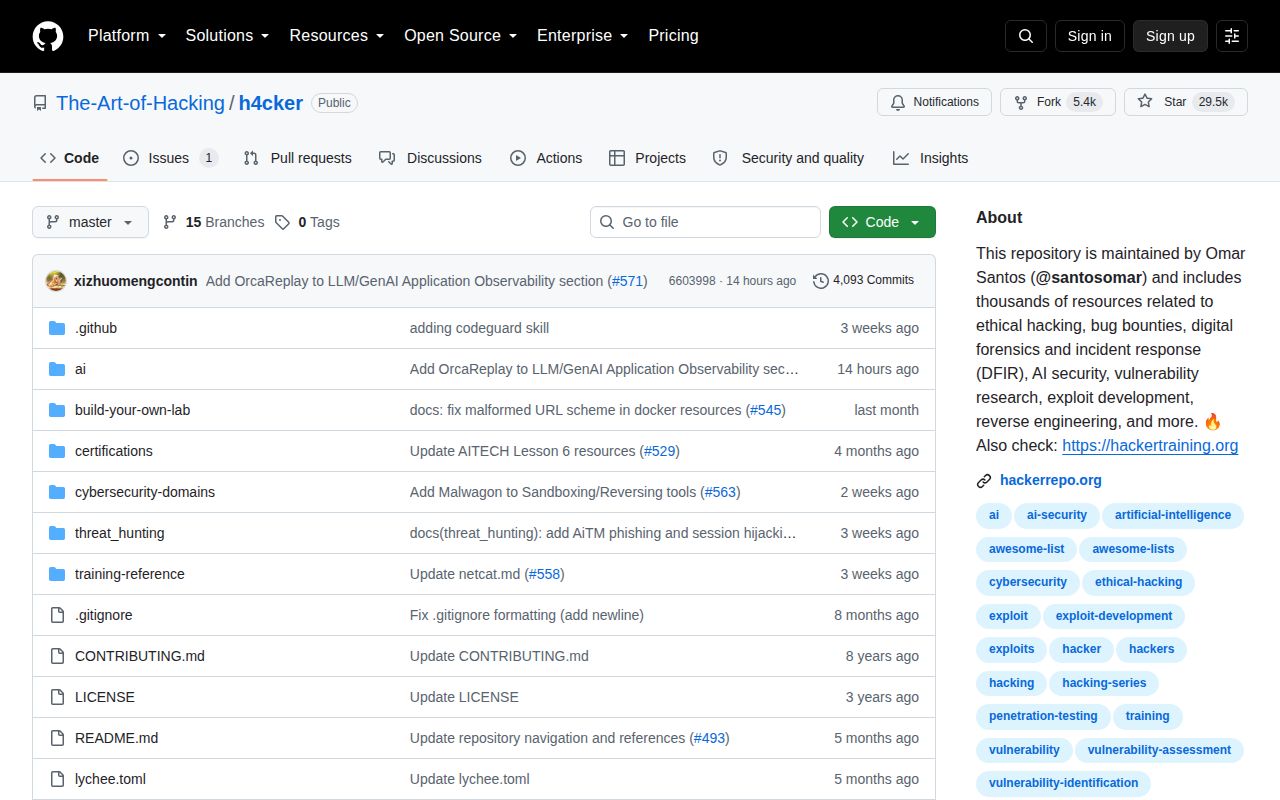
GitHub recorded 29,493 stars and a last push on September 21, 2026. Two pull requests were merged that day, adding references for offline agent-traffic replay and an AI guardrail benchmark. The only open item was an August proposal for an eBPF threat-hunting guide, last updated September 1. Recent additions plus a small open queue show ongoing curation. The queue counts issues and pull requests together, so it should not be read as a defect count.

There is no latest GitHub release. That is not evidence that the project has been abandoned, because the September push and accepted contributions say otherwise. It does mean you cannot choose a named release and read a change log before updating a classroom mirror or internal reference copy. Pin a commit if the material must stay stable. Our lab used commit 6603998, while the activity figures describe the live repository fetched on September 22, 2026.

H4cker works best as a map for someone who can judge each destination. Its 10-domain index and active additions make discovery easier, while the failed 3-second build and absent test target rule out treating the clone as a verified toolkit. Start from a specific subject, pin useful material, and build each lab separately. If you need one teachable sequence, use a focused guide such as the OWASP Web Security Testing Guide instead.

Alternatives

ProjectWhat it isPick it when
Awesome Penetration TestingA narrower catalog of penetration-testing tools and learning resources.pick this instead when offensive tooling is the goal and H4cker's defensive, governance, certification, and AI sections are extra weight.
OWASP Web Security Testing GuideA structured guide for testing web applications and web services.pick this instead when you need a maintained testing method for web security rather than a cross-domain reference shelf.
Awesome HackingAn index of security-focused awesome lists for hackers and researchers.pick this instead when you want a compact directory that points to other curated lists.

What people are saying

  1. [velocity-scout] The-Art-of-Hacking/h4cker

Sources

  1. H4cker repository
  2. Cybersecurity domains index
  3. AI security and engineering index
  4. Cybersecurity lab-building guide
  5. Open eBPF threat-hunting proposal
  6. Accepted agent-traffic replay reference
  7. Accepted AI guardrail benchmark reference

More dev tools reviews

asdf · discord.js · bend · 100-exercises-to-learn-rust · PhotoGIMP · mvt · the whole board →