
The license notice is a reason to stop before adoption
OpenClaude's license notice says the project lacks Anthropic's authorization to distribute the proprietary source it derives from. The MIT permission covers contributors' modifications where legally permissible. If your organization requires a clearly licensed dependency before adoption, the project's own notice is a reason to stop. A passing build can't resolve the question raised by that file.
Our checkout occupied 34.9 MB and contained 3,506 files, with roughly 928,614 source lines. OpenClaude wraps cloud and local models in a coding-agent CLI with shell commands, file editing, and conversation history. The useful idea is keeping a familiar terminal workflow while changing the model behind it. You can connect tools through MCP and use saved provider profiles.
What happened when we ran it
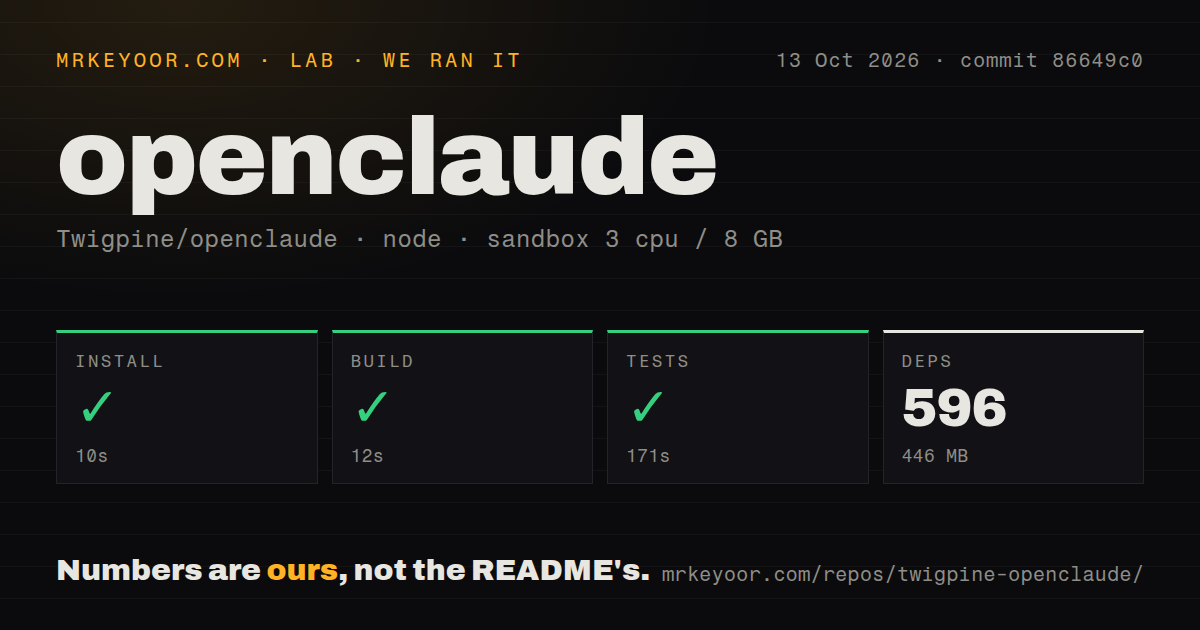
Our OpenClaude install succeeded in 10 seconds, adding 596 Bun packages and occupying 446 MB on disk. The build passed in 12 seconds, and the test step passed in 171 seconds. We cloned commit 86649c0 on October 13, 2026, into an unprivileged Debian container with 3 CPUs and 8 GB of RAM, using image lab-node:22 and no secrets. No failed step appears in the supplied measurement summary.
The lab scan found 3 CI workflow files, a Dockerfile, and a tests directory. Those are useful repository signals alongside the successful commands. The summary provides no test-case count or coverage figure, so the result is a passing test step, without a claim about how much behavior it covers. We also have no completed coding-task benchmark, live provider comparison, or model-quality result. This run verifies repository mechanics in the stated sandbox.
Provider setup requires an explicit choice
The 10-second dependency install doesn't provide model access. The README setup guidance says fresh installations default to Twigpine Opengateway, which requires an API key. The /provider command selects a backend and saves a profile. Local Ollama is another route, with a separately running model service. Saved profiles suit developers who already have model endpoints.
Project .env files aren't loaded automatically. You must export the provider variables or use the documented provider-env-file option. The README also warns that provider behavior differs: Anthropic-specific features may be absent elsewhere, and smaller local models can struggle with extended tool flows. Being able to connect an endpoint doesn't establish that its model can finish the coding job you have in mind.
Existing Claude Code configuration needs deliberate migration
The 446 MB source environment is separate from the configuration you may already keep for Claude Code. OpenClaude now uses its own .openclaude locations and says it doesn't read the .claude directories. The README advises copying only settings and tools you personally created for OpenClaude, then setting up provider authentication again. Existing Claude Code credentials are specifically excluded from the suggested migration. Someone expecting an automatic replacement for their configured CLI should account for that work.
The package name has also moved from @gitlawb/openclaude to @twigpine/openclaude. The documented upgrade removes the old global package before adding the new one, because both expose the same command. Node handles the installed runtime, while source work needs Bun. The README also documents missing-ripgrep troubleshooting.
Forking a chat doesn't isolate file edits
Our 171-second passing test step doesn't prove that parallel coding sessions are isolated. The README explicitly says --fork-session branches conversation history without copying a working tree or creating a Git worktree. Two conversation branches can therefore refer to the same files unless you arrange separate checkouts. That's an important distinction for developers who want competing implementations. A new transcript gives you another conversation, while filesystem separation remains your responsibility.
Background sessions are local child processes with logs under OpenClaude's configuration directory. The documented attach command points you toward following those logs because full terminal reattachment isn't implemented. This suits a developer who wants to leave a prompt running and inspect it later. It is less appealing if you need a persistent remote worker with an interactive reconnect experience. The README describes a separate headless gRPC route, which adds a different deployment choice rather than changing that limitation.
Web tools can send a local-model session outside the machine
The 596-package source installation included no secrets, so our run doesn't establish which web backends a configured session contacts. The README names Exa as the default search option for non-Anthropic models, with a keyless tier and service limits. It also describes other backends and provider-specific behavior. Choosing a local inference model alone doesn't make web research local. Review the search configuration if your reason for using Ollama is keeping project information inside a particular boundary.
Basic HTTP fetching can fail on sites that require JavaScript or block ordinary requests. The documentation provides an optional Firecrawl route, which introduces another service and credential. Meanwhile, the advanced setup guide describes permission checks and an opt-in permissive setting that relaxes some guards. I'd evaluate the file and shell actions on a disposable project before broadening permissions. Model selection and tool access both affect the experience you're buying into.
October releases show active work, with SDK fixes still proposed
GitHub recorded a push on October 13, 2026, with 67 open issues and PRs combined. Release v0.32.0 arrived October 12, including the package rename and search changes. Open PR 2253 concerns session-file handling in the v2 SDK when an embedder creates multiple sessions in one process. That is a specific embedding concern, not evidence that every terminal conversation loses history. The proposal also isn't a released fix.
OpenClaude's source checks passed, including the 12-second build, but I'd resolve the license notice before making it a work dependency. OpenCode is another provider-flexible coding agent, while Aider suits developers who prioritize editing with Git integration. If you continue with OpenClaude, evaluate your chosen model on a small real task and inspect every file change. The passing repository run gives you a starting point for that evaluation, rather than proof that the agent can do your job.