Incremental trees suit editors better than batch parsers
Tree-sitter builds a concrete syntax tree from source text and can reuse a previous tree after an edit. The caller describes the changed byte and row-column ranges, edits the old tree, and parses the new text with that tree as a reference. Tools can then update highlighting, navigation, structural selection, or queries without reparsing unrelated regions from scratch. The parser is also designed to return useful structure when the source contains errors.
This is syntax infrastructure, not a whole language service. Tree-sitter does not supply type inference, name resolution, lint rules, or a compiler backend. Those systems can consume its nodes, but the tool author owns their semantics and invalidation. That division is healthy for editors and code search, where a stable partial tree is useful before a program compiles. A compiler project may prefer a generator built around its later semantic phases.
Grammar development needs JavaScript and a native compiler
A grammar author installs the CLI, initializes a tree-sitter-<language> project, writes grammar.js, generates C code, and tests example files. The CLI can come from a release binary, Cargo, or npm. Although the tree-sitter binary itself has no runtime dependencies, generation requires a JavaScript runtime and parser testing requires a C or C++ compiler. The generated C parser can then be embedded through the runtime library or a binding.
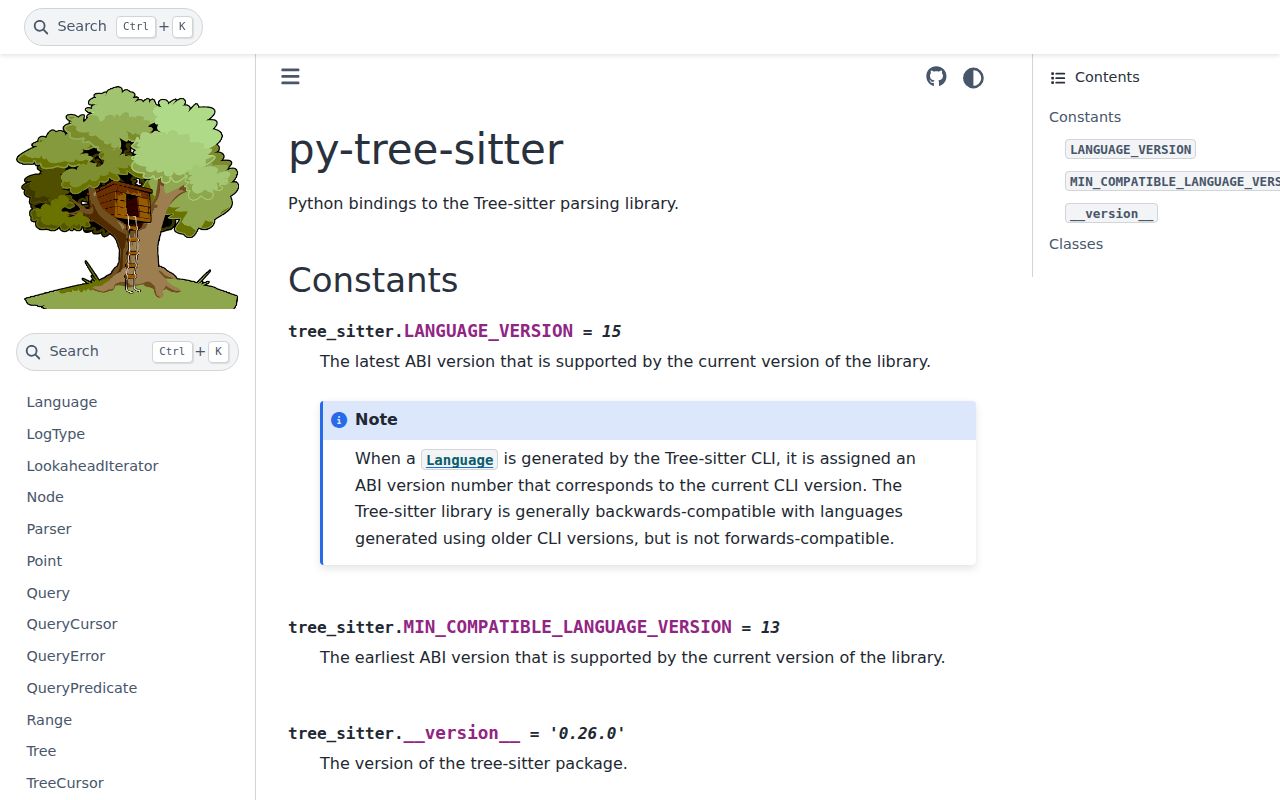
The official documentation lists bindings for Rust, Python, JavaScript, Go, Java, Kotlin, Swift, Zig, Haskell, C#, and Wasm, with more maintained elsewhere. It warns that some third-party bindings may be incomplete or outdated. Language grammars are also separate packages with their own maintainers and releases. Adopting Tree-sitter therefore means selecting a binding and grammar, not merely adding the core repository.
What happened when we ran it
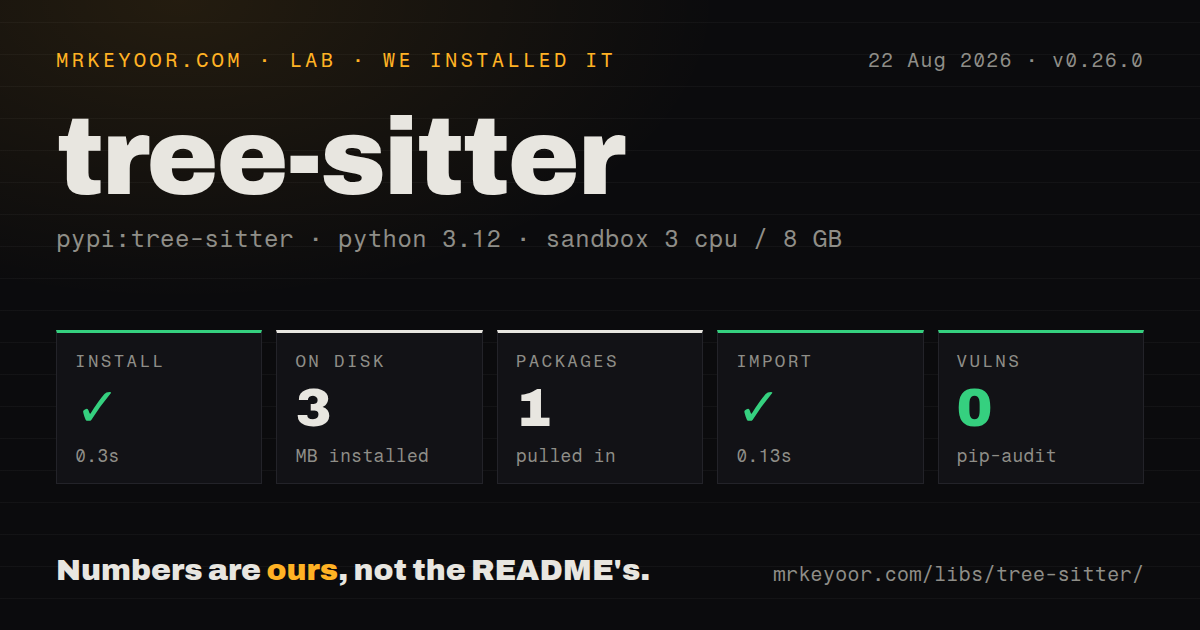
Our sandbox cloned commit 74b7d0c into a fresh unprivileged Debian container with 3 CPUs and 12 GB of RAM. The checkout contained 620 files, about 100,299 lines of source, and occupied 4.3 MB. Cargo installed 187 packages in 13 seconds, and the Rust build succeeded in 60 seconds. The repository had 14 CI workflow files, a Dockerfile, and a tests directory.
The test step failed with exit code 101 after 9 seconds. Cargo reported 39 passed and 266 failed out of 305, with none ignored, measured, or filtered out. The tail named failures across tree cursors, edits, aliases, included ranges, and scanner-token reuse. It did not include assertion messages, panics, missing files, or another cause, so the only defensible finding is that this checkout's detected suite failed broadly in our stated environment.
A 60-second successful build does not offset 266 failing tests. Before using this commit, rerun the suite with complete output and compare the required toolchain with upstream CI. Our summary cannot tell whether one setup fault caused many cases or whether the failures are independent. That diagnosis would require logs the measurement block does not provide.
Wasm deployment adds files and ABI coordination
The web binding ships JavaScript plus a core tree-sitter.wasm runtime. Each language arrives as another Wasm file. Bundlers may need an explicit copy step or locateFile callback so the runtime asset is served from the expected URL. A working JavaScript import can still fail later if the Wasm file is absent, served with the wrong path, or incompatible with the grammar.
Parser ABI versions create another boundary. The web documentation says recent releases accept a defined range of grammar ABIs and warns that some older prebuilt Wasm grammars use an unsupported dynamic-linking format even when their parser ABI appears acceptable. Rebuilding with a current CLI is the advised route. Pinning web-tree-sitter without pinning each grammar artifact leaves a deployment exposed to quiet incompatibility.
Native grammars belong inside the application's trust boundary
Generated parsers are compiled code loaded into the host process. Issue 5888 asks for sandboxing because editor distributions may bundle many grammars from unrelated maintainers. The issue does not demonstrate malicious parser code, but its trust argument is sound: a grammar artifact has the privileges and failure impact of native code inside the editor unless the application isolates it. Source review or reproducible builds can reduce that risk.
Issue 5807 reports several C-library functions recursing once per tree nesting level and shows a deeply nested input overflowing the stack in one path. The report names versions and real files with thousands of nesting levels. Tools parsing untrusted or generated input should fuzz their chosen grammar, cap resource use where possible, and decide whether a parser crash can take down the whole host process.
Release activity is current, while combinations still need testing
Version 0.26.13 was published on August 23, 2026. It fixed query handling, case-insensitive generation, error-node width, Rust binding behavior, and CI workspace coverage, while updating Wasmtime. GitHub recorded a push on August 26, 26,758 stars, and 100 combined open issues and pull requests. Current work covered parser generation, Wasm dependencies, query memory, grammar behavior, and sandboxing.
Tree-sitter is the default shortlist choice for an editor that needs incremental concrete trees. Its focused runtime and wide grammar ecosystem are hard to replace. The integration unit is a tested set of versions across the core, binding, CLI, and grammar. Given our 39-to-266 result, that exact set should pass locally before the parser becomes a foundation for user-facing tooling.