TimesFM is a zero-shot baseline, not a final forecast
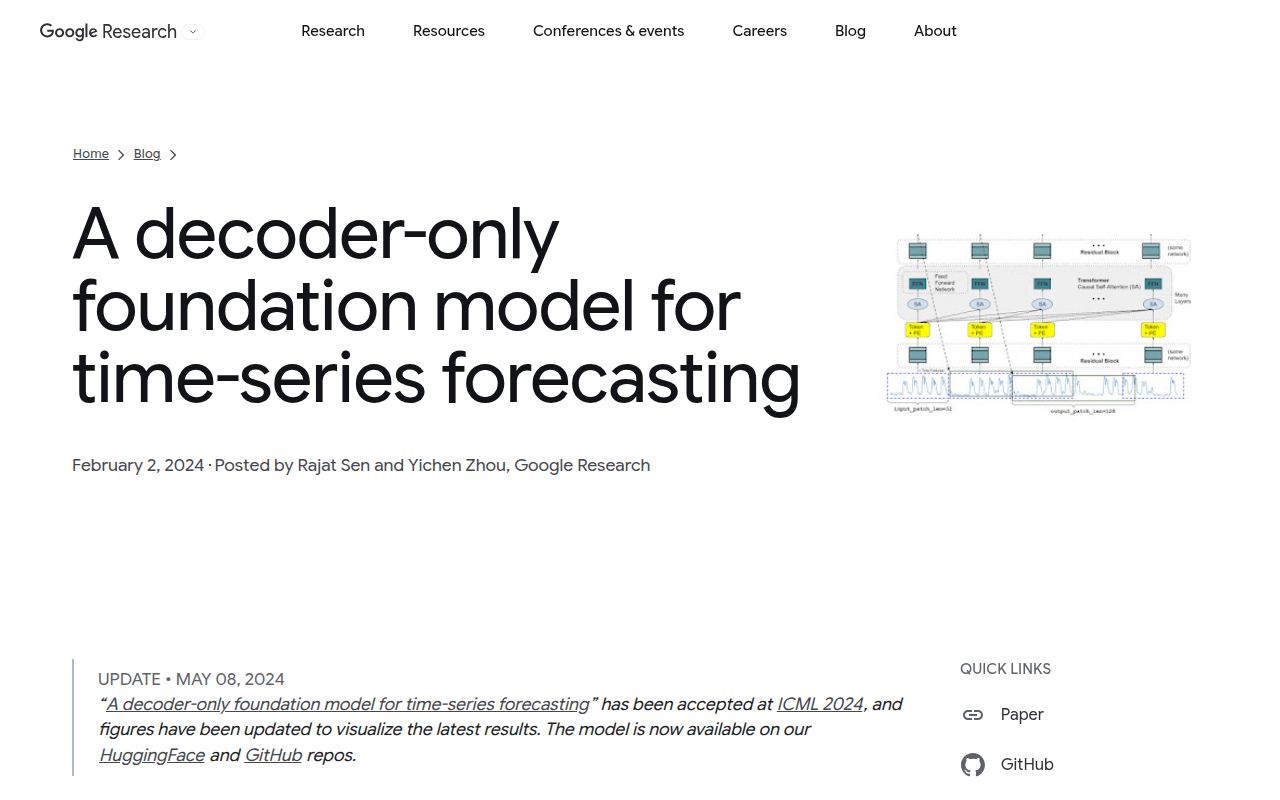
TimesFM takes one-dimensional histories and predicts future values without fitting a separate model to each series. Version 2.5 uses 200 million parameters, accepts up to 16,000 context points, and can forecast up to 1,000 steps with an optional 30 million-parameter quantile head. That makes it attractive for a catalog of products, sensors, or operational metrics where training and maintaining one model per series would be expensive.
The result should enter a comparison, not skip one. A pretrained model may transfer useful patterns, but it does not know a company's stockouts, sensor replacements, accounting changes, or promotion calendar by default. Run rolling historical windows and compare the exact horizons used for decisions against seasonal naive, moving averages, statistical models, and the incumbent system. Break errors down by series type because one average can hide expensive failures.
The API covers point, quantile, and covariate paths
The README example loads a Torch checkpoint, compiles maximum context and horizon values, then sends a list of NumPy arrays to forecast(). It returns point forecasts and quantile output. Configuration flags cover normalization, sign-flip invariance, positive-value inference, and quantile-crossing correction. Those switches express assumptions: forcing positive values may suit demand but would be wrong for a series such as temperature deviations or profit changes.
TimesFM 2.5 removed the old frequency indicator and brought back covariate support through XReg. Known future inputs can improve a forecast when prices, holidays, weather, or regional attributes genuinely exist at prediction time. They also create a direct route for leakage. Every backtest must reconstruct what was known on that date, not attach the final cleaned dataset to an old prediction point. Quantile ordering does not prove the resulting intervals are calibrated.
What happened when we ran it
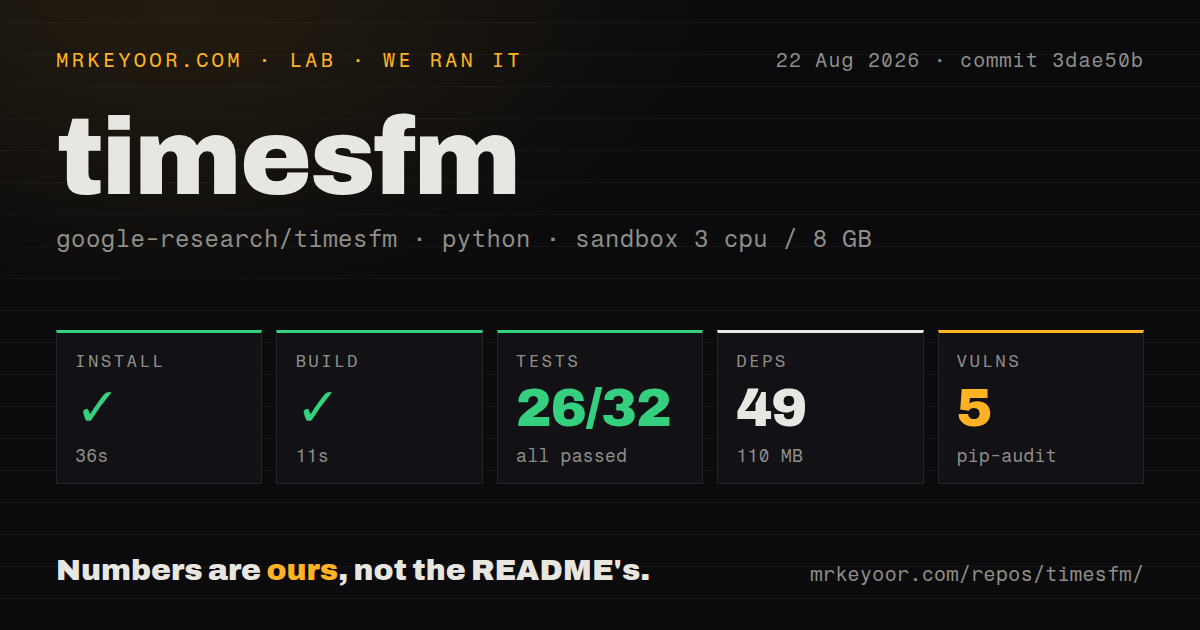
Our sandbox installed 49 packages in 36 seconds, consuming 110 MB on disk, and completed the build in 11 seconds. The checkout was small for a model package: 103 files, about 15,377 source lines, and 4 MB. We tested commit 3dae50b in a fresh unprivileged Debian container with 3 CPUs, 8 GB of RAM, Python 3.12, and no secrets.
Pytest stopped after 11 seconds with 26 passed, 0 failed, and 6 collection or setup errors out of 32. Every listed error came from a module that could not import pandas, including the v1 data-loader and TimesFM tests. The log therefore shows an incomplete test environment rather than six failed assertions. Pip-audit found 5 known vulnerabilities, so an adopter should identify the packages and fixed versions before approving the environment.
Torch, Flax, and XReg are separate installations
The README provides timesfm[torch], timesfm[flax], and timesfm[xreg] extras. Users must also select PyTorch or JAX builds that match CPU, GPU, TPU, or Apple Silicon hardware. That separation is sensible because accelerator packages are not interchangeable, but it makes the one-line install only the start of a reproducible service image. Pin the backend, model checkpoint, package, NumPy stack, and optional data dependencies together.
Version names add another trap. TimesFM 2.5 is the latest model, while the July 2, 2026 package and GitHub release are numbered 2.0.2. Older 1.0 and 2.0 model code sits in the v1 directory, and the README directs those users to package version 1.3.0. Record both the checkpoint identifier and Python package version in every experiment instead of writing “TimesFM 2” in a report.
Reused input lists can change the next forecast
Open pull request 468 reports that the 2.5 forecast() path mutates the list supplied by its caller when a batch needs padding. Its example starts with 3 inputs for a global batch size of 4. The first call appends a short zero array to the original list; the next call then treats that padding as a real fourth series and returns an extra forecast. The proposed fix copies the list before adding padding.
That bug is easy to defend against while it remains unmerged: pass a fresh list, assert its length and contents after every call, and verify output cardinality. Repeated-call tests matter more than a single successful notebook cell. The same principle applies to XReg batches and quantile outputs. Test one series alone and in different batch groupings, and reject any unexplained change caused only by its neighbors.
The open release has active code, not product support
GitHub showed 28,269 stars, 224 combined issues and pull requests, and a last push on July 14, 2026. Release v2.0.2 arrived July 2 with package-loading and compilation updates. August pull requests were still updating 2.5 examples and fixing the input mutation, so work continued after the last push visible on the default branch. The repository has 2 CI workflows, a tests directory, no Dockerfile, and Apache 2.0 licensing.
Google states that this open version is not an officially supported product. BigQuery ML, Google Sheets, and Vertex Model Garden are listed as product routes for users who want a managed context. Self-hosters own backend packaging, model loading, scaling, dependency advisories, monitoring, and forecast validation. TimesFM is worth trying because the setup is modest and the model offers a common zero-shot reference. Adoption should follow measured improvement on your series, never the model name alone.