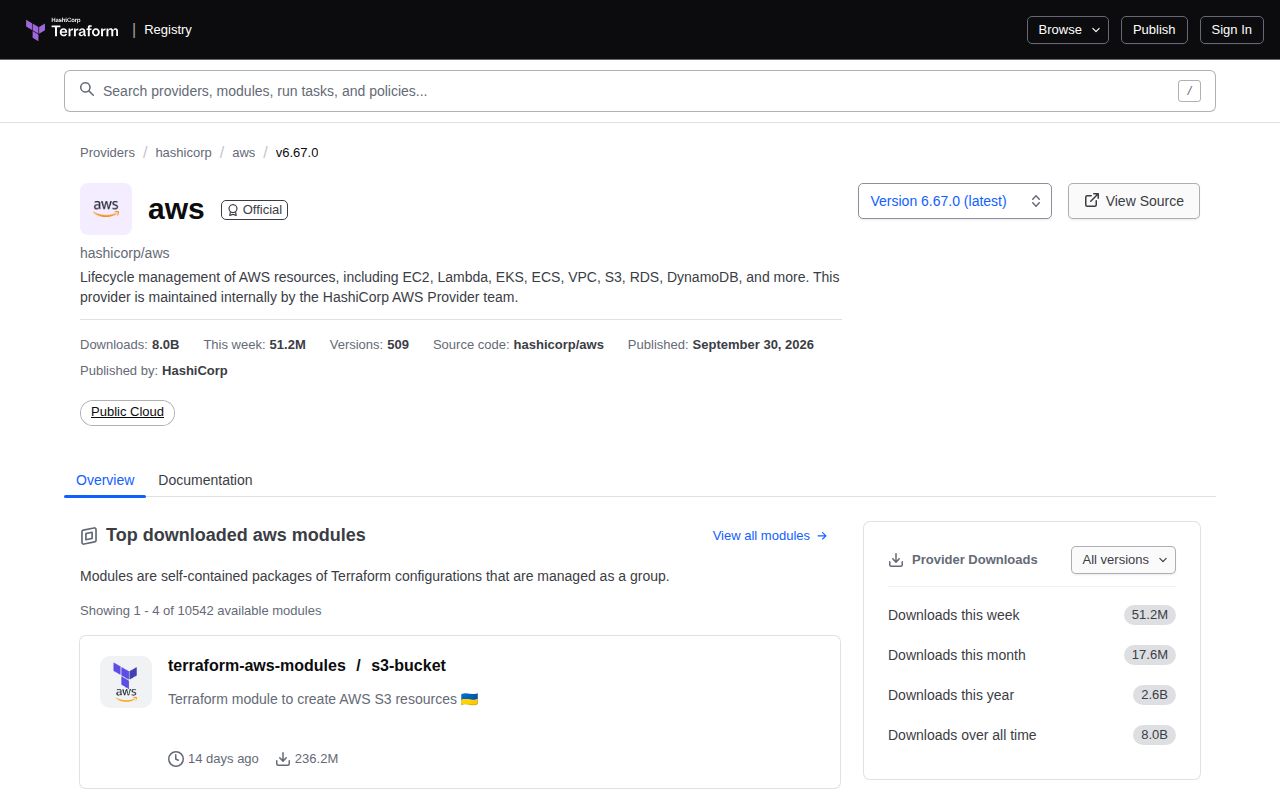
Most users should download v6.67.0 instead of building the source
The Terraform AWS Provider turns HCL resources into AWS API calls and keeps the resulting objects tied to Terraform state. For an infrastructure team, that means plans can show a proposed change before an apply reaches AWS. The provider is broad enough that one repository carries code for established services, newer Bedrock resources, data sources, imports, retries, and service-specific edge cases.
That breadth produces an unusual split. A normal user declares hashicorp/aws, pins a version, supplies AWS authentication, and lets Terraform install the release. A contributor meets 21,055 files, about 3,633,063 lines of source, and a 256.6 MB checkout. Judge setup based on which side of that line you occupy. The released provider is routine Terraform plumbing. The source tree is industrial software.
What happened when we ran it
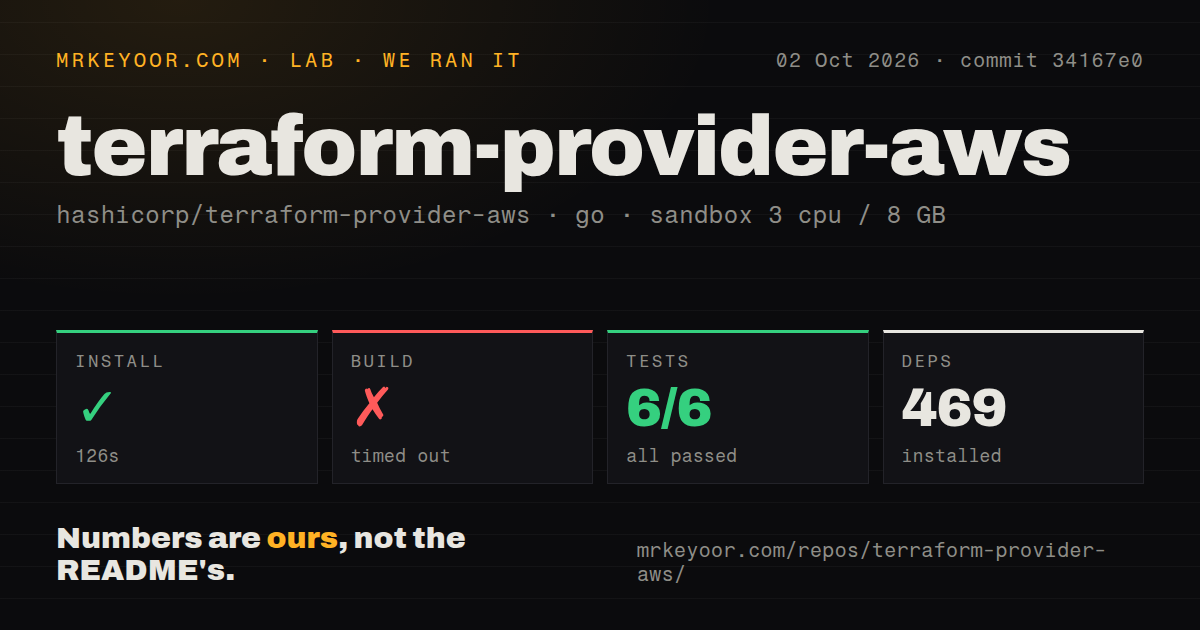
Our run at commit 34167e0 installed 469 Go packages in 126 seconds inside a fresh Debian container with 3 CPUs and 8 GB of RAM. The build command then reached our 900-second limit without finishing. The supplied log did not identify a compiler error, so the defensible result is a timeout. We cannot turn it into a failed build cause that the log never showed.
The test command also reached 900 seconds. Six reported tests had passed and none had failed when the cap arrived. Its final lines showed successful results in internal/acctest, jsoncmp, knownvalue, statecheck, actionwait, and backoff; several neighboring packages reported no test files. The last completed package shown was internal/backoff, which passed in 107.695 seconds. This was an incomplete suite with clean reported results, not a green full run.
Our repository scan found 47 CI workflow files, no Dockerfile, and no directory literally named tests. Go projects commonly keep test files beside source, so that directory result should not be read as an absence of tests. The partial output proves tests exist. More useful is the timing: even an uncredentialed local command can exceed a 15-minute feedback window on a small container.
Full validation belongs in targeted packages and AWS accounts
HashiCorp's contributor guide separates local unit tests from acceptance tests. The latter create, read, and destroy real AWS resources. They need an AWS profile or access keys plus a default region, and the guide warns that services such as RDS, OpenSearch, and WorkSpaces can be expensive to exercise. A casual make testacc is therefore a cloud operation with billing and cleanup consequences.
The practical contribution loop starts narrow. Work on the relevant Go package, run its unit tests, then select the acceptance cases tied to that resource. Use a dedicated account with cost controls and permissions chosen for the test. HashiCorp says contributors who cannot pay for acceptance coverage can submit a best-effort implementation and ask maintainers to run it. That policy lowers the financial barrier, though it can lengthen review.
Repeated builds have a local cost too. The development guide warns that the Go cache can grow dramatically during sustained provider work and recommends scheduled cleanup. A development override in Terraform's CLI configuration points hashicorp/aws at your locally built binary. That is useful, but it also makes version discipline important: a forgotten override can make a project test your checkout rather than the pinned registry release.
A 3,597-item queue reflects AWS scale and active triage
GitHub listed 2,665 open issues and 932 open pull requests on October 3, 2026, matching the repository's combined count of 3,597. That queue would be alarming in a small utility. Here it reflects thousands of AWS behaviors, feature requests, documentation reports, and patches arriving at once. It still creates real search and triage work for anyone deciding whether a provider bug already exists.
The maintenance signals are current. The repository was pushed on October 2, 2026, and v6.67.0 shipped on September 30. That release added resources and fixed behavior across App Runner, Auto Scaling, Bedrock AgentCore, Config, DynamoDB, and RDS. Four earlier v6 releases also appeared during September. A large queue has not stopped releases, though users should read upgrade notes for the services they operate.
One current notice makes that concrete. HashiCorp advised users of aws_redshiftserverless_workgroup to run v6.66.0 or newer before AWS reintroduced a parameter on October 13, 2026. Older versions could produce a permanent diff or block an apply. Pinning protects you from surprise upgrades, but staying pinned forever can preserve a provider bug after the AWS API changes underneath it.
The aws provider wins when Terraform state already owns AWS
Use this provider when your team has chosen Terraform and AWS resources should participate in the same plan, review, state, and apply workflow. The MPL-2.0 codebase, detailed registry documentation, contributor guide, and frequent releases support that job. The 900-second timeouts matter mostly to contributors and organizations that build internal forks.
Choose AWSCC when Cloud Control coverage is the deciding factor. Pick Pulumi if general-purpose languages are a firm requirement, or Crossplane when Kubernetes reconciliation should remain in control. For mainstream Terraform on AWS, hashicorp/aws remains the sensible default. Just do not confuse a simple provider declaration with a simple repository: our 6 completed tests barely began to cross it before the clock ran out.