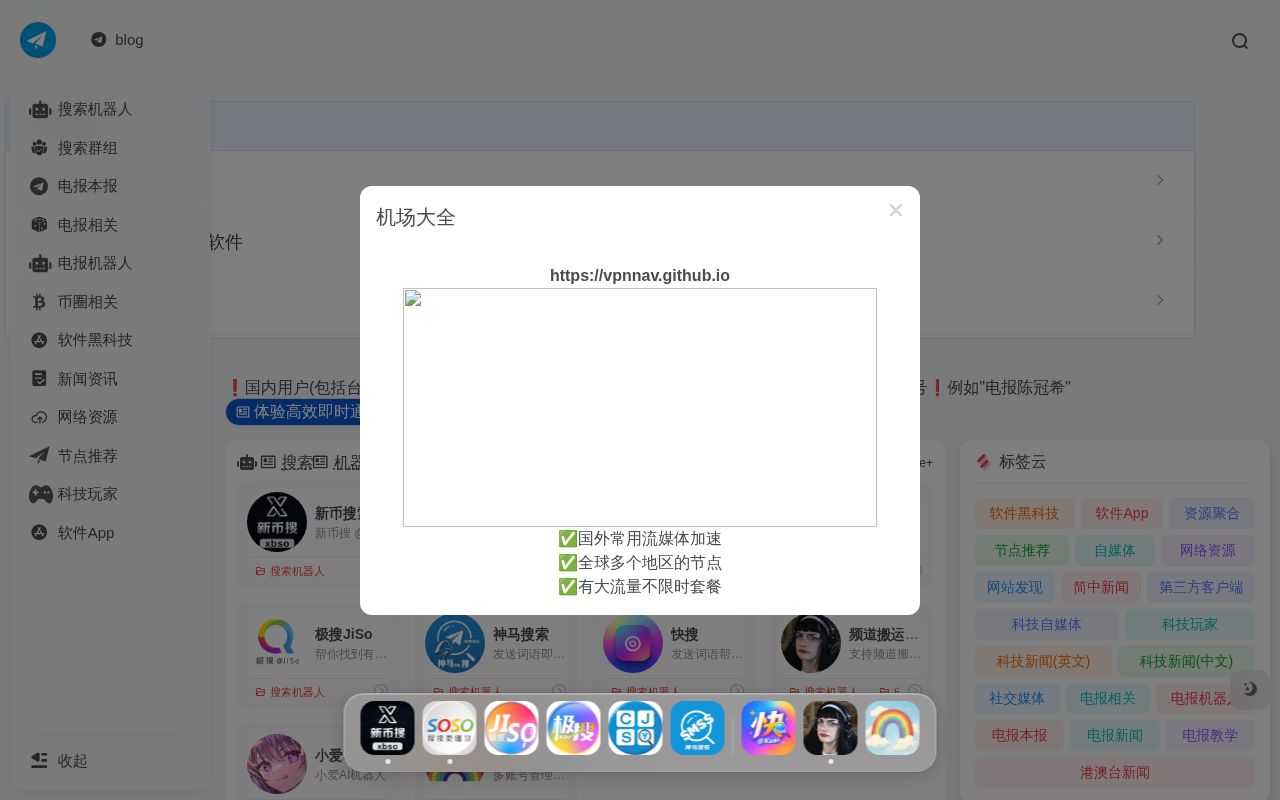
This is a Chinese link directory, not Telegram software
TelegramGroup is one very large README that collects groups, channels, bots, account instructions, and commercial offers for Chinese-speaking Telegram users. GitHub detects no primary programming language because there is no application here. The document is primarily Simplified Chinese and has no English documentation. Its opening sections point readers to search bots and topical communities, then branch into account help, client settings, crypto services, entertainment, regional groups, and paid listings.
The README we fetched was about 250 KB, while the repository description claims more than 10,000 entries. We did not independently count those destinations, so the claim should remain the project's own. GitHub reported 23,033 stars and 10 open issues and pull requests combined. Those figures show attention, but they do not tell you whether any individual Telegram handle is current, safe, or accurately described.
The list mixes discovery with advertising
A useful community directory normally answers two questions: what is listed, and why should a reader trust the selection? TelegramGroup answers the first through category tables, but it gives little process for the second. Search bots sit next to referral links, VPN offers, exchange signups, paid account services, promotion tools, and direct advertising slots. Some rows clearly identify prices or invitations. Others use promotional wording that is hard to separate from editorial selection.
The README says listings and advertising are available for payment, including a quoted price of 500 yuan or 70 USDT in one intake section. It also contains exchange referral codes and percentage discount claims. Those details make the commercial relationship visible, which is better than hiding it, but they also change how the directory should be read. A link's presence is not evidence of security, legality, service quality, or official Telegram endorsement.
The risk varies sharply between categories
Official bots such as BotFather and Telegram's support routes appear alongside third-party search, account, payment, and content services. A reader can easily move from a familiar official handle to an unrelated bot that requests an account action or payment. The README includes instructions about sensitive-content settings, account appeals, API credentials, crypto wallets, and virtual cards. Errors in those areas can cost more than a broken entertainment link.
The document also includes adult-oriented sections and services described as bypassing forwarding restrictions, growing channel audiences, monitoring keywords, or manipulating faces and clothing in images. That makes the directory unsuitable for schools, family catalogs, and corporate allowlists without heavy filtering. One repository page containing more than 250 KB of mixed destinations cannot confer a single safety rating on them. Treat every external handle and domain as a separate product.
What happened when we ran it
We did not run TelegramGroup in our sandbox. The measurement harness found no supported ecosystem, GitHub reports its language as null, and the repository has no Dockerfile. It would be misleading to report an install time, package count, build result, or test result for a Markdown directory. The correct use is to read the document, search within it, and decide whether to open an external destination.
That absence of executable code also means the repository cannot check the services it lists. There is no described crawler that confirms 10,000 links, no test suite that flags a renamed Telegram handle, and no build that separates editorial rows from advertising. Our run produced no security or dependency finding because there were no dependencies to install. Link safety, account behavior, and payment claims remain outside the repository's control.
Fresh edits do not verify old entries
The repository was pushed on 2026-08-26, the same date as this review, so the document is not abandoned. GitHub had no latest release to return. Recent collaboration visible through the issues endpoint consisted mainly of pull requests that added or changed listings, including wallpaper channels and VPN or community entries. Several open pull requests had not been updated since 2024 or 2025.
A fresh push proves that someone edited the README. It does not prove that every older row was revisited. This distinction matters with Telegram, where handles can change ownership and external domains can expire. The project does not describe a 30-day verification cycle, automated link checks, or a dated review stamp per entry. Readers should compare a destination's current profile, message history, administrator identity, and requested permissions before joining or paying.
English readers should use official help first
The directory occasionally includes English names and an English account-appeal template, but navigation and explanations remain Chinese. Machine translation can explain a category label, yet it may blur warnings about payments, account restrictions, or regional legality. Telegram's official FAQ is a better first source for login, privacy, moderation, and client behavior because it owns those systems and publishes multilingual guidance.
For discovery, Telegram's own search and known community referrals give less breadth but a clearer chain of trust. Developers wanting an open-source Telegram project should look at the official desktop client or a maintained API library instead. TelegramGroup has no API surface, versioned dataset, package, or license listed in the repository facts we fetched. It is a browsable document with external links. That is a valid format, but it is a poor foundation for an application.
Use it as an untrusted index
TelegramGroup can save a Chinese-speaking reader time when searching for a narrow topic or an official bot hidden inside a crowded platform. Its huge scope also guarantees uneven stakes: joining a discussion group is different from giving a bot account access or sending cryptocurrency to a promoted service. The directory provides proximity, not due diligence.
The safest workflow is manual and slow. Search the README, identify a candidate, verify whether the handle is official, inspect recent posts, and leave when a service asks for permissions or money that its purpose does not justify. With no lab run, no releases, and no documented link validator, there is no technical result that upgrades the list into a trusted catalog. Use it for leads, never as proof.