The 1,146-file checkout combines a catalog, CLI, and MCP server
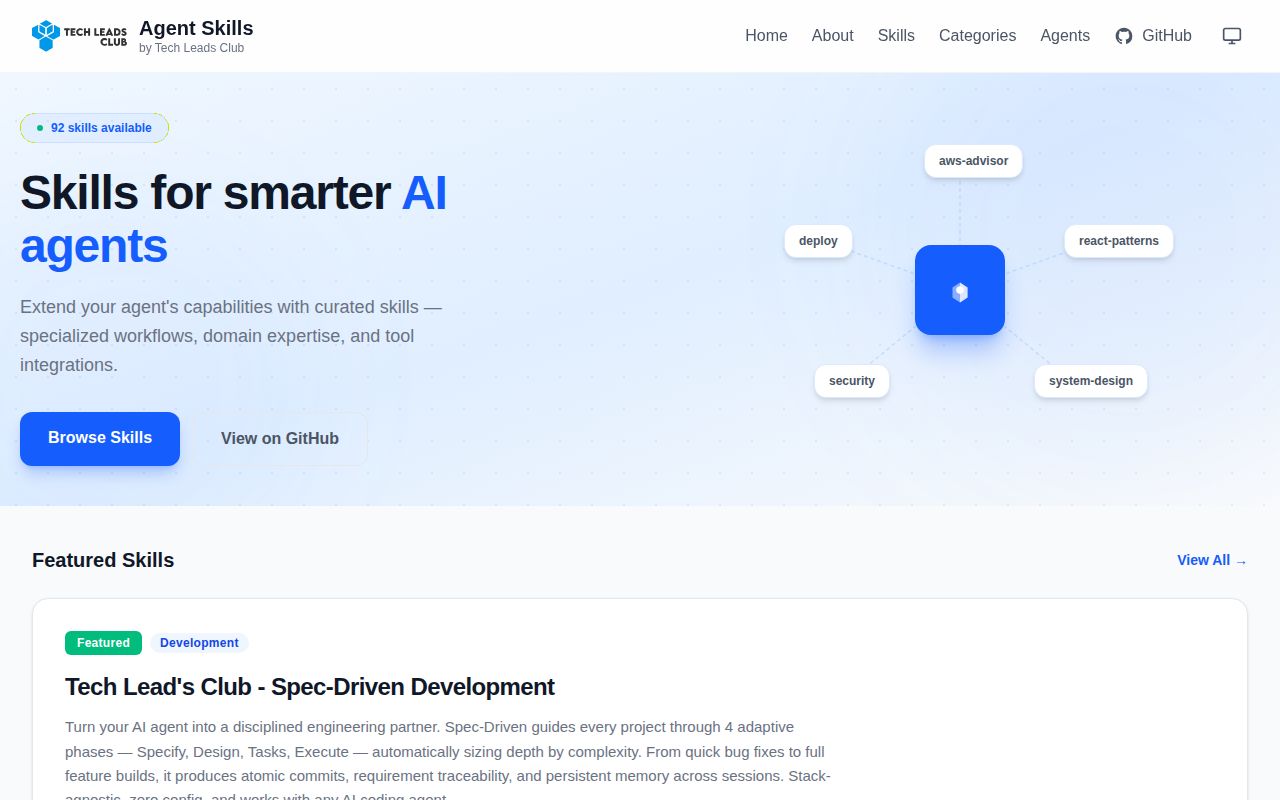
Agent Skills is larger than a folder of prompts. The 1,146-file repository contains an npm installer, a categorized skills catalog, and an MCP server that lets an agent search before fetching instructions. The CLI can list, install, update, remove, and cache skills across local or global scopes. It also supports copies and symlinks, which matters when one developer moves between Claude Code, Codex, Cursor, and other clients with different discovery directories.
The checkout measured 11.1 MB and about 44,911 lines of source before installation. Catalog files are fetched from a CDN on demand instead of shipping every skill in the CLI package. The MCP server follows the same selective model through four tools for listing, searching, reading a skill, and fetching named files. That is a sensible shape for agents with limited context, and it keeps the server read-only rather than giving a catalog browser general filesystem access.
The security case meets 30 dependency advisories
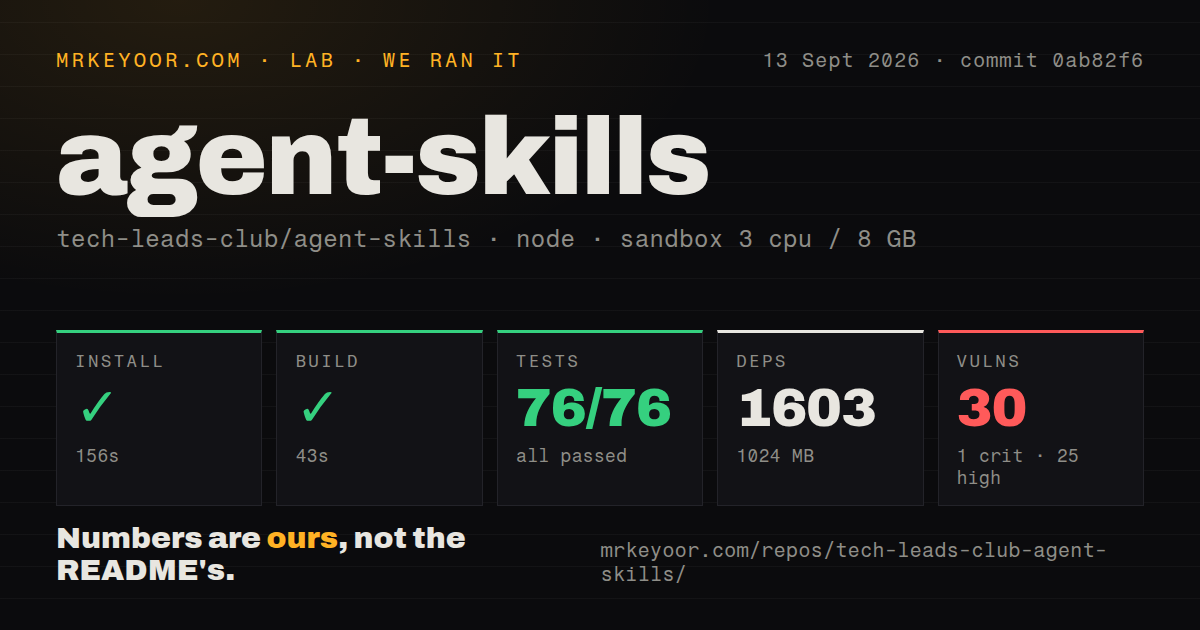
Our npm audit returned 30 vulnerabilities known to npm in the installed tree: 1 critical, 25 high, and 4 moderate. Those findings do not prove that the CLI exposes each vulnerable code path, and they do not measure malicious instructions inside a skill. They do mean the README's language about installing with absolute confidence is too broad. A buyer should ask for triage of the exact dependency findings before treating the registry as an approved supply source.
The repository does put real controls around skill handling. Its security policy describes path checks, symlink target validation, SHA-256 content hashes, atomic lockfile writes, and a JSON Lines audit trail. Changed skills are scanned with Snyk Agent Scan before release, provided the workflow has a SNYK_TOKEN. Fork pull requests do not run that scan in the normal workflow; the policy says a required merge-queue check is needed if maintainers want every fork contribution blocked on scanning.
What happened when we ran it
Our sandbox installed commit 0ab82f6 in 156 seconds. Npm added 1,603 packages and occupied 1,024 MB on disk. The build then succeeded in 43 seconds, and Jest completed in 31 seconds with 76 passed and 0 failed. That is a clean functional result for the commands the lab ran, paired with a dependency tree that is both slow to install and expensive enough to notice in a small CI runner.
The same fresh Debian run used 3 CPUs, 8 GB of RAM, Node 22, no secrets, and an unprivileged container. The repository was an npm workspace monorepo with 2 CI workflow files, no Dockerfile, and no tests directory. The absent directory does not mean tests are missing: the command found and passed 76 Jest cases. No other install, build, test, performance, or runtime result can be inferred from this source-level run.
CLI v1.4.10 has disputed Codex and Antigravity paths
Two open reports identify destination problems in CLI v1.4.10. Issue 188 says Codex installs go to .codex/skills, while the reporter expects the standard .agents/skills locations. Issue 193 says global Antigravity installs go into an application data folder that Antigravity does not scan. The latter report describes the result as a silent install: files exist, but the agent never lists or activates the skill. Both reports were open when checked.
Platform guidance also needs reconciliation. The README badge says Node 22 or newer, while the current root package.json declares Node 24 or newer. Our Node 22 build passed at commit 0ab82f6, but that measured result cannot override a newer manifest requirement. For team deployment, pin the CLI version, run one install per supported agent, and confirm that the agent discovers the skill before distributing a shared setup script.
September 2026 activity is healthy, while licenses stay mixed
The last push was September 12, 2026, and catalog release v0.17.8 arrived on September 10. GitHub showed 5,429 stars and 29 combined open issues and pull requests. Recent activity included new skill proposals plus the Codex and Antigravity path reports, so the queue reflects both catalog growth and installer maintenance. A stale tag is not the concern here; the project is moving often enough that teams should pin versions and read the relevant release notes.
Licensing depends on what you install. The software engine uses MIT, skills written by the maintainers use CC-BY-4.0, and imported skills retain their original terms. The README also says catalog users must credit Tech Leads Club. That is manageable for an individual developer, but a company distributing generated assets or bundling skills internally needs an inventory that records each skill's source and license instead of treating the npm package as one uniformly licensed product.
A 1,024 MB install makes sense only if the catalog saves review time
A 1,024 MB installed tree is reasonable only when a shared catalog removes more review work than it creates. Vercel's skills CLI accepts Git repositories, local paths, and direct downloads, so it suits teams that already know their sources. Anthropic's repository is better for Claude examples and the Agent Skills specification. Superpowers is narrower: it imposes one development method covering design, planning, testing, and review rather than offering a general marketplace. Agent Skills wins when curated breadth and one cross-agent catalog are the reason for adopting it.
All 76 tests passing gives the installer a credible starting point, and the MCP server's selective reads are useful. The 30 audit findings prevent a blanket trust recommendation, especially when the project markets security as its main distinction. Trial it in a disposable project, inspect the actual skill files and licenses, check the target directory, and keep the selected catalog revision pinned. If your organization cannot own those checks, a smaller approved set in a repository you already control is the safer choice.