TauriTavern packages SillyTavern as a native app
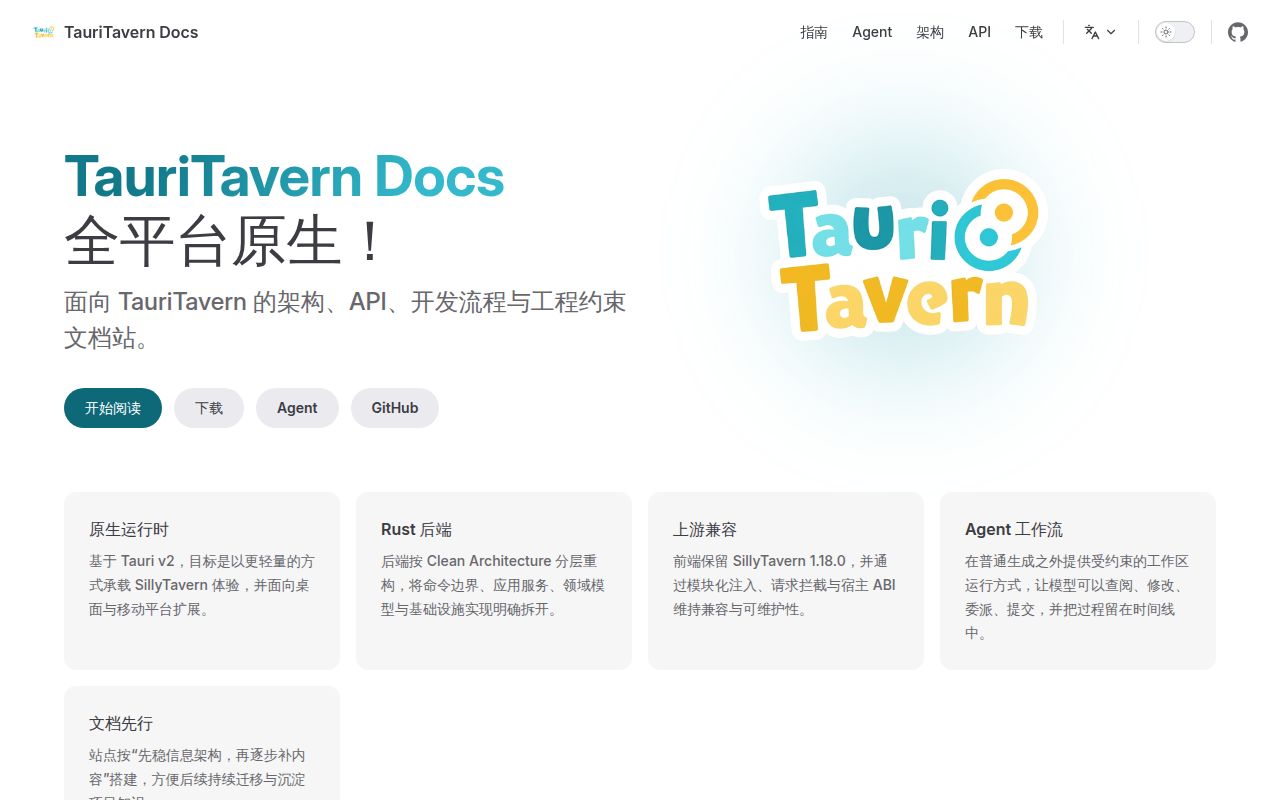
TauriTavern keeps the familiar SillyTavern front end and moves backend responsibilities into a Rust and Tauri v2 application. The README says character cards, chat records, presets, World Info, and front-end extensions retain compatible data formats and directory layout. Users download a normal application for desktop or mobile instead of installing Node.js and starting a local web server.
The port is independently maintained rather than an official SillyTavern client. Its front end was synchronized with upstream 1.18.0 when the README was fetched, while native bridges handle storage, HTTP, media, sync, tokenization, and extensions. Our clone contained roughly 438,079 source lines across 2,238 files, which explains why compatibility is a continuing engineering job rather than a thin Tauri wrapper.
Mobile access and local data are the practical gains
Packaged builds cover Windows, macOS, Linux, Android, and iOS, with TestFlight used for Apple's mobile platform. Desktop package routes include Scoop, Homebrew, AUR, Flatpak, Nix, and release downloads. The application stores character and conversation data locally and includes portable mode, while sync can operate through local encrypted pairing or the separate TT-Sync v2 route.
This breadth is the case for TauriTavern over upstream SillyTavern. A phone or tablet becomes a supported client rather than a browser pointed at another machine. Version 2.2.0 also introduced optional chat DOM virtualization, native Gitoxide-based extension management, and backup controls with opt-in Zstandard compression. The release warns that compressed backups are not readable by SillyTavern, so portability depends on that setting.
Extension compatibility stops at the front-end boundary
Front-end extensions can be installed and updated through the built-in Git implementation, including repositories hosted outside GitHub. Node-only backend plugins from SillyTavern do not work because TauriTavern replaced that backend. Anyone whose workflow depends on a server plugin should inventory it before migration, rather than assuming general data compatibility also covers executable extensions.
There are active compatibility reports even within the front-end layer. Issue #192 describes a dialogue-coloring extension failing to color the startup chat and card dialog. Version 2.2.0 asks virtualization users to meet minimum releases for Tavern Helper and LittleWhiteBox because extensions must understand the virtualized lifecycle. A test migration should cover startup, long histories, card editing, World Info, backups, and each extension.
An open SSRF report changes the security advice
Issue #184 describes client-supplied custom_url, reverse_proxy, and custom headers reaching the Rust request path without a protocol allowlist or private-network address filtering. The report is tied to commit 3a8c540, the same commit our lab ran, and says scripts inside the webview, including third-party extensions, can initiate those requests. The issue was still open when checked on August 25, 2026.
That report is specific enough to affect a buying decision even though it remains an issue report, not a release advisory. Do not load untrusted extensions in an environment where localhost services, LAN systems, or cloud metadata endpoints are sensitive. A safe fix belongs in the Rust request boundary, as the report argues, because browser restrictions do not protect a native HTTP client.
What happened when we ran it
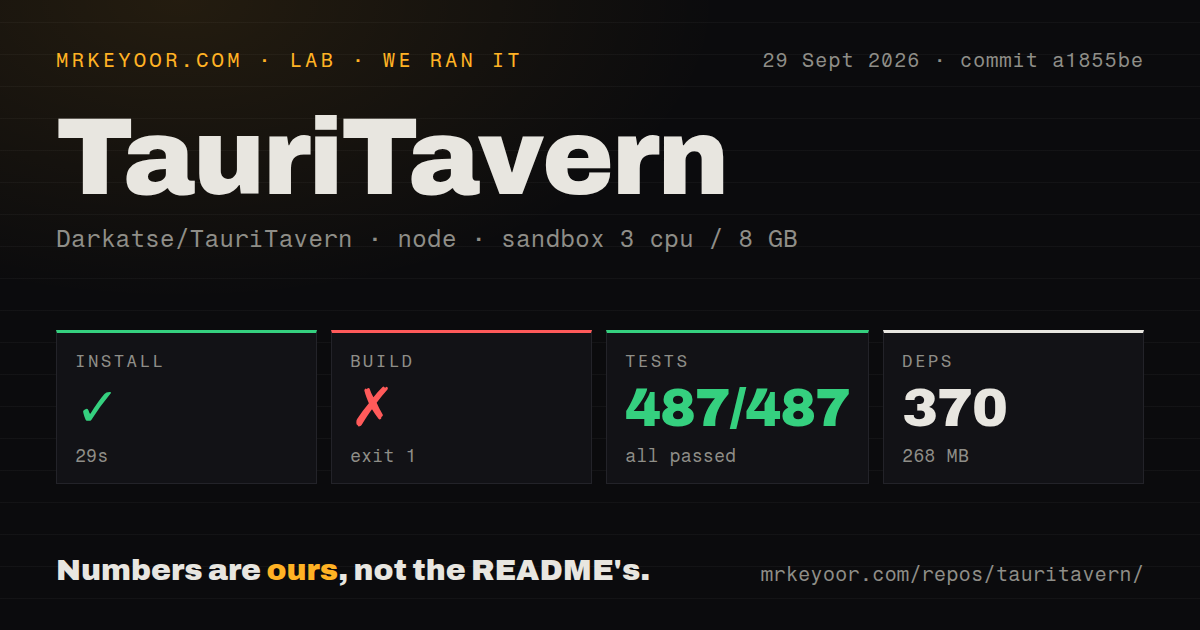
Our sandbox installed 80 pnpm packages in 16 seconds at commit 3a8c540; dependencies occupied 155 MB. The repository itself was 62.5 MB and had about 438,079 source lines. Installation resolved cleanly in an unprivileged Node 22 container with 3 CPUs and 8 GB of RAM. No Dockerfile was present, though the repository did include a tests directory and 6 CI workflows.
The build failed after 72 seconds in the Rust side of the Tauri application. pkg-config could not find gdk-3.0 at version 3.22 or newer, and PKG_CONFIG_PATH was unset. The error asks for the system package containing gdk-3.0.pc or a path to it. This is a concrete Linux desktop development dependency missing from the fresh container, not a JavaScript compile error.
The test command ran for 109 seconds and exited 101. node:test counted 910 passing tests and zero failures, but the overall command did not pass. The supplied tail shows World Info ordering, token prefetch, batch limits, and model-choice cases succeeding before a generic lifecycle failure. Since the actual nonzero cause is absent, we cannot say whether another stage, native code, or the runner ended it.
v2.2 is active, broad, and still settling
The stable v2.2.0 release arrived on July 30, 2026, and the repository was pushed on August 25. GitHub listed 42 open issues and pull requests. Recent work included Gemini history handling and QuickJS macro access, while user reports covered startup after power loss, iPad gestures, provider switching, mobile crashes, and extension behavior. The dates show active maintenance alongside unfinished platform edge cases.
Choose TauriTavern for its packaged native experience and SillyTavern-compatible front-end world. Choose upstream SillyTavern when backend plugins or exact upstream behavior are essential. The source build needs native Linux packages beyond pnpm, and our 910 passing Node tests did not produce a clean command exit. Most importantly, keep third-party extensions out of trusted networks until the request-routing boundary has a verified fix.