Supervision starts after the model returns detections
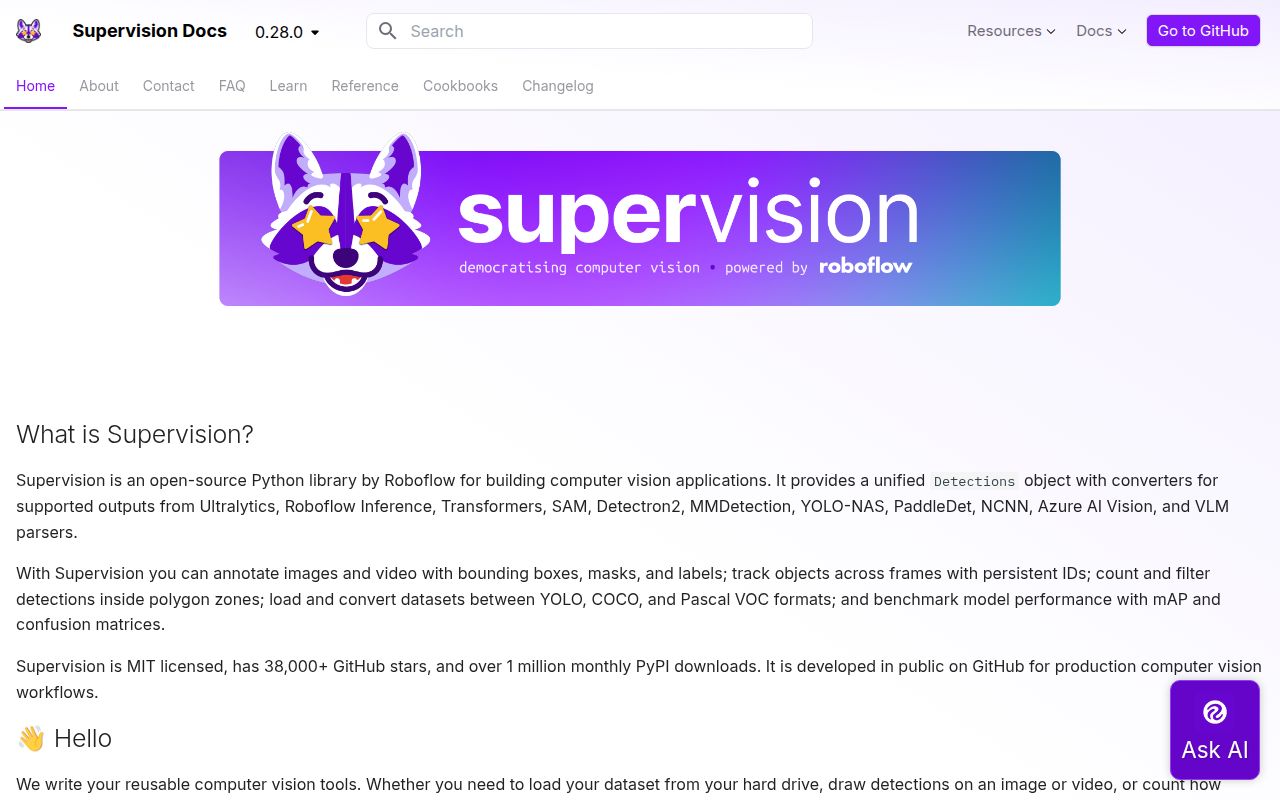
Supervision does not train or serve a vision model. It gives model output a common Python representation and supplies the operations applications repeatedly need afterward. Detections can hold boxes, masks, classes, confidence values, tracker IDs, and attached data. Annotators draw those results, trackers connect objects across frames, and geometry helpers handle zones, intersections, and measurements. Connectors accept output from several popular model libraries.
That division is the reason to adopt it. A team can switch a detector or compare two models while keeping much of its counting, drawing, and video logic. The tradeoff is another abstraction between model tensors and application code. When a connector drops metadata or a new model returns a shape Supervision does not expect, developers still need to understand both sides. The library saves routine work; it does not make model outputs interchangeable in every detail.
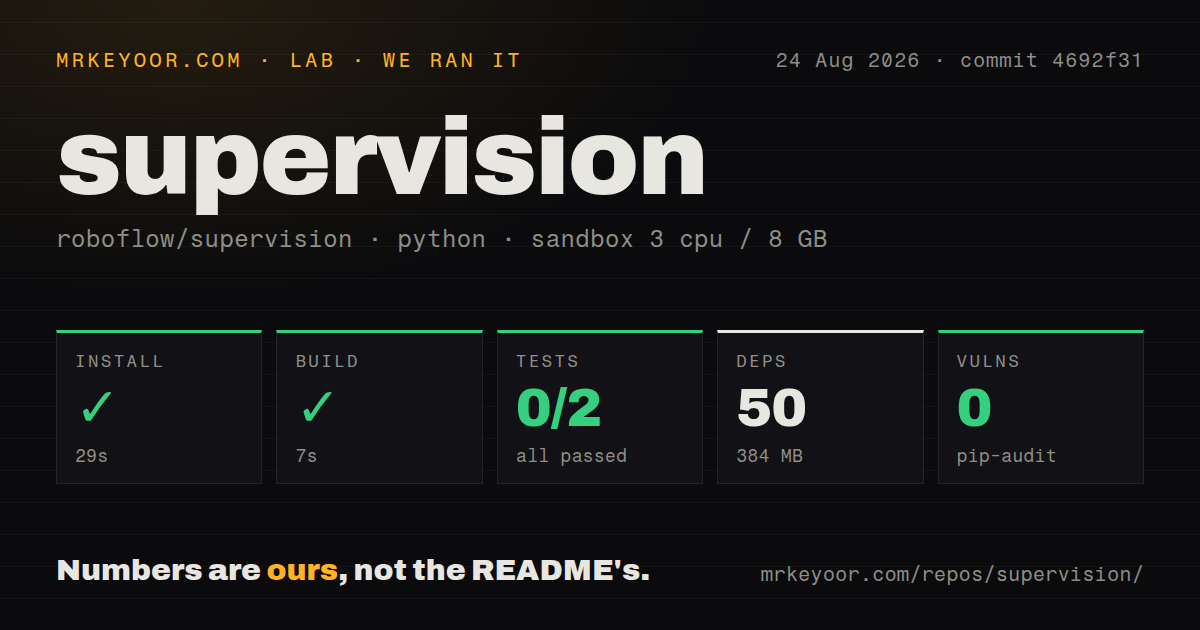
The base package covered 50 dependencies before any model arrived
The README's smallest instruction is pip install supervision on Python 3.10 or newer. Its first model example separately installs Pillow and RF-DETR. A Roboflow Inference example needs an API key, while other connectors depend on their own model packages. This is sensible packaging for a model-neutral toolkit, but the practical environment is defined by the features and backends an application selects.
Our installed environment used 384 MB for 50 packages. That is not excessive for many vision workstations, yet it matters in serverless jobs, edge containers, and command-line tools that only need a few geometry functions. The repository has fallback paths for some image conversion work, and release 0.30.1 made PyAV lazy when OpenCV is active on macOS. Even so, test the import graph for the exact minimal package you intend to ship.
What happened when we ran it
Our sandbox installed commit 4692f31 in 29 seconds, then built it in 7 seconds. The checkout contained 416 files, roughly 95,513 lines of source, and occupied 70.4 MB. Pip-audit found 0 known vulnerabilities among the installed Python packages. The repository had 10 CI workflow files and a tests directory, with no Dockerfile found by our scan.
Tests exited with code 1 after 45 seconds. A focused collection result reported 0 passed, 0 failed, and 2 errors because tests/metrics/test_sklearn_parity.py could not import sklearn. The wider wrapper's final line recorded 3,517 passed, 20 skipped, 1 failed, and 2 errors in 30.07 seconds. We are preserving both log summaries because they describe different layers of the run; neither supports calling the suite clean.
Dataset conversion is useful, but it is not a data quality check
Supervision loads, splits, merges, and exports common detection datasets, including COCO, YOLO, and Pascal VOC layouts. Images can load on demand while iteration exposes paths, pixels, and annotations. These utilities remove a lot of format glue from training and evaluation scripts. They are particularly handy when one project receives labels from several tools or must feed more than one training library.
Conversion can preserve a malformed label just as faithfully as a correct one. Class mappings, image dimensions, empty annotations, polygon validity, and train-test leakage remain the user's job to validate. The same caution applies to merged datasets, where class sets are reconciled but semantic differences between two labels with the same name are outside the file format. Add assertions around the data contract instead of treating a successful export as proof that the dataset is sound.
Release 0.30.1 fixes calculations that can change saved results
The August 24, 2026 release focuses on numeric precision and stability. It corrects oriented-box area and intersection calculations at large coordinate origins, integer overflow in scalar box IoU, polygon centers with large coordinates, and corner alignment in smoothed rotated tracks. It also changes complex-valued box coordinates from silently losing the imaginary component to raising a type error. No public signature was added or removed.
Those fixes are a sign of careful maintenance, but they deserve regression checks in geospatial imagery, stitched frames, or pipelines with stored thresholds. The release notes explicitly say corrected results may differ from 0.30.0 for affected inputs. A counting or matching application can change behavior when an IoU value moves across a threshold even though the upgrade has no signature change. Pinning alone is insufficient; keep representative fixtures with large coordinates and rotated objects.
Current activity supports adoption, while integration tests remain your responsibility
GitHub listed 49,750 stars, 73 combined issues and pull requests, and a last push on August 25, 2026. Version 0.30.1 was published one day earlier. Recent closed reports and release work cover macOS library loading, box finiteness, polygon overflow, and documentation examples. That is stronger health evidence than star count by itself.
Supervision is a practical default for Python teams that have a detector but do not want to rebuild tracking, annotation, geometry, and format conversion. Our 7-second build and thousands of logged passes make the codebase credible, while the missing sklearn collection dependency keeps the measured result short of clean. Use the narrowest extras possible, test your chosen connectors, and keep numeric fixtures around any decision threshold.