Application links are useful before you touch Python
Open an internship link before spending time tailoring your resume. Summer2027-Internships gives you company, role, location, application link, and listing age in the same table. Pitt CSC and Simplify maintain it, combining community submissions with Simplify's monitoring. The README separates software engineering from product management, data science and AI, quantitative finance, and hardware. For a student who already knows their target role and city, browser search is enough to start finding leads.
The Python code belongs to the maintenance side of that experience. Our checkout had 33 files and about 3,011 source lines, with a 19.5 MB footprint before installation. Applicants can read the published tables without cloning any of it. That distinction makes this an easy recommendation as a bookmark. Installing the updater only makes sense if you want to inspect the underlying data, regenerate the tables, or work on how contributions reach the list.
Graduation requirements still need an employer-page check
The legend marks roles requiring advanced degrees, US citizenship, or applicants who do not need sponsorship. Those warnings can save you a wasted application, but they leave important questions unanswered. Issue 9704 requests graduation-year and academic-standing filters. The documented CLI search supports company, title, location, category, and active status. It does not offer a graduation-window filter. Check the employer's requirements before treating a role's presence here as evidence that you qualify.
The lab found 4 CI workflow files, yet that count says nothing about whether an employer will accept your graduation date. The contribution guide documents a listing-validation workflow and human approval for submitted changes. These controls help manage the data. They cannot replace reading the advert. The contribution rules also restrict submissions to the US, Canada, or remote roles, despite international entries appearing in the table. Someone searching across Europe or Asia should keep a separate regional list open.
What happened when we ran it
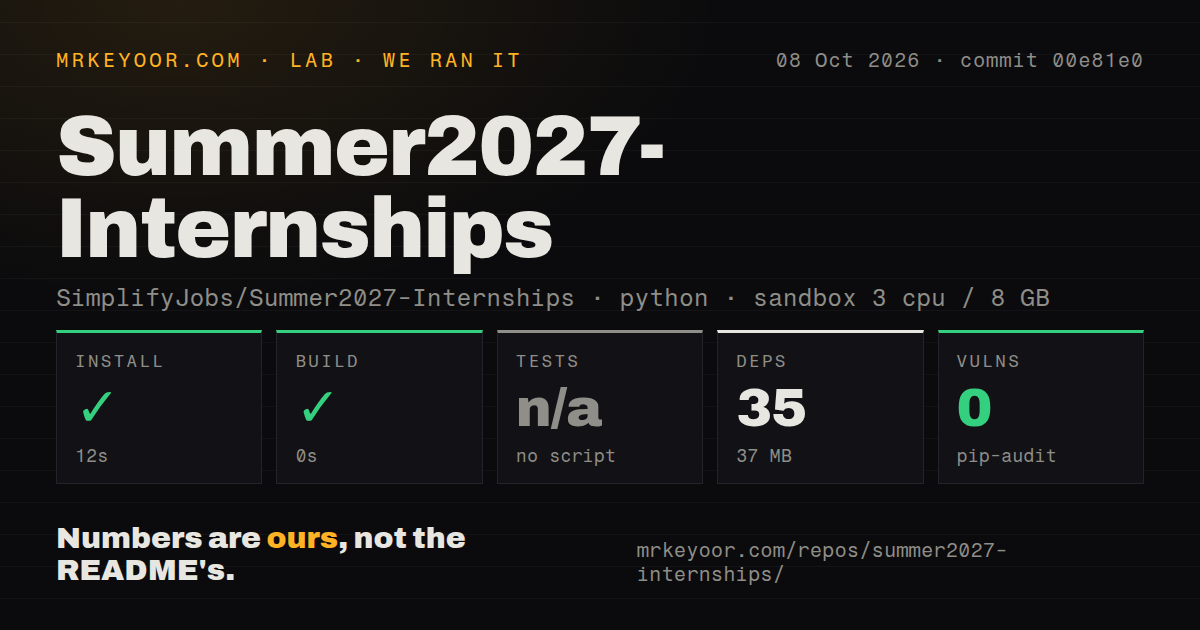
Our sandbox installed commit 00e81e0 in 12 seconds on October 8, 2026, adding 35 packages and occupying 37 MB on disk. The build succeeded in 0 seconds. We used the ghcr.io/astral-sh/uv:python3.12-bookworm image in a fresh, unprivileged Debian container with 3 CPUs, 8 GB of RAM, and no secrets. Installation and build completed successfully in that environment. These measurements cover the repository setup, without establishing the accuracy or availability of internship postings.
Tests were skipped because the repository had no test script or target. The scan also found no tests directory and no Dockerfile. Pip-audit reported 0 known vulnerabilities. That result is useful evidence about known dependency advisories in the installed environment. It provides no measurement of application-link freshness, sponsorship accuracy, or categorization. A successful build recorded at 0 seconds gives us little basis for judging the updater's behavior, especially without a test result to examine.
A fork does not include Simplify's daily discovery service
The contribution guide explains the workflow clearly: internships live in .github/scripts/listings.json, approved issue forms update that file, and another action regenerates the READMEs. Code contributors use Python 3.12+ and uv. Local search and inspection have documented commands, including uv run python main.py listings search --location Remote --active. The guide also identifies a private external script that imports internships from Simplify's database daily. A fork gives you the stored listings and updater, leaving you to supply your own ongoing discovery feed.
The 37 MB installed footprint makes local exploration inexpensive in disk terms, but our Debian result does not settle other platforms. Current source sets the timezone to America/Los_Angeles and calls time.tzset() unconditionally. Open PR 9703 proposes guarding that call for Windows. Its report describes an import failure on that platform. We did not reproduce it in the lab. Windows contributors should examine that change before assuming the documented commands will work unchanged on their machine.
October activity coexists with a reported correction backlog
The last push was October 14, 2026. GitHub showed 47,978 stars and 112 open issues and PRs, with recent internship submissions and an October request for better eligibility filtering. There was no latest release returned by the API. For a continuously updated list, a release tag would be a poor maintenance signal anyway. Issue 9696 reports an edit waiting several weeks. That is a specific contributor's report, rather than a measured turnaround time for all submissions.
Our scan's 4 workflow files support the documented automation, but corrections still depend on approval. If you find an expired role, use the Edit Internship form with its application URL and keep searching. Developers face another boundary: GitHub reports no license, and the repository tree has no license file. Issue 9700 asks about reusing the public listings. I would resolve those terms with the maintainers before making this data the foundation of a republished job service.
Use a dedicated international list when geography decides the search
SpeedyApply's SWE college jobs list separates US and international internships and includes salary columns. That is a better starting point when geography or advertised pay drives your shortlist, though employer-page checks still apply. For full-time entry-level work, Simplify's New Grad Positions matches the job type more closely. Its README names particular graduating cohorts, so check those before switching. Off-season applicants can stay within this repository and open its separate off-season README.
The 12-second install makes the maintenance code approachable, but the applicant's useful next step is already available in the browser. Pick a location, find a recent role in your category, and read its actual requirements. Record your application status somewhere you control. I would use this list repeatedly during a search, while keeping employer pages responsible for eligibility and deadlines. Before rewriting a resume for a promising title, check that the employer is still accepting applications from someone graduating when you do.