Submarine puts 7 remote-admin jobs in one client
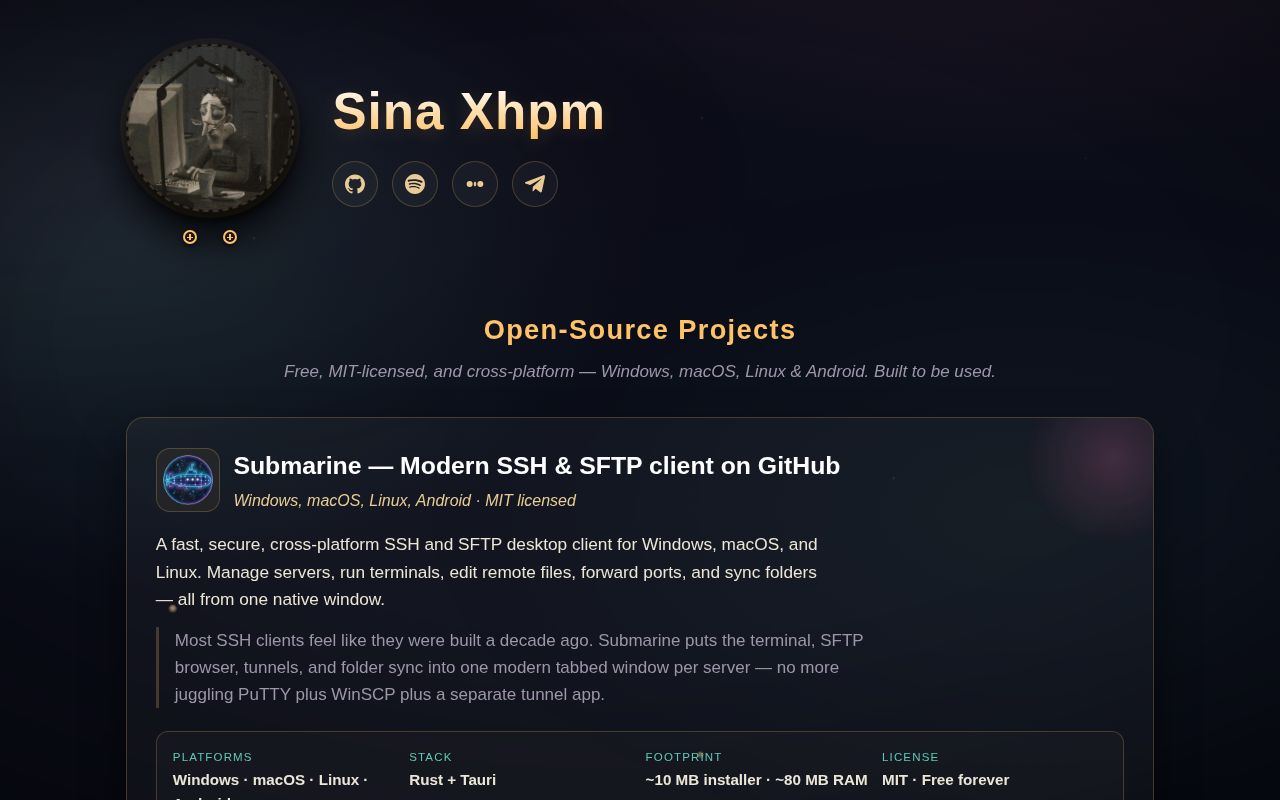
Submarine combines at least 7 jobs around one SSH profile: terminal access, SFTP, port forwarding, folder mirroring, server inspection, Docker control, and encrypted sync. Sessions can be split, pinned into a wall, or receive broadcast input. The appeal is easy to picture if one server currently means a terminal window, a separate file-transfer client, and another place to remember tunnels.
The scope goes beyond a prettier shell. Its SFTP view can edit remote files, the mirror compares both sides by size and content hash, and deleted remote files move into .submarine-trash/. Docker views cover containers, logs, statistics, resources, and interactive shells. That concentration saves context switching, but it also gives one desktop application broad power over production hosts. Trial it with a low-risk machine before importing an entire server list.
Version 0.3.8 installers are unsigned
The README says every current desktop build is unsigned. On Windows, SmartScreen can require the user to choose the extra run option. macOS may need an xattr command to remove quarantine. Android 8.0 and newer uses a release-page APK rather than the Play Store, so the user must allow installation from that source. Those are real adoption hurdles in managed workplaces.
Release v0.3.8 provides packages for Windows, macOS, several Linux formats, and Android. The desktop app uses a Rust and Tauri backend with a React and TypeScript interface. Building it yourself requires Node 20 or newer, stable Rust, and the operating system's Tauri prerequisites. Windows also needs Strawberry Perl for the vendored OpenSSL build, which makes source setup more involved than the downloadable binary path.
What happened when we ran it
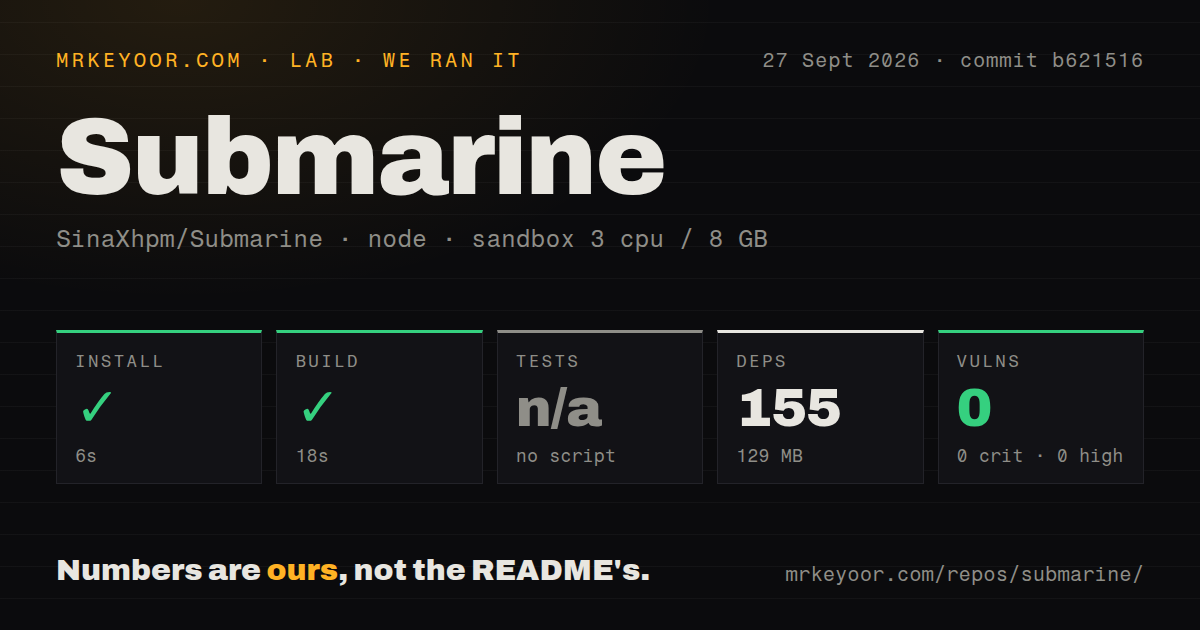
Our sandbox installed Submarine at commit b621516 in 6 seconds. Npm added 155 packages and used 129 MB on disk. The checkout held 197 files, roughly 37,533 lines of source, and 5.3 MB before dependencies. The build succeeded in 18 seconds inside an unprivileged container with 3 CPUs and 8 GB of RAM.
There was no test script or target, so we skipped tests. That is different from a passing suite. Npm audit reported 0 known vulnerabilities across all listed severity levels. Our test method covered the Node install and available build command; it did not open an SSH session, exercise the Rust connection layer, validate cryptography, or install the unsigned desktop packages.
The repository had 1 CI workflow file, no Dockerfile, and no tests directory in our checkout. A Dockerfile is not expected for a native desktop client, but the missing automated test target matters because the app handles credentials, remote file writes, tunnels, and container controls. The 18-second build proves that this commit compiles through the available path. It does not prove those operations behave correctly on every supported platform.
Hosted sync is encrypted, while self-hosting is still requested
Submarine says profiles are encrypted locally with Argon2id and AES-256-GCM before optional sync uploads them. The documented service stores the encrypted blob at api.sinaxhpm.com, and the README says there is no registration or password recovery flow. Cloud sync is optional, so a user can keep profiles local and use the client offline.
A company may still care who operates the storage endpoint, even when it receives ciphertext. Issue 12, opened September 26, 2026, asks for a self-hostable sync server so profiles can move between office and home devices without relying on the default service. That option is a request, not a documented feature. Organizations with that rule can leave sync off, but then cross-device profile delivery becomes their own process.
Existing SSH identity workflows can block adoption
Issue 2 gives a concrete incompatibility: one user could not try Submarine because their hosts depend on .ssh/config, 1Password through ssh-agent, and Teleport-generated certificate settings. The open request asks the app to reuse that configuration. If your fleet relies on agents, certificates, proxy rules, or generated host blocks, test one representative connection before moving saved profiles.
Platform gaps are also explicit. Android gets the shared vault, terminal, SFTP, and tunnels, but folder mirroring stays desktop-only. Issue 9 asks about iOS support, and issue 10 requests smartcard access through agents. These requests were open on September 26. Submarine fits password and file-key workflows described in its README better than enterprise identity setups that already depend on external agents or hardware.
September activity is brisk for a young project
GitHub listed 358 stars and 20 open issues and pull requests when fetched. The repository's last code push and v0.3.8 release both landed on August 22, 2026, while issues and pull requests were updated through September 26. That combination shows active users and current maintainer work, although the v0.x version and open integration requests still point to an early product.
Submarine earns a trial when its 7-in-1 workflow replaces real daily friction. Start with a disposable host, verify file transfers and key handling, and decide whether unsigned distribution fits your policy. The missing test target is the reason to stage that trial carefully. If ssh-agent reuse or self-hosted sync is non-negotiable, the open issues already answer the buying question: wait or choose another client.