QMK puts up to 32 layers inside the keyboard
QMK moves keyboard customization below the operating system. A keymap can define ordinary keys, layers, mouse controls, shortcuts, lighting, and code that runs on the controller. The result travels with the keyboard instead of depending on a desktop remapping app. That makes QMK a natural first stop for a supported wired custom board, especially when one layout must behave the same across several computers. It also means a change goes through a compile and flash cycle rather than a settings window.
The beginner guide allows up to 32 layers and accepts keymaps written in C or JSON. A typical flow sets a default keyboard, copies its default keymap, edits the layout, runs qmk compile, and flashes the generated .hex or .bin file. QMK can remove much of the bootloader guesswork when the keyboard definition is complete. If the board lacks a supported flash target, the user has to identify the bootloader and fall back to its specific procedure.
The 1,137.7 MB checkout is a hardware catalog as well as code
Our measured clone contained 41,795 files, about 10,026,165 lines of source, and occupied 1,137.7 MB before the installed Python environment. Much of QMK's practical value sits in that scale: the repository holds definitions and default keymaps for many community keyboards alongside shared firmware code and bundled libraries. You should search the keyboards tree for the exact model and revision, not assume that a familiar product name means every PCB revision shares a target.
The setup guide also draws firm platform lines. Windows users get QMK MSYS, macOS users install through Homebrew, and Linux users are steered toward Debian-family, Fedora-family, or Arch-family systems. The standard environment does not support musl-based Linux distributions. QMK Toolbox provides graphical flashing and debugging on Windows and macOS, while Linux users follow the command-line route. The toolchain is part of the product here because AVR, Arm, bootloader, and USB permissions all meet at flash time.
What happened when we ran it
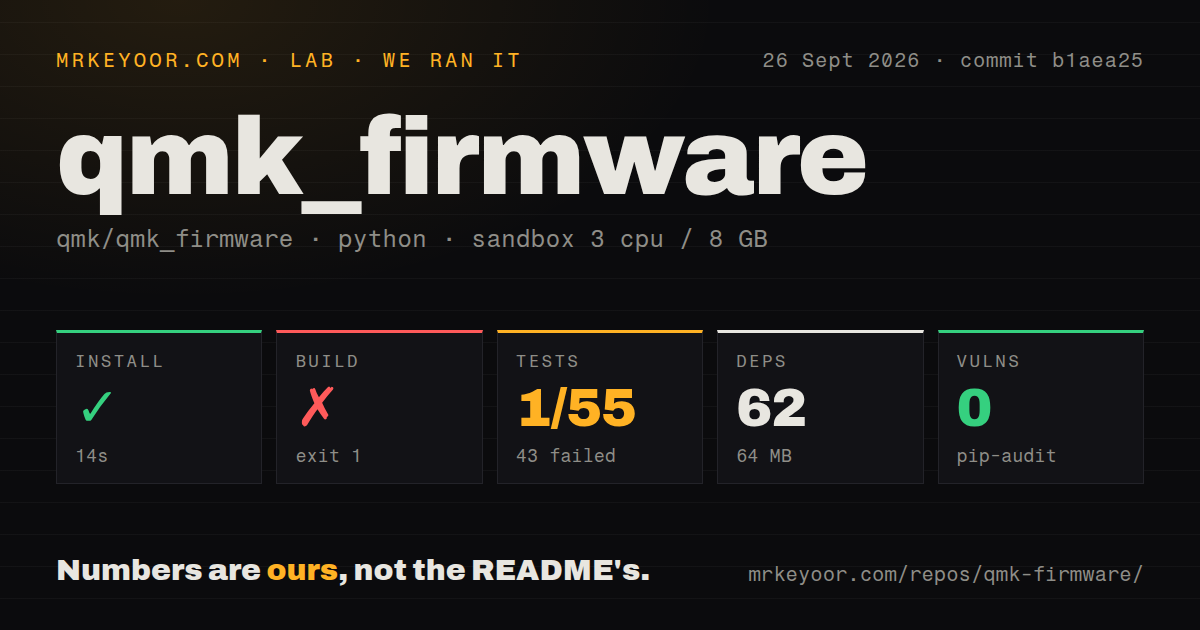
Our sandbox installed 62 packages in 14 seconds and used 64 MB for them. The build failed with exit code 1 after 1 second. Its final lines show invalid-escape SyntaxWarnings in LVGL release scripts and a Pico SDK workflow generator. The tail does not show the final error that made the command exit, so blaming those warnings would be speculation. The useful result is that commit b1aea25 did not build through our generic Python 3.12 Debian path.
Pytest also exited 1 after 15 seconds. It reported 1 passed, 43 failed, and 11 collection or setup errors out of 55. The visible failures repeatedly raise FileNotFoundError for an executable named qmk while testing CLI commands such as rules-file generation, JSON formatting, and keyboard search. The log proves that executable was unavailable to those tests; it does not tell us whether the cause was packaging, PATH configuration, or a missing setup step.
Pip-audit found 0 known vulnerabilities among the installed Python packages. The repository had 19 CI workflow files and a tests directory, but no Dockerfile. Those facts do not turn the failed local run into a pass. They point to the next attempt: use QMK's documented installer or maintained platform environment, run qmk doctor, then compile one known default keymap before modifying or flashing any hardware.
Flashing starts with the exact bootloader, not a generic USB command
The flashing guide lists several ways a keyboard may enter bootloader mode, from a key chord to a physical reset button or shorting reset and ground pins. It warns against unplugging the board while firmware is being written. QMK Toolbox can recognize some devices and choose the flasher, while qmk flash uses bootloader information from the keyboard definition. A missing or incorrect definition moves the recovery burden back to you, so save the known-good firmware and learn the reset path before changing the map.
Hardware-specific behavior deserves the same caution. Issue 26480 reports that split RGB lighting on one RP2040 Sofle build wrote LED colors outside the allocated array and corrupted the emulated EEPROM cache. The reporter tied the changing bytes to 4 LEDs and stopped the corruption with a bounds check. Issue 24675 discusses a different limit: code paths using 8-bit LED indexes cannot represent a 324-LED design without patches. Both reports concern unusual configurations, but firmware bugs can alter device state rather than merely crash a desktop process.
September 2026 activity matters more than the missing release page
GitHub recorded 20,730 stars, 548 open issues and pull requests, and a last push on September 26, 2026. The repository's latest-release API returned no GitHub release, so there is no current release page to cite. That absence is not evidence of abandonment. The push date and September issue discussions show current work, including a detailed report about combo timing and another about split-keyboard RGB memory writes.
QMK earns its place by supporting the messy reality of custom keyboards: many controllers, board revisions, bootloaders, and user-defined layouts in one tree. The cost is equally concrete. Our ordinary Python container could install its packages but could not build the checkout or run the CLI tests successfully. Start with QMK when your exact wired board is listed and you want firmware-level control. Start elsewhere when wireless power use, CircuitPython editing, or runtime remapping is the design's main constraint.