The source marks its own guesses, and readers should keep them marked
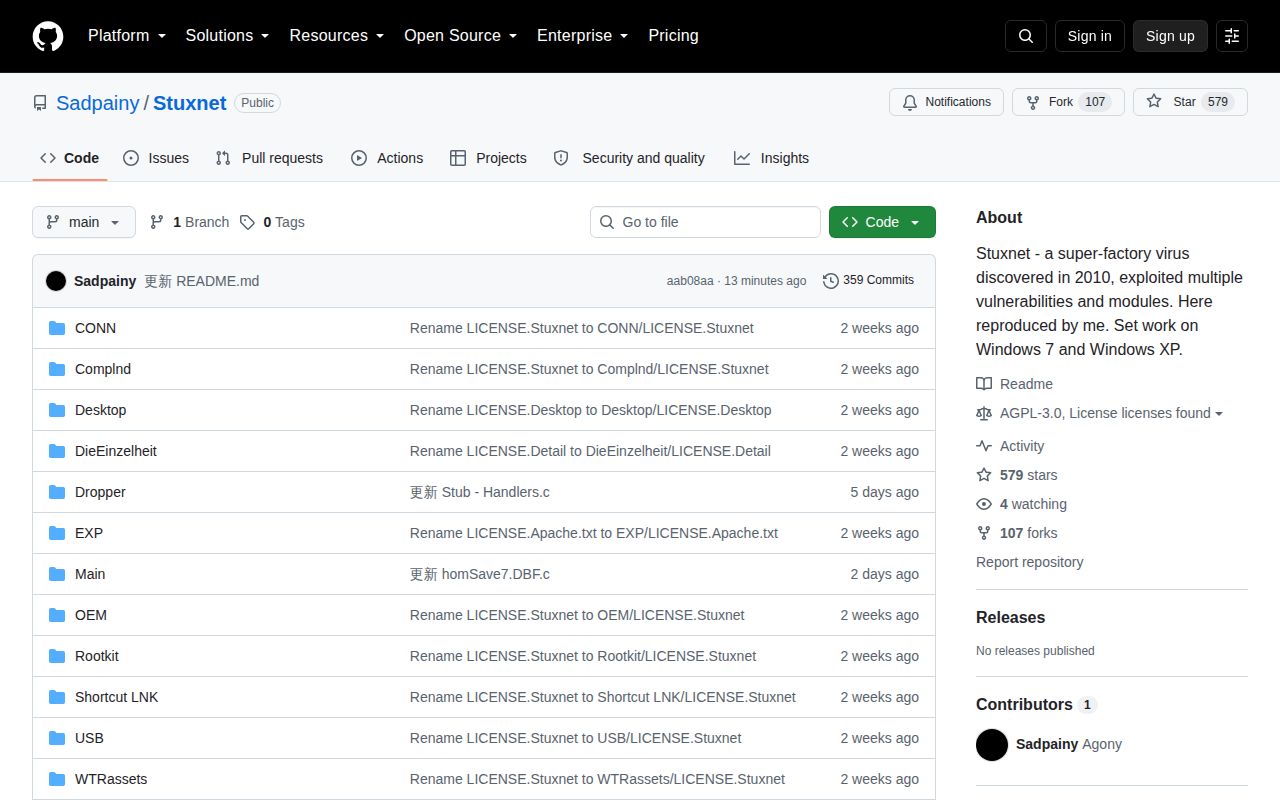
Stuxnet presents a C reconstruction of the worm discovered in 2010, arranged into directories for droppers, Windows rootkits, USB behavior, network components, and Siemens S7 hooks. That layout gives a student somewhere concrete to start. The important qualification appears inside the files themselves: this is reconstructed code, not the attackers' recovered development repository. Main/xyz.dll.c, for example, separates observations labeled TRUSTED from a MAYBE section that describes inferred decryption, loader, and configuration behavior.
That distinction should govern the whole reading. A plausible implementation can help you understand how a reflective loader or Step 7 project infection might work, yet it cannot prove that the original binary used the same routine. The repository's 579 stars do not change that evidentiary limit. Use the source as a set of hypotheses beside an authenticated sample and primary reports, never as the final record of what Stuxnet did.
The README's build command points to a file that is absent
The README says to enter Main and run nmake /f Makefile.win, then compile the S7 hook DLL with Microsoft's cl. The current repository tree contains C files in both locations, but Main/Makefile.win is missing and no other makefile appears in the tree. A reader following the quick start reaches a dead end before the compiler can settle any question about the code.
The remaining requirements are also specific: Visual Studio 2019 or 2022, or mingw-w64, Windows XP or 7 for driver compatibility, and WDK 7600 when compiling kernel drivers. Those details describe a specialized Windows research environment, not a normal C project setup. GitHub has no published release to provide a known binary or source snapshot. Reproducing the repository therefore means designing part of the build process yourself.
What happened when we ran it
Our lab did not run commit 9f4a5c9. The fresh Debian container had 3 CPUs, 8 GB of RAM, no secrets, and no elevated privileges, but the harness found no supported ecosystem definition and no Dockerfile. There was no declared install, build, or test route it could execute safely. We are not treating the README's Windows commands as a successful build.
That result says nothing about whether individual C files could compile after manual work. It does say the repository is not self-describing enough for our standard run. We have no lab test count, dependency audit, build duration, or executable behavior to report. Claims about those would be invented. The useful finding is the gap between a prominent passing-tests badge and the absence of a runnable path in our sandbox.
The code is useful for navigation, not provenance
The directory names form a study map. Rootkit holds files named for mrxcls.sys, mrxnet.sys, and jmidebs.sys; WTRassets contains C reconstructions for the temporary modules; s7 and s7otbxdx cover the Step 7 side. An included vulnerability note lists Windows and Siemens CVEs, while a large Symantec PDF supplies historical context inside the checkout. This organization can shorten the first hour of exploring a complicated incident.
Some files go well beyond annotation. They contain working-looking Windows API calls, PE parsing, registry operations, network behavior, and driver-shaped code. The README also says the reconstruction preserves original logic and attack vectors, a stronger claim than the per-file MAYBE labels can support on their own. A careful analyst should trace every bracketed source marker and compare important behavior with the cited report or a disassembly before relying on it.
The safe classroom is offline and disposable
The README recommends VMware or VirtualBox with host-only networking, internet access disabled, and analysis through tools such as Ghidra, x64dbg, ProcMon, and Wireshark. Follow that boundary. Even incomplete malware reconstruction can contain code you do not want on a workstation or a network that reaches production equipment. Windows XP and 7 also belong in a disposable lab, not on a shared office segment.
The project's AGPL-3.0 metadata does not settle every reuse question because the README names several license files, including AGPL, Apache, and component-specific texts. Anyone redistributing modified code should inspect which terms cover each directory. For study, the more immediate problem is attribution: reconstructed sections, decompiled observations, and inferred functions sit in the same files, so notes must preserve those labels.
An October 4 push shows activity, not verification
GitHub records the latest push on October 4, 2026, with 0 open issues or pull requests and no published release. Recent closed contributions corrected documentation grammar. That is current activity, but it does not show that the missing makefile was restored, the Windows build was reproduced, or the inferred routines were independently checked. Repository health here cannot be reduced to recency.
Stuxnet can be a useful index for experienced malware researchers because it names components and puts proposed C beside historical material. The absent build file and mixed certainty labels make it a poor first malware lab and a weak source for claims that need proof. Keep the code inert, keep the VM isolated, and let the original binaries and primary analyses decide what is true.