SQLBot packages ChatBI as a workspace application
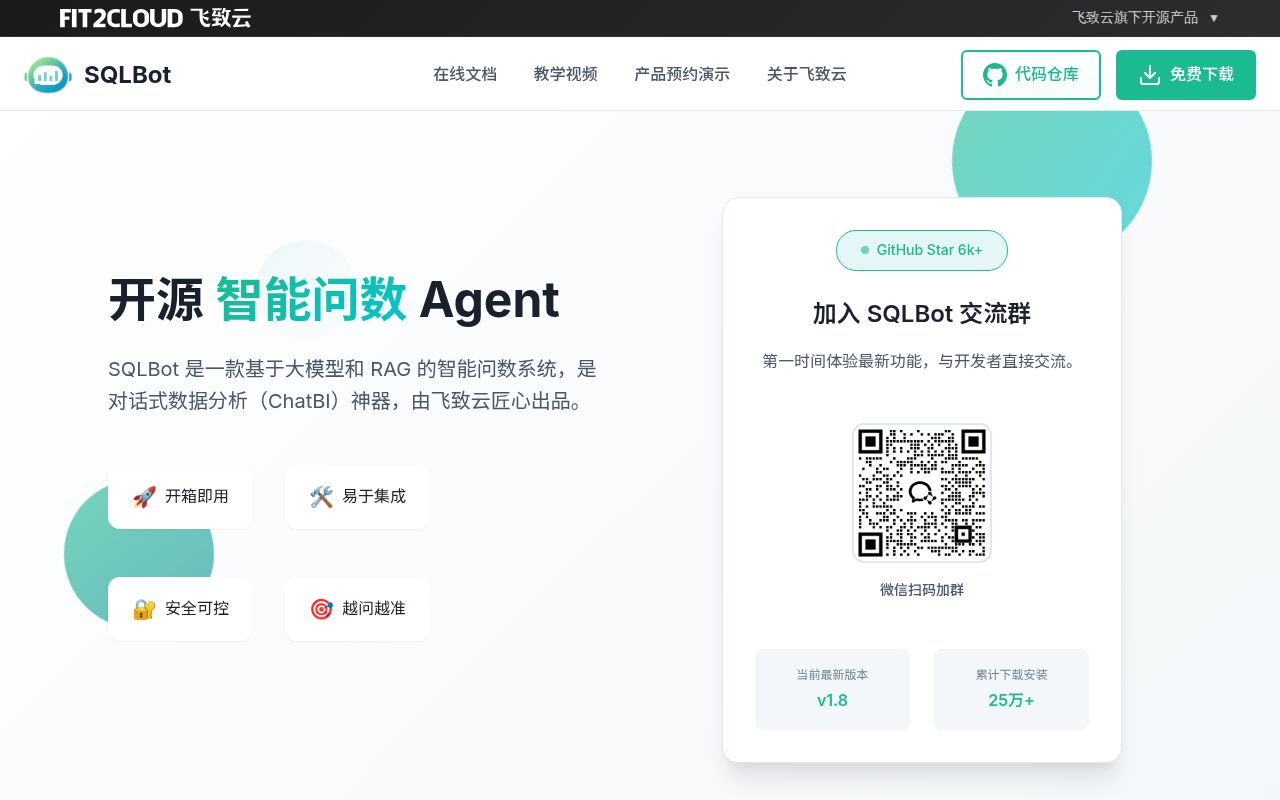
SQLBot gives non-specialists a chat box for asking questions of business databases. It uses a language model to produce SQL, returns tables and charts, and supports follow-up analysis. Administrators can add terminology, custom prompts, and known-good SQL examples to teach the system how their organization names metrics and tables. The product also has workspace isolation and data-permission controls, which puts it closer to an internal BI service than a developer library.
The measured repository supports that product scope. commit 59ca097 contained 940 files and about 87,817 lines of source, with the Python project under backend/. The checkout was 36 MB before installation. Web embedding, a pop-up interface, and MCP calls are documented integration paths, with n8n, Dify, MaxKB, and DataEase named as consumers. Teams can place SQLBot in front of analysts or expose its query flow to another automation system.
The official container asks for privileged mode
The English quick start tells operators to run one published Docker image with --privileged=true. That is convenient for a trial and awkward for a locked-down production environment. The command also maps the web and service ports directly to the host, persists application files and PostgreSQL data, and restarts the container unless stopped. Before deployment, an operator needs to decide which ports are reachable, where backups live, and whether the image can run with fewer privileges.
The initial interface is documented at port 8000, with a second mapping on 8001. Five host directories preserve spreadsheets, files, images, logs, and PostgreSQL data. The README publishes admin and SQLBot@123456 as the first login, so changing that credential and restricting network access belong in the first session. The repository has no Dockerfile even though it has 7 CI workflow files, which leaves the ready-made image as the documented installation route.
What happened when we ran it
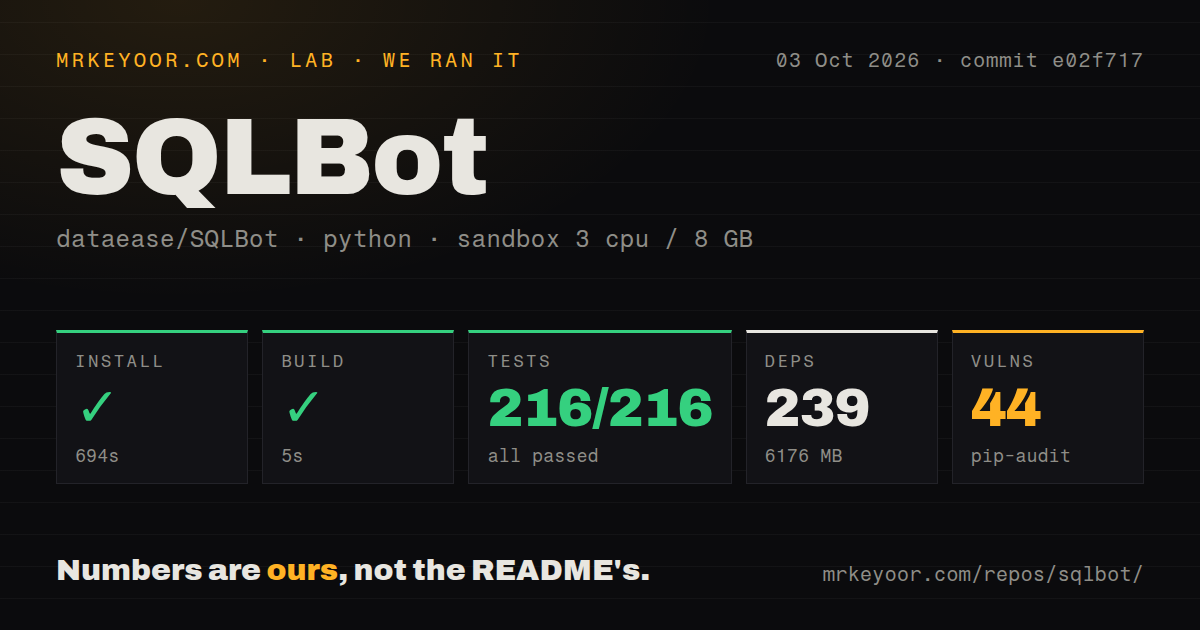
Our sandbox installed the backend at commit 59ca097 in 321 seconds. It pulled 241 packages and occupied 5,405 MB on disk inside a fresh Debian container with 3 CPUs and 8 GB of RAM. The build then succeeded in 11 seconds. Those numbers make the source build possible on modest compute, but the resulting Python environment is large enough to affect CI cache size, developer machines, and image rebuild time.
The test command failed with exit code 5 after 11 seconds. Pytest reported 0 passed and 0 failed because it collected 0 tests, and the final line was no tests ran in 0.06s. The repository has a tests directory, but the log gives no reason for the empty collection, so we will not invent one. Pip-audit found 30 known vulnerabilities in the installed environment. Each advisory needs package-level triage before this build handles production credentials or database access.
Version 1.10.0 fixed security bugs while one access report stays open
Release v1.10.0, published on July 16, lists fixes for SQL injection, prompt injection, privilege escalation, embedded-app security, row-permission escaping, and cross-workspace enumeration. That is meaningful maintenance in software that generates queries and sits near sensitive data. It is also a reason to keep releases current and test authorization at the API boundary instead of relying only on what the interface hides.
Open issue 1336, filed August 24, reports 2 export endpoints without the workspace-admin check used by their corresponding management pages. The report says an authenticated ordinary member can export training and terminology data from the current workspace. Issue 1291 raises another boundary: v1.10.0 reportedly sends the first 3 sample rows of matching tables to the configured model and lacks a setting to turn that off. Buyers with regulated data should verify both behaviors against the exact release they deploy.
The modified GPLv3 terms rule out white-label forks
SQLBot's license follows GPLv3 with added conditions. Its frontend logo and copyright information cannot be removed or modified, and contributors agree that their code may be used in the producer's commercial services. The README directs companies to a support address for commercial licensing. That may be acceptable for an internal deployment carrying SQLBot's identity. It does not fit a vendor intending to ship the interface under its own brand without a separate agreement.
Maintenance activity is current. GitHub showed 6,688 stars, 73 open issues, and 1 open pull request, and the last push was August 26, 2026. The latest tagged release was v1.10.0 from July 16. A current push and busy issue list point to an active project, while the open authorization report shows why activity cannot substitute for a local security review. The combined GitHub repository count was 74 issues and pull requests.
Choose SQLBot when a managed ChatBI workspace is the requirement
SQLBot makes sense when the desired outcome is a browser application with users, workspaces, permissions, charts, saved terminology, and several integration routes. Chat2DB is a better match for a developer-facing database workbench. WrenAI puts more emphasis on a governed semantic layer, while DB-GPT offers a wider data-agent framework. SQLBot's opinionated package saves product work, but it also brings its container, license, and authorization model with it.
Our 321-second install and successful 11-second build show that the backend can be assembled in a clean container. The 5,405 MB footprint, 0 collected tests, and 30 audit findings set the conditions for a responsible trial: isolate it, patch dependencies, add regression coverage, change the default login, and test every database role. Teams willing to do that work get a feature-filled ChatBI starting point. Teams seeking a small text-to-SQL component should pick a narrower project.