Put a local album and a Spotify track in the same queue
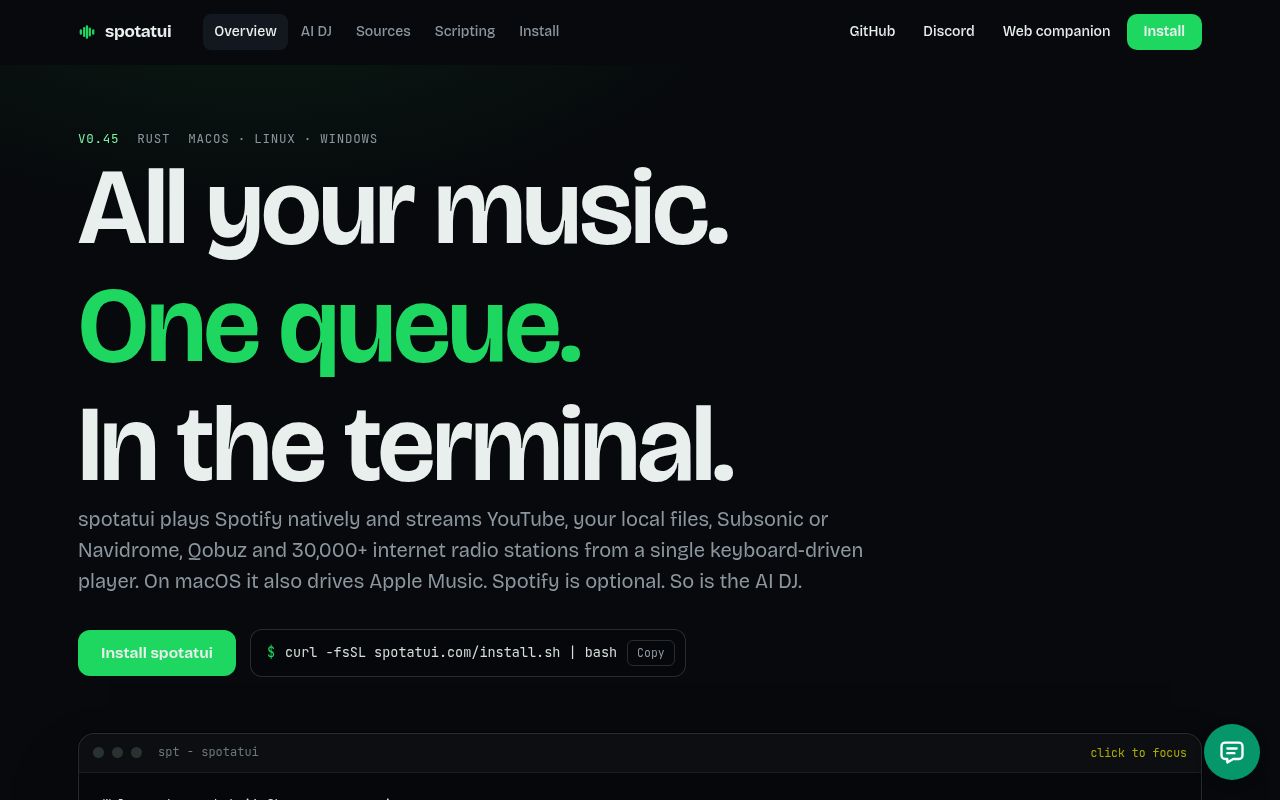
Spotatui lets you queue music from different sources inside a terminal player. That is its strongest reason to exist: your own files and a hosted catalog can share the listening session. The README lists Spotify alongside Subsonic/Navidrome, internet radio, YouTube, Qobuz, and Apple Music on macOS. Spotify playback uses a built-in client, so you do not need to keep Spotify's desktop application running as the audio engine.
The terminal interface is only part of the project now. Our checkout contained 667 files and roughly 188,584 source lines in 24.7 MB, and the repository also ships a desktop preview. For someone already living in a terminal, the appeal is direct: search with /, enter the Songs panel, and queue a track with z. The README documents that navigation explicitly. You can control playback without switching to a separate browser tab whenever the album ends.
What happened when we ran it
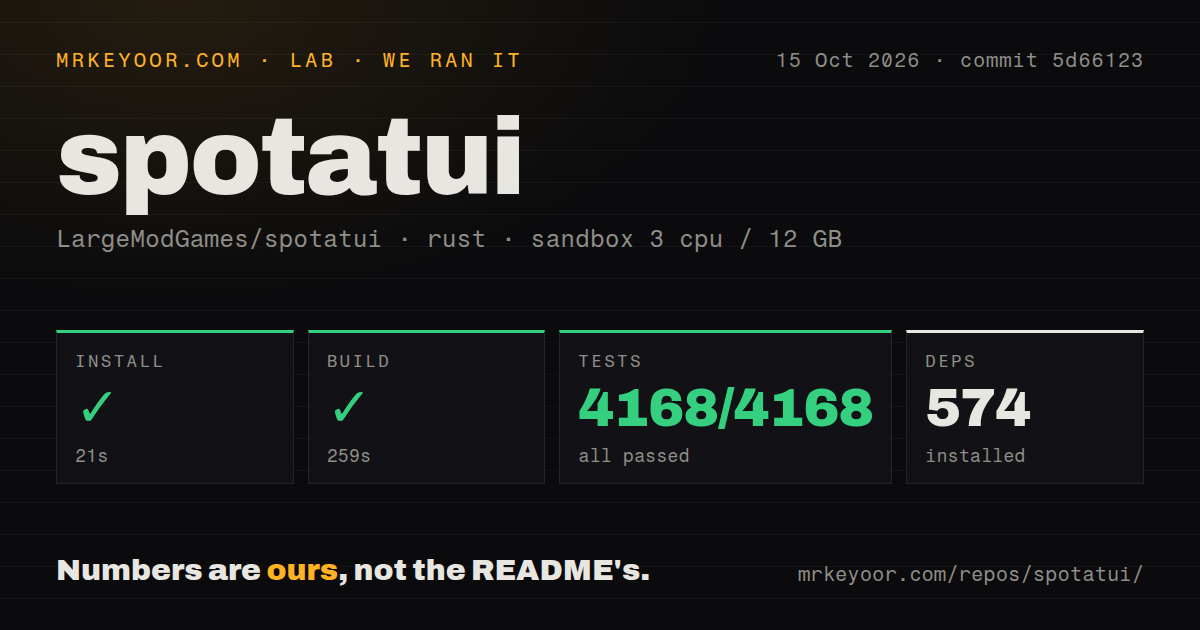
Our spotatui run installed 574 packages in 21 seconds, built successfully in 259 seconds, and passed all 4,168 tests in 94 seconds. The lab ran commit 5d66123 on October 15, 2026, in the lab-rust:1 image with 3 CPUs and 12 GB of RAM. The container was unprivileged and had no secrets. The recorded install, build, and test steps all completed successfully, which gives a prospective contributor useful evidence about that checkout.
The 4,168 passing tests do not establish that Spotify pairing or every audio backend worked in our sandbox. There were no account credentials in that run, and the measurements contain no listening-quality or service-compatibility result. Our scan found 9 CI workflow files, no Dockerfile, and no tests directory. A missing standalone directory plainly did not prevent Cargo from running tests. Directory names would have been a poor substitute for the command's actual result.
Release downloads include sources that default Cargo builds omit
The README says prebuilt terminal binaries include all sources, the MCP server, and the AI DJ. Plain cargo install and the Nix flake provide a Spotify-only default without album art. This difference can decide whether the app does the job you downloaded it for. A successful compile can leave a Navidrome user staring at the wrong source picker. The feature-selection instructions explain the required Cargo flags.
Our 259-second build is a measured contributor cost, not a reason every listener should compile the application. Use a release binary if you want the documented full feature set without managing Rust feature flags. If you need a source build, record those flags beside the version. Issue 819 described the installation-guide mismatch, and PR 860 closed it on October 15. The current guide now explains the difference. Treating that report as an unresolved defect would mislead readers.
Spotify still needs Premium, and other services have their own requirements
Spotify requires a Premium account even though spotatui removes the developer-app and client-ID setup. First launch presents a pairing code and opens Spotify's confirmation page. Local files need a music directory, Subsonic needs a server account, and Qobuz needs a paid account. YouTube relies on an external yt-dlp executable, with ffmpeg recommended. Apple Music works through the macOS Music app as a remote-control integration. Pick your source before deciding the setup is simple.
All 4,168 tests passed without secrets, but that cannot settle whether your subscription, server login, or selected output device will behave correctly. Try your actual daily queue before replacing an existing player. The mixed-source queue and playlist mirroring make spotatui more interesting than another Spotify skin, though each service retains its own access rules. A free Spotify listener gains a different interface, not a way around the subscription requirement.
The desktop preview has a narrower Linux baseline
The v0.46.0 release notes require glibc 2.39 and WebKitGTK 4.1 for the Linux desktop preview. They name Ubuntu 24.04 or newer and Debian 13 among the supported environments. Those requirements apply to the desktop app and should not be generalized to the terminal binary. The same notes say the Windows installer is unsigned and the macOS app is not notarized. That is enough to rule out the preview on some managed machines.
A passing 94-second Cargo test step is no evidence that the desktop preview works on an older workstation. The installation guide also says the desktop and terminal interfaces share settings and history, and only one runs at a time. Choose the terminal app for the keyboard workflow that brought you here. Adopt the preview only if its system requirements and shared-instance behavior fit how you intend to listen.
Agent control is optional, with an explicit socket setting
Spotatui exposes playback and listening history through MCP, allowing an existing coding agent to search and queue music. Its MCP guide requires the compiled feature and an opt-in control socket, enabled through behavior.mcp_enabled. The bridge talks to the running player over loopback TCP. A separate in-app AI DJ can use a configured agent or API backend. These are optional ways to operate the player, and the account behind the agent supplies its own usage allowance.
The project was pushed on October 15, 2026, a day after v0.46.0 shipped. GitHub listed 1,642 stars and 57 open issues and PRs combined, while recent activity included documentation fixes and an open request to pin playlists. That combination supports trying a maintained player, with account and packaging checks still required. For terminal users with music spread across services, start with the release binary and put your real queue through it.