It is a speech research platform, not a transcription utility
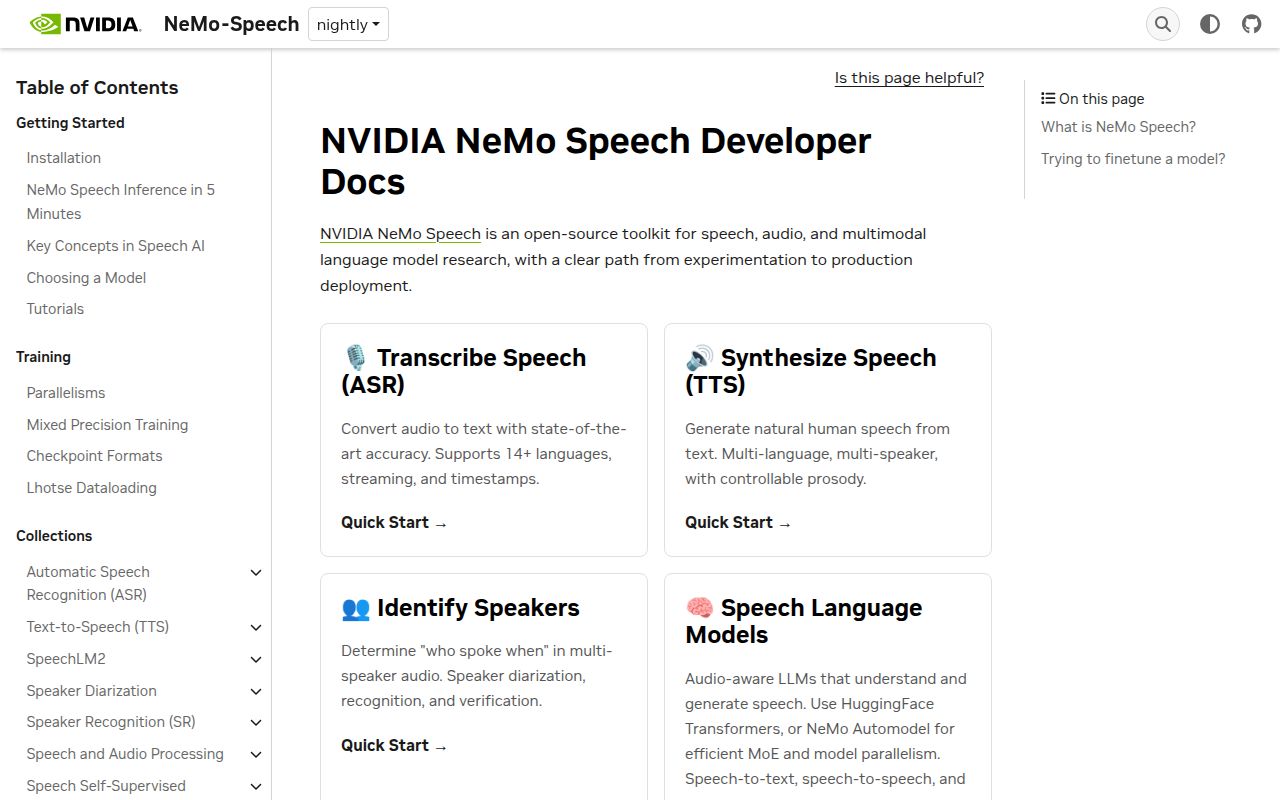
NVIDIA NeMo Speech is best understood as infrastructure for people building speech models, not as a small library that turns an audio file into text. Its scope covers automatic speech recognition, text-to-speech, and speech-focused language models, with PyTorch code and pretrained checkpoints serving as the common foundation. That breadth solves a real organizational problem: a speech team can train, customize, and deploy several related model families without maintaining unrelated toolchains for every task.
The 3.0.0 release also marks a clearer identity after the wider NeMo repository split. The README says this repository now focuses on audio, speech, and multimodal LLMs, while v2.7.3 was the final pre-split release covering additional modalities. That narrower boundary is useful, but existing NeMo users should treat the split as a migration event and verify that older workflows still map cleanly to the new package and documentation structure.
The strongest case is breadth backed by current checkpoints
The project is unusually specific about what its current speech stack can do. Its July 2026 MagpieTTS release lists 12 languages, including Arabic, Korean, Portuguese, English, Spanish, German, French, Vietnamese, Italian, Chinese, Hindi, and Japanese. The June Nemotron-3.5-ASR-Streaming-0.6B release claims 40-language support and controllable latency from 80 ms to 1 second. Those are publisher claims rather than results from our box, but they show that the repository is tied to maintained checkpoints rather than being only a framework shell.
There is useful range within individual models, too. Parakeet-unified-en-0.6b combines offline and streaming English inference in one model, with punctuation and capitalization support, while Nemotron 3 VoiceChat targets full-duplex, interruptible conversation. The README links directly to Hugging Face collections, demos, release documentation, and NGC containers. For a team evaluating capabilities, those direct paths reduce the distance between reading about a model and finding its checkpoint or supported runtime.
What happened when we ran it
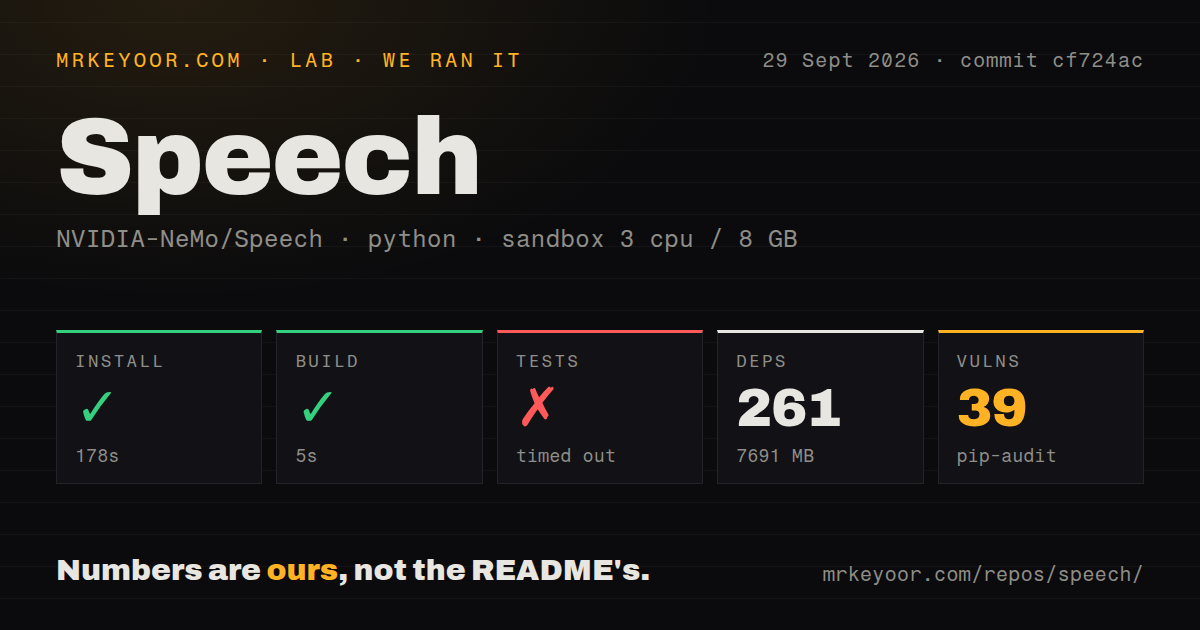
Our run used commit 3998328 in an unprivileged Debian container with 3 CPUs and 8 GB of RAM. Installation succeeded in 297 seconds and pulled in 257 packages, leaving a 7,023 MB environment on disk. The build then succeeded in 9 seconds. Those results prove the source can install and build in a clean, constrained environment, but they also show a substantial storage and dependency bill that the short uv sync example does not communicate.
Testing was not cleanly resolved. The suite hit our 900-second cap at 17% completion, so we cannot claim that it passes. The last log lines showed many skipped tests and nine failures in tests/collections/asr/test_asr_exportables.py, while nearby ASR classification and dataset tests had made progress. The log does not identify the cause, and we will not guess. For buyers, the practical finding is that validation needs more time and possibly environment-specific investigation.
The repository itself is large: 2,416 files, about 474,626 lines of source, and a 136.1 MB checkout in our measurement. Pip-audit reported 2 known vulnerabilities. That does not establish whether either issue is exploitable in your use case, but it does mean security review cannot stop at the Apache-2.0 license or the CodeQL badge. Pin dependencies, inspect the audit details, and decide whether your deployment path includes the affected components.
Setup is reproducible, but not lightweight
The README's installation guidance is better than average for a CUDA-heavy ML project. It recommends uv, commits a lockfile, separates CUDA 12 and CUDA 13 extras, and explains how to reproduce the exact container baseline with Python 3.13. It also supports installing over an existing Python, PyTorch, and CUDA environment instead of replacing that stack. This flexibility is valuable for teams already operating GPU images with strict compatibility requirements.
The minimums are still demanding: Python 3.12 and PyTorch 2.7 or newer, with an NVIDIA GPU plus CUDA required for training and recommended for inference. The documented tested combinations include PyTorch 2.11 with CUDA 12.9 and PyTorch 2.12 with CUDA 13.2. The warning about setting TORCH_FORCE_NO_WEIGHTS_ONLY_LOAD=1 for some checkpoints is candid and necessary, because loading untrusted non-weight objects can permit arbitrary code execution.
Activity is high, but issue volume demands triage
This is plainly an active project. The repository was pushed on August 26, 2026, the same day as this review, and v3.0.0 was released on August 7. The README records a steady run of checkpoint news through 2026 rather than a single launch burst. With 18,336 stars and 27 CI workflow files in our clone, NeMo Speech has both adoption signals and visible engineering machinery behind it.
There are 286 open issues, which is meaningful even for a project of this size. That number is not proof of neglect when weighed against the same-day push and recent release, but adopters should search issues for their exact GPU, CUDA, export, and checkpoint combination before committing. The repository has a tests directory and active automation, yet our 900-second timeout illustrates how expensive it can be for an outside team to reproduce the maintainers' confidence locally.
It belongs inside an established GPU platform
In a real stack, NeMo Speech fits behind data preparation, experiment tracking, model storage, and an existing deployment gateway. Training teams can use it to adapt ASR or TTS checkpoints, then package selected artifacts through NVIDIA's documented container path or their own controlled image. Keep application authentication, request limits, observability, and user-facing APIs outside the framework; NeMo Speech supplies model engineering capability, not a complete product control plane.
Choose it when one team genuinely needs multiple speech disciplines and has the GPU operations skill to support them. For a single transcription feature, openai/whisper is easier to reason about. For research recipes across many speech tasks, ESPnet or SpeechBrain deserves comparison, and for a TTS-only program, Coqui TTS is more focused. NeMo Speech earns its complexity when its broad model surface will actually be used.