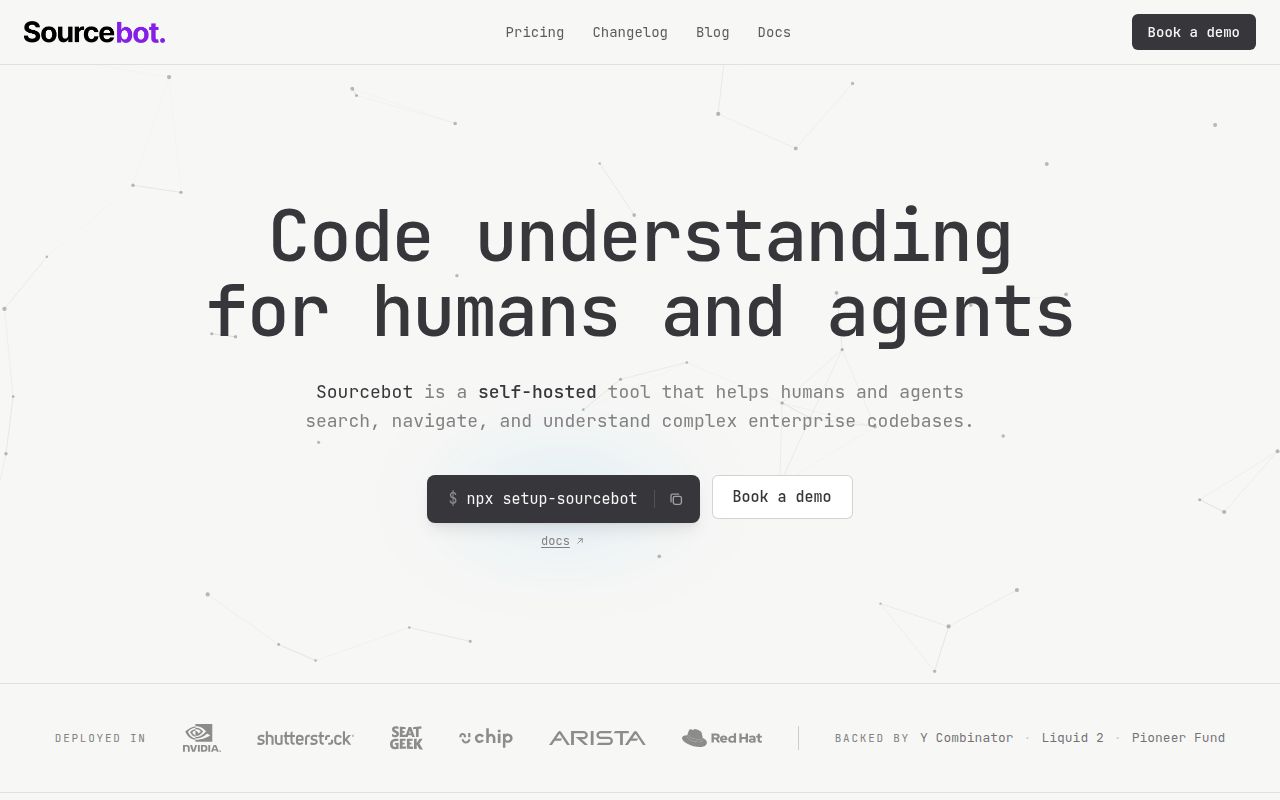
Current Sourcebot development is closed source
Sourcebot v6.0.0 changes the purchase decision before you type a search query. You can still host the product yourself, but you cannot inspect its current development in this public repository. The maintainer's October 8 announcement says future development moves into a private repository while earlier releases remain public. For a team choosing tools on the strength of accessible source, that boundary deserves more attention than the screenshots.
The product addresses a useful problem: an agent working in one service often needs the implementation of another. Sourcebot indexes repositories so people and agents can search them without checking out every dependency. Its README connects GitHub, GitLab, Bitbucket, Azure DevOps, and local Git directories. That makes it relevant to a company with code scattered across hosts, provided the company accepts the distribution and access conditions of the current product.
Code search exposes files and symbols through MCP
The README documents regular expressions, boolean queries, and filters for repository, file, language, or symbol definition. An engineer tracing an API can narrow a query before opening the matching source. The MCP server exposes code search, file reading, and symbol definitions and references to clients including Claude Code. Those are specific retrieval operations, so an agent can fetch the code needed for a question rather than depend entirely on its local checkout.
The v6.0.0 release also adds a Knowledge Base of generated architecture documents with citations for selected repositories. That is useful documentation to examine, not proof that the generated explanation is correct. The attraction is the link back to source: you can inspect the implementation after reading the answer. We have no measured retrieval accuracy, indexing throughput, or answer-quality result, and the documented interface alone cannot establish any of them.
What happened when we ran it
Our October 14, 2026 sandbox did not run commit a5a2930: the harness reported no supported ecosystem for a checkout classified as Python and found no Dockerfile. The sandbox had 3 CPUs and 8 GB of RAM, ran without elevated privileges, and contained no secrets. No installation, build, or test command produced a result. This is a limitation of the attempted lab path, and it is not evidence that Sourcebot itself fails to start.
The supplied measurement gives no application error log to interpret. It supports neither a setup-time estimate nor a passing-suite claim. A fresh Debian container also says nothing about search relevance or whether permissions behave correctly for a real organization. Those questions remain unmeasured here. Anyone evaluating the product should distinguish the documented deployment instructions from successful execution on their own infrastructure before granting it access to private code.
The wizard depends on Docker and a configured provider
The current README recommends Node.js 24 LTS alongside Docker and Docker Compose. Its setup wizard asks which repositories to index, optionally configures a model provider, writes configuration files, and starts Sourcebot. Manual Compose and Helm routes are also linked. This is a service to operate, with repository access and configuration to maintain, rather than a search command you run against the current folder and then forget.
Ask Sourcebot uses a language model provider you configure with your own key. Keeping the search service on your server does not by itself keep the code sent to that provider on your server. The README says the provider choice controls where code goes. Before connecting sensitive repositories, decide which provider is acceptable and inspect its data handling. Basic search and model-assisted answers should have separate approval decisions inside your organization.
v6 removes anonymous access and changes activation
The v6.0.0 release notes require owner registration and activation for every deployment, including the free Basic plan with five seats. They also remove anonymous access and require pre-v6 offline license keys to be reissued. These conditions can disqualify an otherwise suitable search service for a public browsing installation or an environment whose procurement rules require independent control over the deployed software.
Permission syncing is documented as following the code host's repository permissions. That matters when one index includes code with different audiences. It still needs evaluation with actual accounts and repositories before rollout. Ask connectors can also access external applications with your permissions and take actions such as creating a Linear or Jira issue. A team enabling those connectors is authorizing more than read-only code search, and should choose access accordingly.
October activity shows maintenance, with less public visibility ahead
GitHub reported a last push of October 10, 2026, with 3,991 stars and 96 open issues and PRs. The recent activity included a login-redirect fix updated on October 13 and a closed pull request documenting the source closure. That is evidence of recent work, not abandonment. It also changes what the public activity can tell you: future private development will not have the same visibility as the older application commits.
Choose Sourcebot when cross-repository context justifies maintaining a shared service and accepting its vendor terms. Choose Zoekt when indexed search is the main requirement and you want responsibility for the search layer yourself. For local searching, codespelunker's CLI and MCP interfaces deserve a look. If the reason you opened this page was to find a current application you could audit and patch, Sourcebot's preserved older code does not answer that requirement.