Contract authors usually need a released compiler
To compile a contract, you don't normally need to work inside Solidity's C++ source tree. The README points beginners to Remix, a browser editor, while the installation guide offers standalone compilers and JavaScript bindings. This repository is most useful when you need to inspect how Solidity translates a contract, reproduce a compiler problem, or change that translation. Choosing the source checkout adds an engineering job before your own application work starts.
Our checkout contained 17,468 files and roughly 738,884 source lines, occupying 64.7 MB. That scale is reasonable for a compiler with supporting documentation and regression material, but it's a poor starting point for someone who simply wants to write a token contract. I'd use a released compiler through an application toolchain first. Open this repository when a specific compiler behavior demands investigation or your product needs an integration beyond those packaged routes.
What happened when we ran it
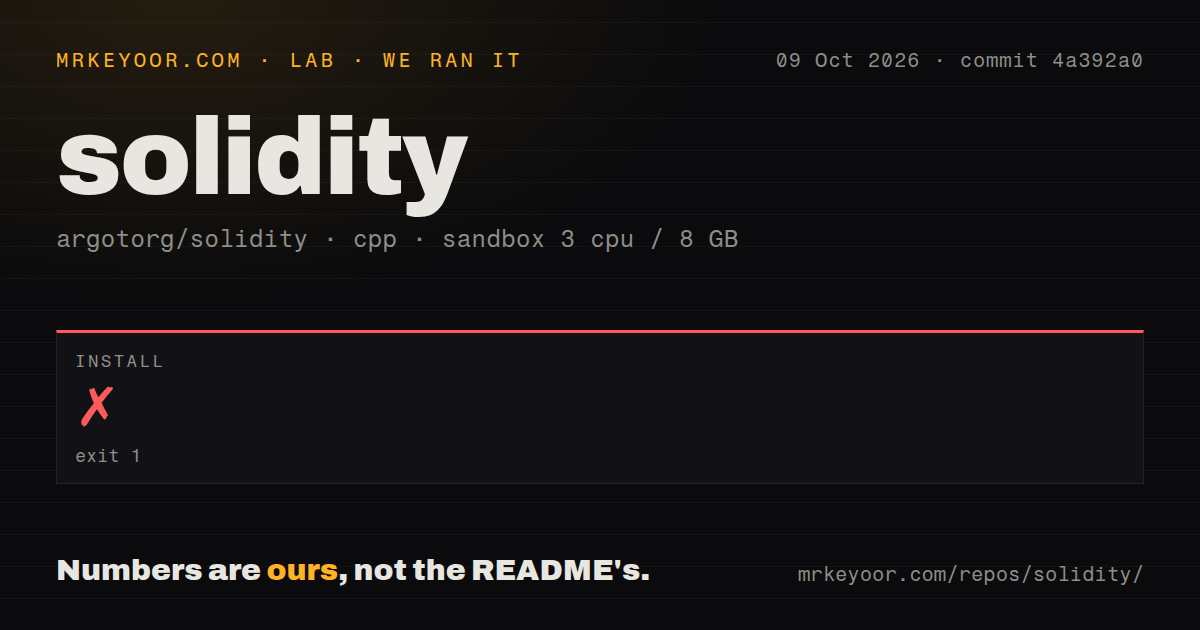
Our run of commit 4a392a0 failed during installation after 1 second, with exit code 1. We cloned it on October 9, 2026, into an unprivileged Debian sandbox using the lab-cpp:1 image, with 3 CPUs and 8 GB of RAM and no secrets. CMake stopped during configuration. The supplied measurement contains no build or test result, so this run supports a setup finding rather than a judgment about compilation speed or compiler correctness.
CMake reported that it could not find Boost, including Boost_INCLUDE_DIR and the filesystem, unit_test_framework, and program_options components. The required minimum was 1.83.0. The call stack points through FindBoost and the repository's EthDependencies file, then ends with configuration incomplete. That's a named dependency failure. It doesn't tell us whether installing Boost would expose another requirement, and it doesn't establish that a correctly provisioned environment would fail.
The sandbox scan found 3 CI workflow files, a tests directory, and no Dockerfile. Those signals show that upstream checking material exists, but they cannot replace a completed local run. Our harness never reached a reported build or test outcome. The immediate next step for a source contributor is to supply the documented Boost development components and repeat configuration, preserving the exact compiler revision and toolchain used.
Boost is documented beyond the short README
The source-build guide lists Boost alongside CMake, Git, and a suitable C++ compiler. The README delegates setup details to that page rather than spelling them out inline. That's an extra click with consequences: a generic C++ container does not promise the library set this repository expects. Our failure is an example of that dependency boundary, not evidence that the project concealed it.
Boost 1.83.0 is the floor named in our failing log. Treat that version and the requested components as environment requirements, rather than assuming any distribution package with Boost in its name will satisfy configuration. The guide also discusses an optional Z3 solver for the SMTChecker, a feature that reasons about contract properties. A source environment should record whether that solver is present, since changing the environment changes which compiler capabilities you can investigate.
Tooling must read errors inside the JSON output
The compiler interface guide recommends standard JSON input and output for automated integrations. It has a consequential detail: compiler errors are reported in the output even when the process terminates successfully. A wrapper that treats process exit status as the whole answer can mistake rejected contract code for successful work. Inspect the error entries and requested artifacts before accepting a compilation result.
Our 1-second failure happened earlier, inside CMake, and says nothing about this interface's behavior. Once you have a compiler, reproducibility also involves the selected EVM target and optimizer settings, both exposed by the JSON interface. Keep those settings with the compiler revision and source inputs. A shared library receiving identical contract text through different configurations is not necessarily producing the same deployment artifact.
Release notes can change the compiler you should trust
Release v0.8.37, published September 10, 2026, documents code-generation fixes affecting memory-byte deletion and custom-error parameter ordering. It also fixes overlapping memory slots for mutually recursive functions in the optimizer. These concern emitted program behavior. For a contract team, reading whether a fix touches its source patterns is more useful than treating a successful compilation as proof that every earlier compiler version was suitable.
The 64.7 MB source checkout isn't the only way to obtain the compiler. The documentation offers packaged routes and specifically directs anyone rebuilding a released compiler to the project's release source tarball, rather than GitHub's generic source archive. That's a practical reproducibility detail. The repository uses GPL-3.0, which also deserves attention if you intend to distribute a modified compiler or incorporate its code into another product. The README points out separate terms for some included code.
October activity supports maintenance, not a green local run
The repository's last push was October 9, 2026, and its open issue and PR queue showed updates through October 11. GitHub reported 837 open issues and PRs. Recent changes concern compiler internals, including calldata handling and intermediate-representation work. Together with the September release, that supports an actively maintained project. The queue count alone cannot tell you how many unresolved defects affect your contracts.
For application work, use Foundry when you need a contract workflow around the compiler, or solc-js when a JavaScript integration is the requirement. Neither is a replacement language compiler implementation, and neither alternative was measured here. I'd take ownership of Solidity's source environment only for compiler contributions, detailed debugging, or an integration that needs it. Start that decision with the concrete obstacle our run found: the checkout couldn't configure without its required Boost components.