
Seventeen Chinese books are preserved as editable sources
The repository contains 17 Chinese-language books covering algebra, geometry, trigonometry, physics, and chemistry. Its main README and maintenance documents are in Chinese, and the catalog marks the ebook language as zh-CN; no English README is present. Each volume has normalized Markdown, while the repository also keeps the original scans and image assets. This is useful for reading, correction, and ebook production, rather than as a translated course for English-speaking students.
The README inventory claims 5,927 scanned pages, 4,875 image assets, 4,878 image references, and 88,653 MathML elements in verified EPUB output. It reports 0 missing or orphaned assets and 0 empty image descriptions. Those figures describe the project's own content audit, not our sandbox. They show the sort of structural checks the scripts perform and the scale of the material a maintainer must inspect when a correction crosses formats.
What happened when we ran it
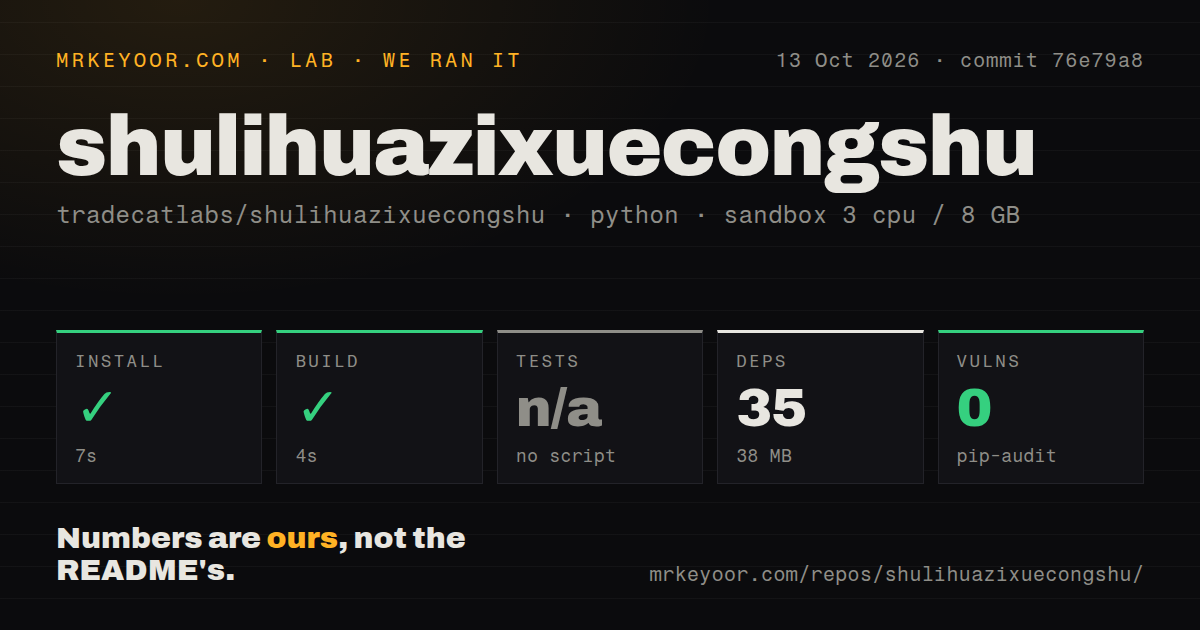
Our measurement setup used commit 76e79a8 in an unprivileged Python 3.12 container with 3 CPUs, 8 GB of RAM, and no secrets. Installation succeeded in 14 seconds, adding 35 packages and consuming 37 MB on disk. The build then succeeded in 7 seconds. For a collection that also ships large scans and thousands of images, the tooling itself was quick to prepare on our box.
The lab found no test script or test target, so it skipped tests rather than inventing a command. Pip-audit reported 0 known vulnerabilities in the installed packages. That audit is reassuring within its narrow scope, but it is not a correctness test for formulas, OCR, page order, image placement, or EPUB navigation. Our scan also found 0 CI workflow files and no tests directory, which leaves the documented Make targets as the visible quality gate.
The 154.8 MB checkout is mostly books and images
We measured 4,935 files and about 2,066 lines of source in a 154.8 MB checkout. The unusual ratio makes sense: 17 raw PDFs and 4,875 images occupy far more space than the Python scripts. Developers looking only for a reusable EPUB builder are taking on the full archive. Readers who want the books may appreciate that bundling because the scans, Markdown, figures, hashes, and catalog stay together for comparison.
The standard path requires Python 3.10 or newer and Pandoc 3.1 or newer, with GNU Make listed as optional. A deeper PDF audit adds PyPDF2 3.x, qpdf, Poppler commands, and ExifTool. The repository has no Dockerfile, so those system tools are your responsibility. No service account or API key is needed for the local build. Generated EPUBs, intermediate files, and JSON reports are excluded from version control and rebuilt through the Make targets.
Four blank scan pages were restored from another source
The known-issues note says pages 49, 50, 55, and 56 of the original solid-geometry scan remain blank. The Markdown and EPUB restore that material from another scan, using neighboring text, printed page numbers, exercise numbering, and figure sequences to map the replacement. The raw PDF is left unchanged so its bytes remain verifiable. Readers get repaired content while auditors can still see the defect in the archived source.
The provenance record gives more detail than most ebook repositories. It identifies the alternate scan, hashes both PDFs, describes OCR at 96 DPI, and says the restored pages were checked against page images. Issue 2 supplied the alternate source and closed the next day. This does not make transcription errors impossible. It does make one consequential repair traceable, including why the replacement scan's page numbers were not copied directly into the normalized text.
Release v2.4.0 ships three combined EPUBs
Release v2.4.0 was published on August 30, 2026. Its notes describe normalizing 7,433 high-confidence traditional characters, 423 Japanese or old glyph forms, and 2 context-dependent uses of 反覆, while checking 7 uncommon contexts against the PDFs. The original scans and images stayed unchanged. This is careful editorial work, but a Chinese reader should still compare suspect formulas or wording with the page image before citing the reconstructed edition.
Since v2.0.0, releases contain 3 combined EPUBs, one each for mathematics, physics, and chemistry. The 17 individual Markdown sources and local per-volume build remain in the repository. More important, the rights statement grants no new copyright license for the original writing, page design, or scans. Personal study, preservation, public hosting, and commercial redistribution can have different legal outcomes. The repository tells users to determine the status that applies in their jurisdiction.
The first five days show work, not long-term maintenance
GitHub says the repository was created on August 27, 2026, released v2.4.0 on August 30, and was last pushed on September 1. It had 872 stars, 163 forks, and 0 open issues when fetched. Both recorded issues were closed on August 30, one for Markdown compatibility and one for the missing solid-geometry pages. That is prompt early activity, but five days between creation and last push is too little history for a durability claim.
The 14-second install and 7-second build make this archive easy to try if you already read Chinese and have Pandoc available. Its better qualities are specific: fixed raw hashes, documented corrections, editable sources, and reproducible EPUB tooling. The weak points are just as specific: 154.8 MB of material, no automated test target or CI, no English guide, and no new rights grant. Keep the scans beside the rebuilt text and treat redistribution as a separate decision.