The displayed count can be 2 to 3 days old
Return YouTube Dislike replaces the missing public dislike number with its own estimate. The service uses archived counts where available, then combines them with likes and dislikes submitted by extension users. For newer videos, its FAQ describes a ratio based on Return YouTube Dislike voters and YouTube's public like count. That can help identify an unhelpful tutorial, but it is not access to YouTube's private number.
Freshness has a stated limit. The FAQ says video values are cached and may update only once every 2 to 3 days. A fast-moving controversy can therefore show an older estimate, and a small or unusual audience may not resemble the extension's voters. The project says the result will never be 100 percent accurate. Read the number as a community sample, preferably beside likes, views, comments, and upload date.
Version 4.0.6 keeps core counts account-free
The extension is published for Chrome and Firefox, with a JavaScript userscript for other browsers. Release v4.0.6 says core dislike counts still work without signing in. Optional premium analytics can use Patreon or GitHub login, and the release tightened Firefox consent checks before account traffic begins. That separation is welcome: a viewer who only wants the missing number does not have to attach a social or payment account.
Privacy still involves a server. The security FAQ says count requests send the current video ID and, when available, the visible like count. Network requests expose the public IP address and request time. Voting adds a persistent random installation ID, the chosen vote, a timestamp, and an address retained for abuse prevention. Version 4.0.6 also documents what optional account data is stored and says signing out clears those account details from the extension.
What happened when we ran it
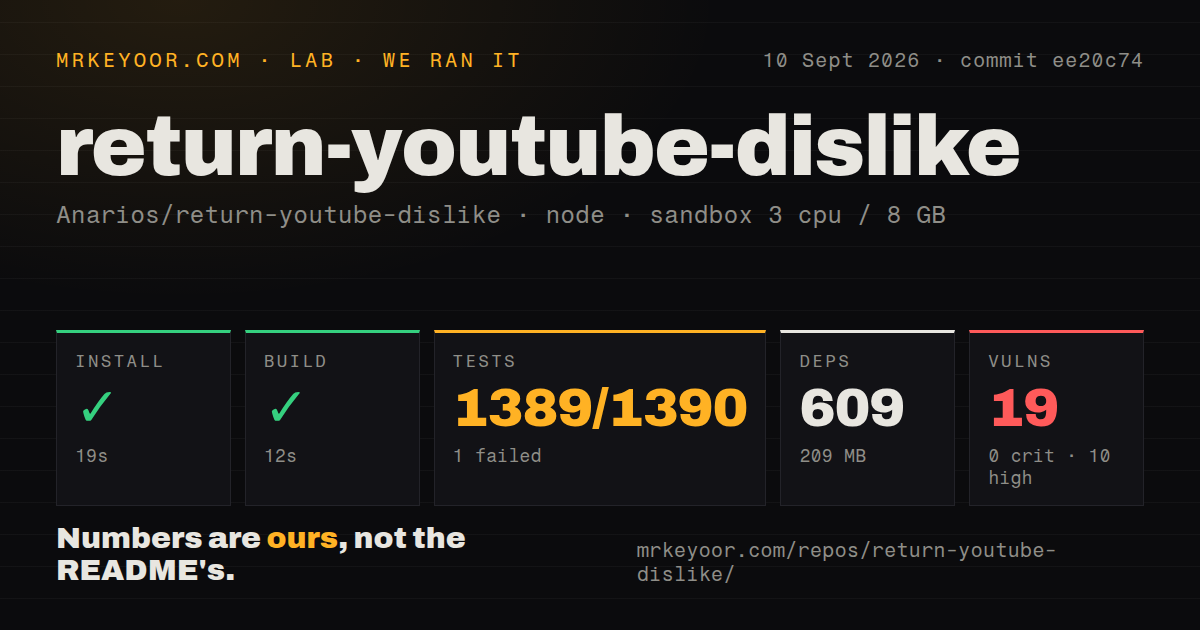
Our sandbox installed commit ee20c74 in 19 seconds, pulling 609 packages and occupying 209 MB. The production build completed in 12 seconds. The checkout itself had 457 files, roughly 72,143 source lines, and used 6.6 MB before dependencies. Those results came from an unprivileged Node 22 container with 3 CPUs and 8 GB of RAM, without secrets.
The test command failed after 32 seconds. Jest reported 1,389 passed and 1 failed out of 1,390 tests, across 71 suites. The only failed suite was Extensions/UserScript/live/live-youtube-driver.spec.js; the provided log tail names that file but does not show the failed assertion or its cause. The narrow finding is that almost all tests passed while the live YouTube driver did not pass in our fresh sandbox.
Npm audit found 10 high-severity findings
Our npm audit counted 19 known vulnerabilities in the installed dependency tree: 10 high, 8 moderate, 1 low, and 0 critical. The log supplied to us does not map those findings to production or development code, so we cannot claim that installing the store extension exposes all 19. A developer building a fork should inspect the full audit, determine which packages enter shipped bundles, and update or isolate the affected paths.
The 609-package install is much larger than the five runtime dependencies listed in package.json because the repository includes Webpack, Jest, Playwright, browser packaging, and other development tooling. The current manifest requires Node 22.17.0 and npm 10.8.2. The contributing guide at the measured commit still names Node 12.18.4 and npm 6.14.6, so contributors should trust the enforced package metadata over that older prose.
Three CI workflows do not stop YouTube page breakage
The repository contains 3 CI workflow files, a production build, Jest coverage, artifact checks, Playwright paths, and live YouTube commands. There is no Dockerfile, which is unsurprising for a browser extension. There is also no top-level tests directory because test files sit beside extension code. The 1,390 discovered tests are stronger evidence than a folder-name signal, even though one live-facing case failed for us.
YouTube can change the page underneath every extension release. Open issue 1074 describes some Chrome pages freezing with the extension enabled and has accumulated 53 comments. Issue 1305 reports a userscript failing after a mobile YouTube layout change. Both reports concern older extension versions or particular browsers, so they do not prove v4.0.6 fails everywhere. They do show the maintenance cost of attaching controls to a site the project does not own.
A September release and 234 open items show heavy use
GitHub lists 13,764 stars and 234 open issues and pull requests. The latest release, v4.0.6, and the last push both landed on September 7, 2026. Recent caption and Firefox-consent reports were closed in September, while translation pull requests and display bugs were still moving. This is an active project with a large support surface, not a dormant extension surviving on its original 2021 idea.
Distribution can lag behind source. Open issue 1288 says the official Firefox listing was out of date and has 46 comments, while issue 1067 requests ordinary Safari distribution because current Safari users may need to build, convert, and sign the extension themselves. Before recommending it across a company, verify the version in each browser store. API users should also design around the documented ceilings of 100 requests per minute and 10,000 per day.
Choose a full alternative client only if one metric is not enough
Return YouTube Dislike does one job with less disruption than replacing YouTube. Its 209 MB development install produces a browser add-on that fits the existing site, and 1,389 passing tests show serious maintenance effort. FreeTube makes more sense when you want a separate desktop client. Invidious fits self-hosters who want an alternate web frontend, while SponsorBlock solves time lost to sponsored segments rather than estimating audience sentiment.
For most Chrome and Firefox viewers, the official extension is the practical choice if its privacy terms and approximate data are acceptable. Developers should be more guarded. The 19 audit findings need triage, the contributor guide names outdated tools, and a live-driver test failed in our run. The estimate remains helpful precisely when treated as one signal, never as a recovered official fact.