Checkpoint extraction still evaluates text from a model pack
Selecting a checkpoint path in the extraction section can make current RVC source read the neighboring train.log file and pass its final field to Python's eval(). Open issue #2866 reported that path on October 1, 2026. We checked current main: change_info_ still contains the call, and the checkpoint textbox still invokes that function when its value changes.
The scope matters. This is the checkpoint-extraction interface, not proof that every conversion automatically executes a model's log file. It is still a dangerous place for code execution because community voice models often arrive as a checkpoint plus sidecar files. The issue includes a reproduction in which a crafted train.log runs code while returning ordinary model information to the interface.
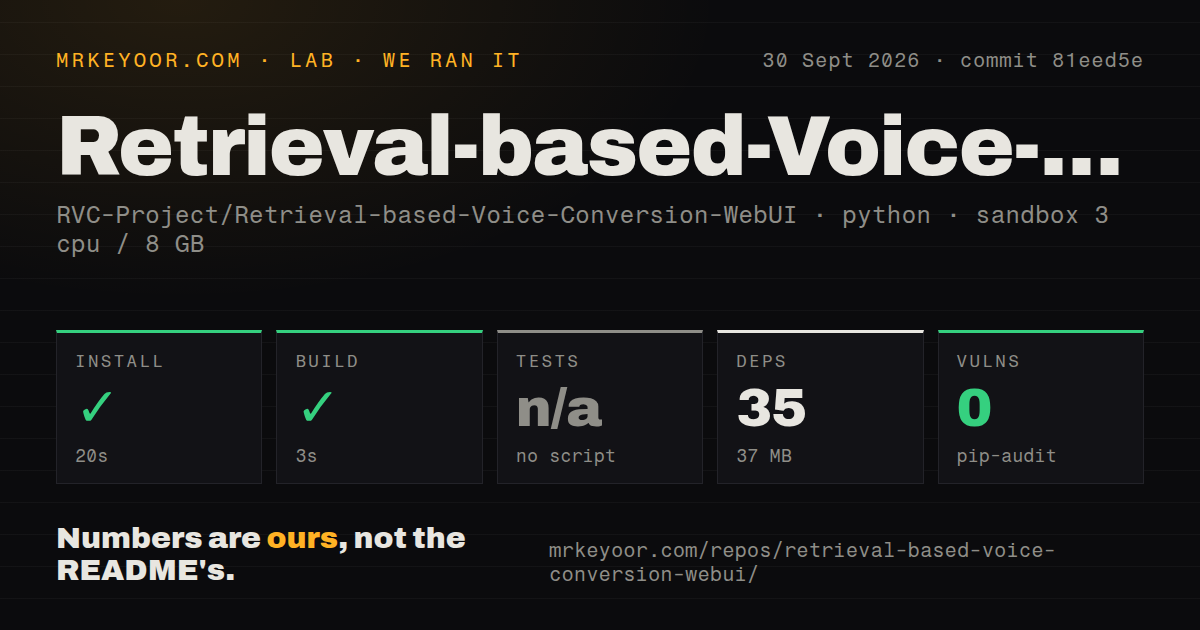
Pip-audit reported 0 known vulnerabilities in the 35 packages our lab installed. That result covers published dependency advisories, while the eval() path is first-party application logic. Treat the findings separately. Until maintainers replace the parser and a fixed revision is available, do not point checkpoint extraction at a third-party model pack. Isolation helps limit damage, but it does not make untrusted input safe.
Ten minutes of low-noise audio starts the training workflow
The English guide recommends at least 10 minutes of low-noise speech. RVC trains a target timbre, retrieves features from that training set, and applies the result to supplied speech or singing. The source performance provides the words, timing, and expression, so this is voice conversion rather than text-to-speech.
The WebUI joins preprocessing, feature extraction, training, index creation, file inference, checkpoint tools, and vocal separation. A separate GUI handles real-time conversion. This is the appeal: a creator can move through a whole RVC workflow without stitching together research scripts. The primary README is Chinese, with maintained English, Japanese, Korean, French, Turkish, and Portuguese versions linked from the top.
RVCv3 should not influence a current buying decision. The README asks readers to look forward to a larger base model with better results, yet it gives no release date or firm delivery commitment. The usable product today is the v1 and v2 workflow, the current WebUI, and the model files the setup guide names.
What happened when we ran it
Our sandbox installed commit 81eed5e in 20 seconds. It added 35 packages and used 37 MB on disk, then the available build completed in 3 seconds. Pip-audit found 0 known vulnerabilities. The container had Python 3.12, 3 CPUs, 8 GB of RAM, no secrets, and no elevated privileges.
There was no test script or target, so the lab skipped tests. We did not get a pass or fail result for preprocessing, training, pitch extraction, index creation, inference, separation, or the real-time GUI. A successful 3-second build says only that the selected build step completed. It cannot substitute for output checks with real audio.
The checkout was much larger than the installed package set: 13,786 files, about 1,030,627 lines of source, 228.5 MB checked out. Our scan found 0 CI workflow files, no Dockerfile, and no tests directory. Those absences leave a team without a visible upstream template for repeatable container builds or repository-level regression checks.
Python 3.12 setup splits at the GPU generation
The current branch targets Python 3.12 x64 and recommends Ubuntu 24.04 x86_64. Ubuntu setup installs FFmpeg, development headers, libsndfile, and PortAudio before Python packages. RTX 50-series cards take a CUDA 12.8 Torch pair, earlier NVIDIA cards take CUDA 11.8, and CPU, AMD, or Intel systems use a separate requirement file. Windows can use DirectML, while Linux assigns AMD and Intel users to CPU operation.
The 37 MB from our run does not describe a ready voice-conversion workstation. The guide separately downloads HuBERT files, an RMVPE model, v1 or v2 pretrained checkpoints, and training silence samples from Hugging Face. PyMSS separation adds another weight directory. Each artifact has a prescribed location, while personal .pth models and .index files go into their own folders.
After those pieces are present, python webui.py starts the interface on port 7865, and --noautoopen suits a headless Ubuntu server. The latest release offers different complete packages for NVIDIA cards before the RTX 50 generation, newer NVIDIA cards, and AMD or Intel hardware. That is a friendlier evaluation route than reconstructing every dependency, though it does not resolve the untrusted train.log path.
The July release is recent, while 583 issues and PRs remain open
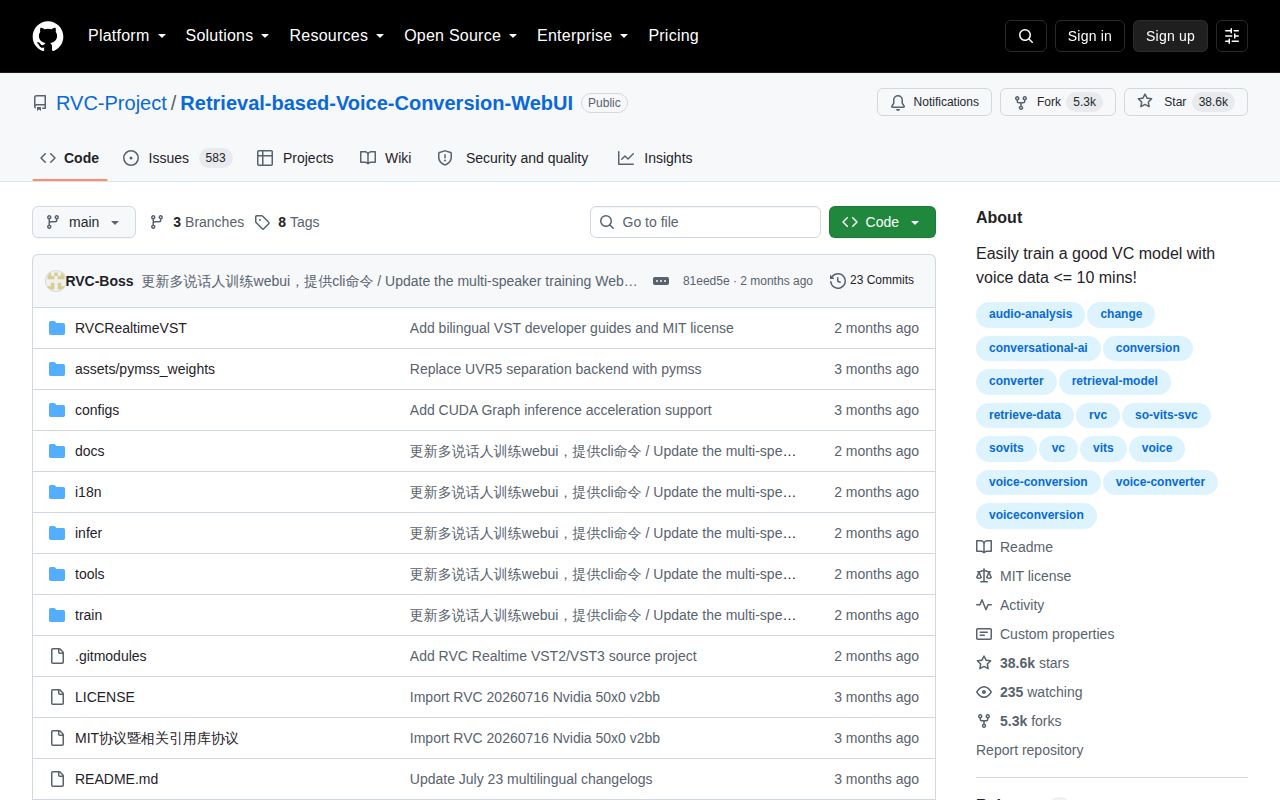
Release 2.3.260718 was published on July 21, 2026, and the default branch was last pushed on August 4. Its notes describe resumable stages, automatic GPU selection, FCPE pitch extraction, PyMSS separation, and dependency fixes. GitHub listed 38,573 stars and 583 open issues and pull requests combined on October 4.
The queue is not a defect count. It does show the support surface around audio devices, training, GPU combinations, and community models. Open issues were still receiving updates on October 3, so user activity continues after the last source push. Recent attention does not close issue #2866 or supply the missing automated test target.
RVC remains useful for permitted voice experiments when you control the dataset, checkpoint, and sidecar files. Our 20-second install makes source inspection cheap, but the missing tests place audio validation on you. The open eval() path draws a harder boundary: use a trusted model on an isolated machine, or wait for a verified fix before accepting packs from other people.