Requests fits a script that can wait for HTTP
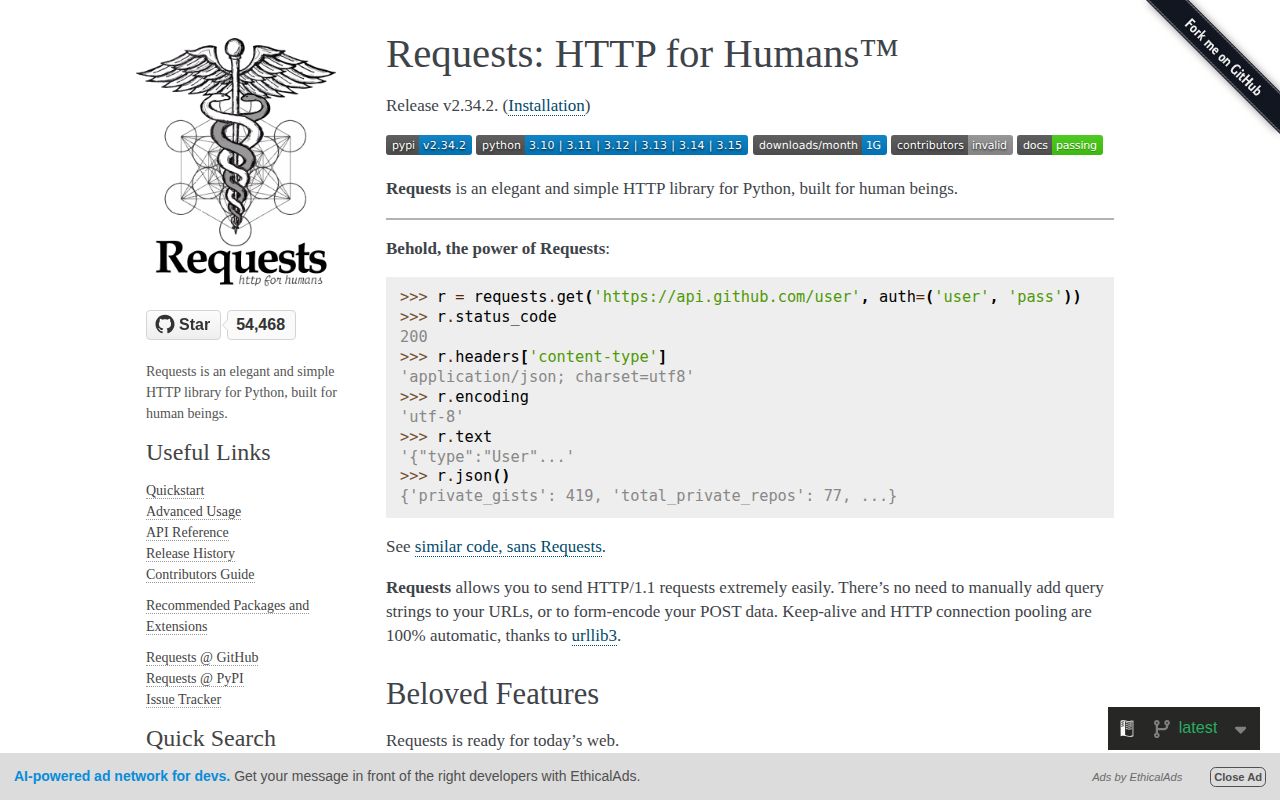
Requests lets a Python script fetch a page, submit a form, or call a JSON API without building HTTP messages by hand. Its README promises HTTP/1.1, persistent cookies, connection pooling, and certificate verification. That's the appeal for a scheduled export or an internal integration: the network code stays readable enough that the next developer can see which address receives which data. You're buying less code to maintain.
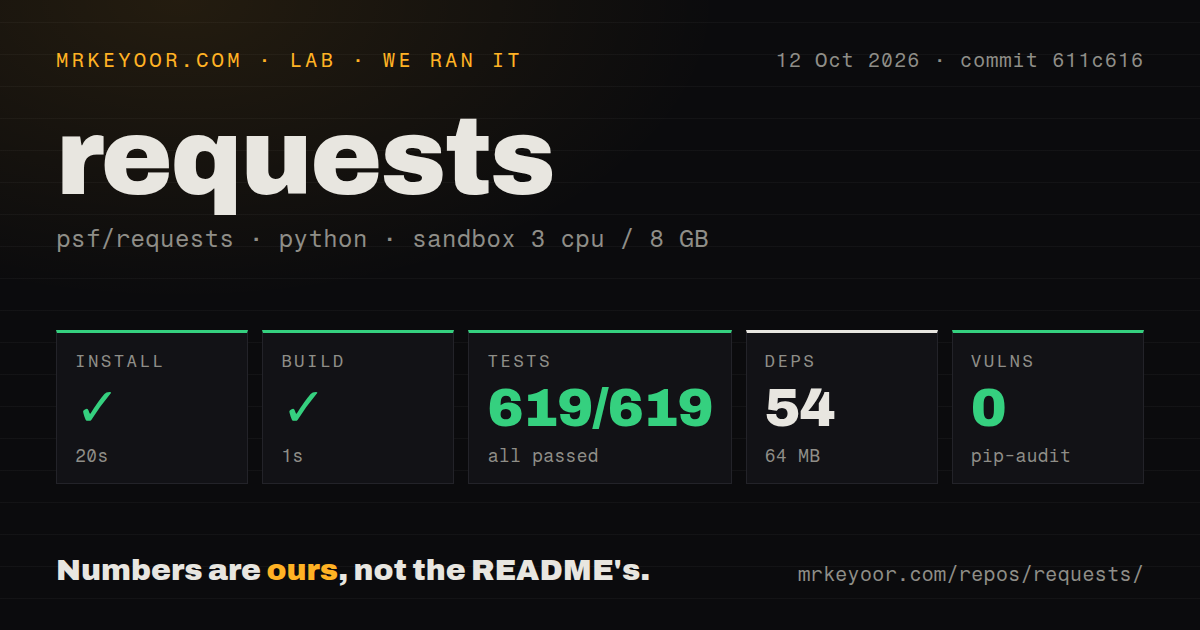
Our checkout contained 128 files and roughly 12,069 lines of source, occupying 4.5 MB before installation. The installed environment used 64 MB. Those are useful proportions for someone considering the source repository, though they don't describe the size of a minimal application deployment. The 54 packages installed in our sandbox belong to that measured environment. Calling them all mandatory runtime dependencies would misrepresent what the lab established.
What happened when we ran it
Our run installed Requests commit 611c616 in 20 seconds and built it in 1 second on October 12, 2026. The measurement setup was an unprivileged Debian container using ghcr.io/astral-sh/uv:python3.12-bookworm, with 3 CPUs, 8 GB of RAM, and no secrets. Both steps succeeded. That supports a straightforward conclusion: this checkout completed those steps without a privileged container or credentials in the environment we used.
Pytest succeeded in 81 seconds, reporting 619 passed, 0 failed, and 15 skipped in the supplied lab summary. We keep the skipped result visible because a passing command doesn't mean every case ran. No failure log needs explaining here. These results concern the checked-out source and this sandbox, rather than every supported interpreter, operating system, or downstream integration that might use Requests.
Pip-audit reported 0 known vulnerabilities. The repository scan found 8 CI workflow files and a tests directory, with no Dockerfile. That is reassuring evidence for a library you embed in another program. It does not measure request latency or throughput, and the audit result belongs to this dependency environment on that date. Neither result promises that your application handles hostile responses or unreliable services correctly.
Timeouts require a decision in your calling code
The Requests timeout documentation says calls have no timeout unless you supply one. A forgotten argument can leave a worker waiting indefinitely. Set a policy where your application creates requests, then handle timeout exceptions where the job can recover. The timeout also isn't a deadline for downloading the entire response. That distinction matters when a remote endpoint keeps sending small amounts of data without finishing.
The 81 seconds our suite took tells you nothing about how long a production call should wait. Choose that limit from your job's deadline and the service you're calling. Also check HTTP status before treating parsed JSON as a successful result: an error response can contain perfectly valid JSON. Requests makes sending the request convenient, while your integration still owns what a response means and whether to try again.
Streaming downloads still use blocking calls
The advanced guide's blocking I/O section explicitly says the default transport does not provide nonblocking I/O. Downloading a response in pieces changes how much you read at once, but those reads still block. For a serial maintenance script, that is easy to reason about. Inside an async request handler, making the same call directly can hold up unrelated work on the event loop.
Python 3.12 in our sandbox was a suitable environment for the README's Python 3.10+ requirement. That compatibility doesn't turn Requests into an async client. HTTPX supports synchronous and asynchronous APIs plus HTTP/2, making it the alternative I'd try when those requirements appear. aiohttp supplies an asyncio client, server, and WebSocket support if the application already revolves around asyncio. Neither recommendation rests on a speed comparison from our lab.
Typed code and multipart forms have specific open complaints
Release v2.34.2, published May 14, 2026, changed the headers input annotation back to Mapping after the preceding release used MutableMapping. That is a small change with consequences for typed integrations. Open issue 7630 reports that iter_lines rejects a valid None chunk size during type checking. The release history shows attention to annotations, while this report gives strict typing users a concrete case to check.
Issue 7634, updated October 16, reports that non-string form field names accepted for ordinary form encoding raise AttributeError when files make the request multipart. This is a user report, separate from our 619 passing cases. If your application constructs field names from external data, validate those names before submission. Developers who require identical handling across both encodings have a specific reason to evaluate another client rather than assume compatibility.
September pushes and October reports show ongoing activity
GitHub recorded the last push on September 28, 2026, with 54,468 stars and 244 open issues and PRs when checked on October 17. October issue updates show continuing user activity after the May release. Those dates don't establish a maintainer response deadline, but they do undermine a claim that the release date alone means abandonment. Apache-2.0 licensing also gives adopters a clear code license.
The 64 MB environment makes working on this checkout a modest commitment in our sandbox. For a real integration, I'd spend the next effort on its actual endpoint: send an expired credential, interrupt a response, and check what the caller records. Reuse a Session for repeated calls when cookies or pooled connections matter. Keep the timeout policy beside that Session so a later call doesn't quietly inherit an unlimited wait.