Check the React version before memorizing an answer
Before you rehearse this bank's answer about string refs, check its version claim. The README says React removed them in v16. React's own upgrade guide places that removal in React 19. For an interview resource, that error matters: you could learn the explanation, repeat it confidently, and get the history wrong. Sudheer Jonna's collection is useful for finding questions you struggle to answer, but I wouldn't make it your sole reference.
The English README has an index linking questions about state, rendering, hooks, and related libraries, with code beside many answers. You can jump straight to controlled inputs or effect cleanup instead of following a course. Our checkout occupied 7.2 MB, so keeping a local reading copy is practical. Developers returning to React get the most from this format: the question exposes a gap, then you decide how much study that gap needs.
What happened when we ran it
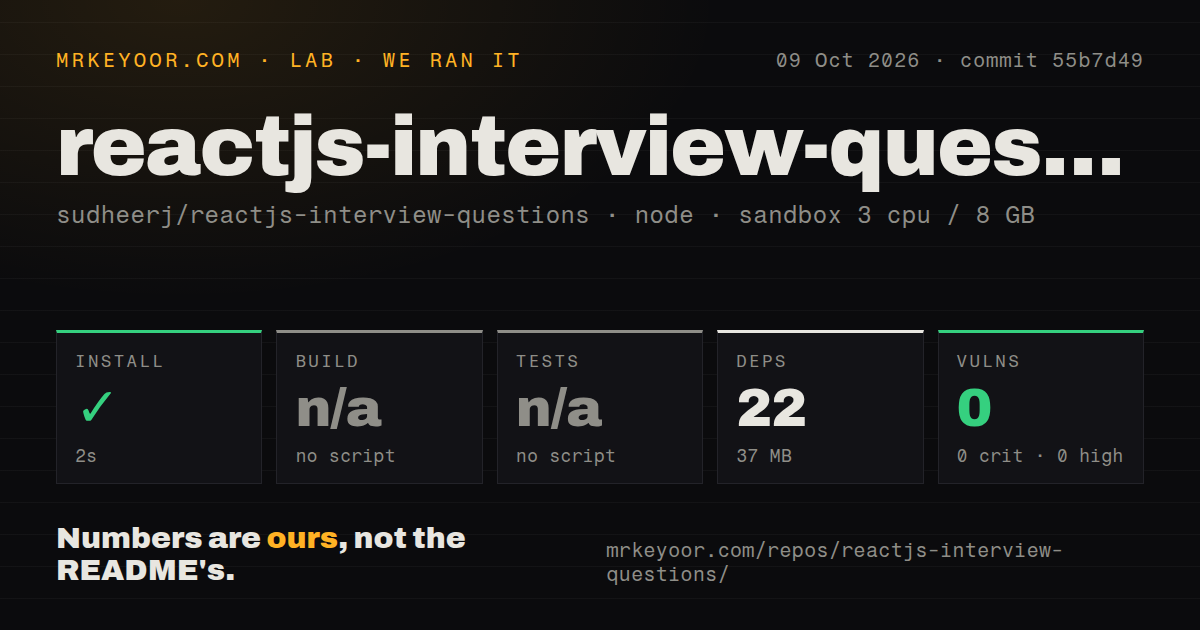
Our sandbox installed commit 55b7d49 in 2 seconds on October 9, 2026, adding 22 npm packages and using 37 MB on disk. The fresh Debian container had 3 CPUs, 8 GB of RAM, image lab-node:22, no secrets, and no elevated privileges. The checkout contained 383 files and about 4,367 lines of source. Installation succeeded, giving us a small local footprint for inspecting the repository.
The lab skipped both build and tests because it found no script or target for either. Neither step earned a passing result. Npm audit reported 0 known vulnerabilities, and the scan found 0 CI workflow files, no Dockerfile, and no tests directory. Those findings describe the measured checkout and command path. They don't establish that every embedded snippet or nested practice application works, and an audit cannot check whether an explanation teaches React correctly.
React 19 coverage still needs corrections
The README includes a React 19 section, so its age isn't the whole problem. That section presents automatic compiler optimization as though choosing React 19 enables it. The official React Compiler installation guide documents a separate setup step. This distinction changes what code you can expect to optimize automatically. A learner needs to know which tool is running before deciding that manual memoization is unnecessary in a particular application.
Elsewhere, the React DOM answer lists older methods without explaining their removal, including unmountComponentAtNode and findDOMNode. The React 19 upgrade guide documents those removals and string refs. Our lab's 22-package install provides no check on that editorial accuracy. Keeping historical questions is useful for maintaining older applications, but each answer needs enough version context that you can distinguish an old codebase from the one you're discussing in an interview.
The throttle example needs source fixes
The coding-hooks throttle example calls React hooks without importing them. Its useThrottle source subtracts a ref object instead of its current value and assigns directly to a variable declared with const. Open pull request 411, opened October 10, addresses these same hook problems. These are visible source defects and a contributor's proposed corrections, separate from our sandbox results.
The 37 MB environment we measured therefore shouldn't become a claim that the practice material is ready to copy. Our build and test steps were skipped, leaving the nested examples unverified by that run. Even the hooks directory's README mostly explains its Vite template rather than a teaching sequence. If you want exercises with a dependable answer key, this adds review work: inspect the example, identify its assumptions, and check the behavior in your own application.
October activity hasn't resolved older documentation reports
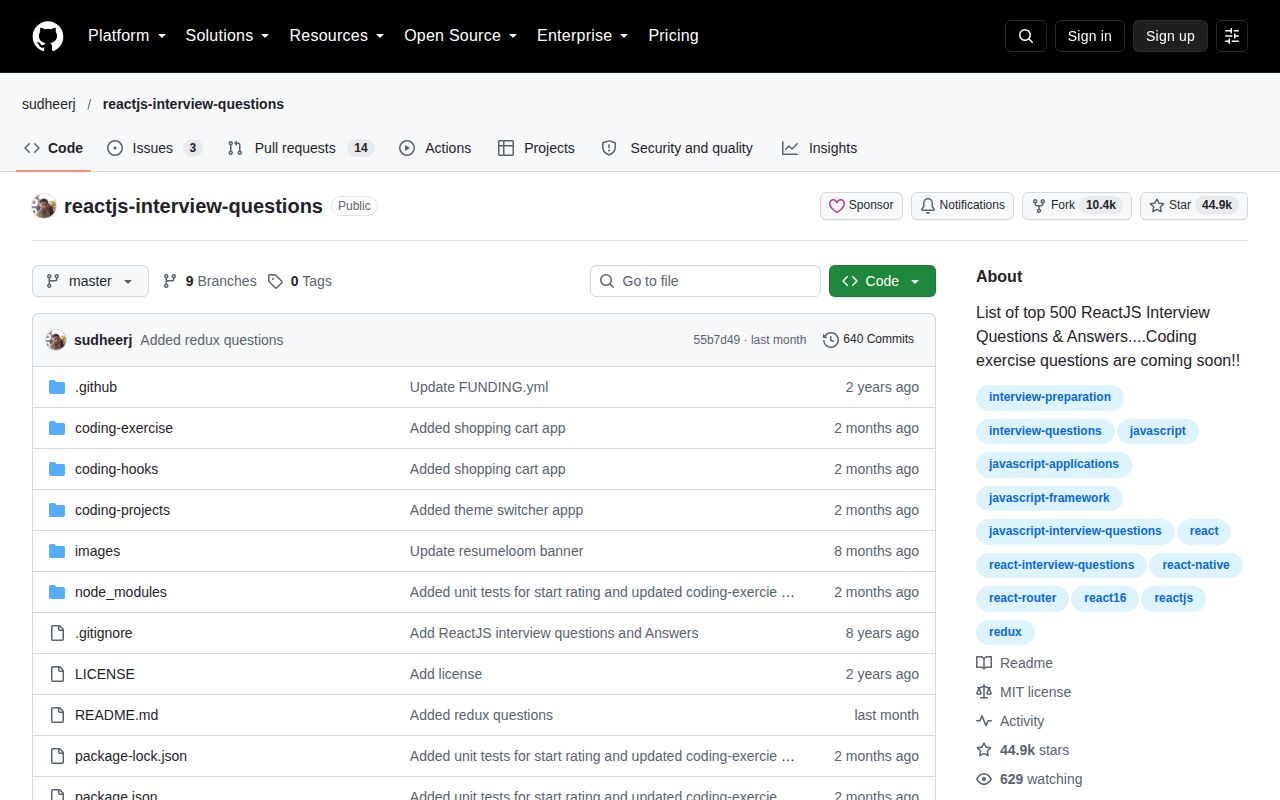
GitHub records the last push as October 13, 2026, with 44,874 stars and 17 open issues and PRs. The open list separates into 3 issues and 14 pull requests. Recent activity includes dependency proposals and the hook correction, so this isn't an abandoned collection. Yet issue 313, asking to replace older React Router answers, remains open after a September 14 update. Activity and answer accuracy deserve separate judgments.
Our scan found 0 CI workflow files, which limits the visible automated checking behind the collection. A documentation project doesn't need a deployment pipeline to be useful, and a passing workflow wouldn't catch every misleading answer anyway. Here, the source defects and unresolved version questions make that missing feedback more consequential. The latest-release API returned no release, but the October push and current discussions provide better evidence of continued attention than a release tag would.
Use official docs to settle disputed answers
Choose React's documentation first if you're learning components and state for the first time. Its lessons provide a sequence and interactive examples. Choose the Front End Interview Handbook when you need preparation across interview formats rather than a React question bank. For gaps in JavaScript itself, the author's JavaScript Interview Questions is the explicitly linked companion. None of those choices makes memorizing answers a substitute for explaining code.
The 2-second install makes this repository cheap to inspect, while checking its answers takes judgment the package manager can't supply. I'd use it to choose practice topics after learning React, keeping official references open beside it. Skip it as your only course or as a source of examples you can paste without inspection. Start with the question about state versus refs: if you can't explain why changing a ref leaves the displayed counter unchanged, build that counter before moving on.