
One DGX Spark is a fixed requirement
This project exists for a narrow reason: make Qwen3.8-Flash-Next fit and stay alive on one NVIDIA DGX Spark. It is a collection of launch scripts, patch generators, memory controls, tests, and operating notes around a pinned vLLM image. The hard work sits below the OpenAI-compatible API, where a large checkpoint competes with its cache and the host for one unified memory pool.
The README budgets a roughly 99 GiB checkpoint, a packed PLE table of about 27 GiB, and around 130 GiB of free disk. It targets the GB10 machine's 121 GiB unified memory and defaults to a 262,144-token context. Those numbers explain why this repository is useful. They also rule out casual adoption. If your machine, checkpoint, or traffic differs, you inherit the measurement work.
What happened when we ran it
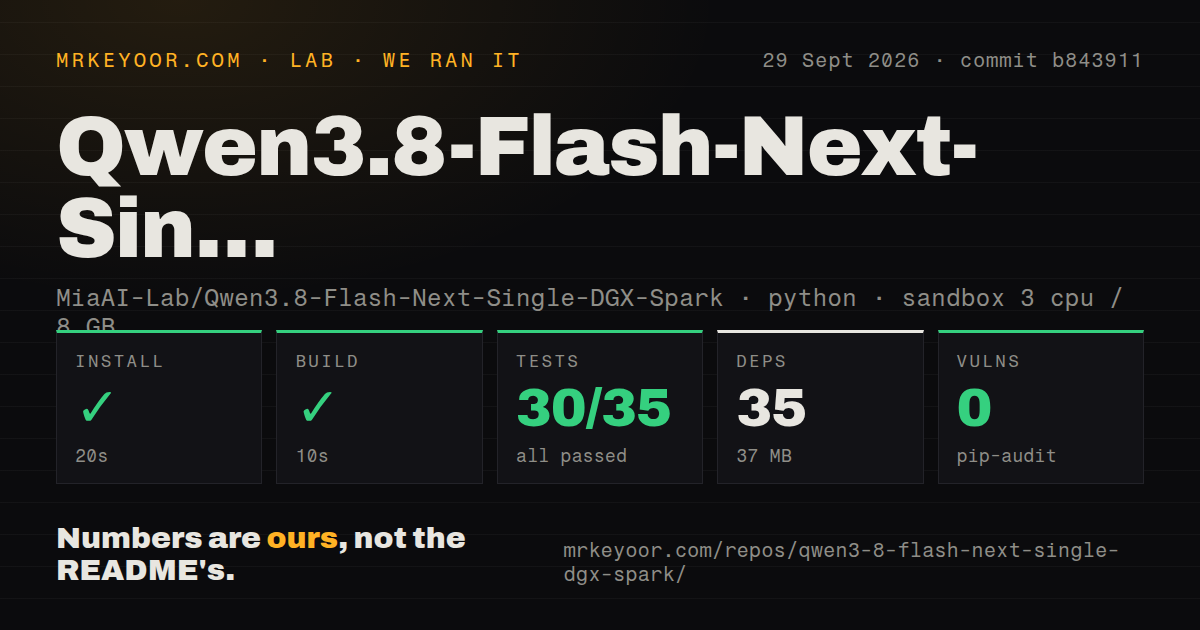
Our sandbox installed commit b843911 in 20 seconds. That step added 35 Python packages and used 37 MB, tiny figures beside the external model assets the serving recipe expects. The build completed in 10 seconds. Pip-audit reported 0 known vulnerabilities, so the lightweight repository environment did not surface a dependency advisory in this run.
Pytest exited with code 1 after 12 seconds. Its summary was 30 passed, 16 skipped, 0 failed, and 5 collection/setup errors. Each named error came from a test module that imported torch, and the log ended with ModuleNotFoundError: No module named 'torch'. The affected files cover determinism, NVIDIA MTP and PLE behavior, the v0.30 memory map, and PLE staging width. We cannot call those checks passing or failing because pytest never collected them.
The 5 collection errors expose the split between kit and runtime
The repository tree has no pyproject.toml, requirements file, or Dockerfile. Most production dependencies live inside the external vLLM image, while the source here modifies that environment at launch. A fresh Python environment can exercise pure tests, but the torch-dependent modules need a runtime that our measured install did not provide.
That distinction matters for release gates. Thirty passing tests show that some script and patch behavior works in a small Debian container. They do not prove that the pinned container can load 99 GiB of weights, that PLE offload behaves on GB10, or that a long request survives memory pressure. Missing torch does not prove the serving path is broken. It leaves 5 important modules uncollected, which a maintainer should close with a documented test environment.
Memory protection is the product you are adopting
The launcher calculates a GPU budget from live host memory, builds or reuses the packed table, starts the container, and runs a watchdog beside it. The README documents three server deaths during an earlier configuration and explains the reserve changes that followed. It also warns that Docker's memory limit does not constrain GB10 GPU allocations. The job is systems operation rather than model downloading.
Host IPC raises the stakes. A hard-killed container can leave shared-memory segments behind until reboot, so the stop path first tries a graceful signal. The API now binds to 0.0.0.0 by default, with a warning when no key is configured. Set API_KEY, use loopback, or put a controlled gateway in front of port 8888. Running a powerful model on a private workstation does not make an unauthenticated network listener safe.
The patches buy fit at the cost of an upstream-shaped deployment
This kit patches PLE offload, FP8 cache handling, ModelOpt behavior, speculative decoding, and optional deterministic execution. That work is the reason the checkpoint can be attempted on one box. It also couples deployment to the exact image and model layouts the scripts expect. An ordinary vLLM upgrade becomes a code review of generated patches, memory assumptions, and smoke tests.
The opt-in v0.30 lane shows the trade. Open issue 77 reports that its engine reaches a reasoning-token validation error after loading weights on a GB10, while the default lane is unaffected. Issue 59 separately questions whether the published single-stream performance reproduces on another Spark. Neither report invalidates the project. Together they make independent workload testing mandatory before you promise latency or availability.
Active issue work is a better health signal than the missing release
GitHub showed 560 stars and a September 25, 2026 push. Its combined open count was 58, which breaks down into 42 issues and 16 pull requests in the API list. Several closed pull requests address concrete launcher and patch defects, while current reports cover startup, health probing, performance reproduction, and output behavior. The repository is active. It is also changing quickly enough that pinning a reviewed commit matters.
There is no published GitHub release, and the root has no CI workflow. AGPL-3.0-or-later covers the launcher and patch sources, while the container, vLLM code, and model checkpoints keep their own licenses. Network operators who modify the AGPL portion must account for its source-offer requirement. This belongs in the deployment review alongside authentication and hardware capacity.
Choose it only when the exact constraint is yours
A DGX Spark owner who needs this exact Qwen checkpoint gets scripts built around the machine's failure modes, plus documentation that records unpleasant results. That can save days of discovering the same memory limits. The kit still asks you to own the operating judgment, and the open performance dispute makes that especially clear.
For a general local model server, choose vLLM, llama.cpp, or Ollama and select a model their normal paths support. Come here when the single-Spark constraint and this checkpoint are fixed requirements. Before production, make all 5 uncollected test modules run, pin the image and checkpoint revision, protect the API, and replay your longest real prompts. The 37 MB repository is the smallest part of that decision.