mrkeyoor.com_
Fri 16 Oct 18:52 UTC
AI Toolsevaluationupdated 08 Oct 2026

Qwen-Image-2.1 review

Qwen-Image-2.1 is a downloadable image model for creating pictures from text and editing one or more reference images. Its English documentation covers transparent output, local edits, multi-image composition, and several third-party runtimes, while this repository itself mainly supplies examples and a separate prompt-rewriting utility.

+101stars / 7d
Verdict

Our prompt-rewriter run installed 35 packages in 16 seconds and built in 2 seconds, but the repository supplied no tests, so it proves packaging rather than image quality. Qwen-Image-2.1 is worth a non-commercial GPU evaluation when native RGBA output or up to 10 references solve a real editing problem. Commercial teams should stop at the license check until they have a separate agreement and a working contact route.

We ran it

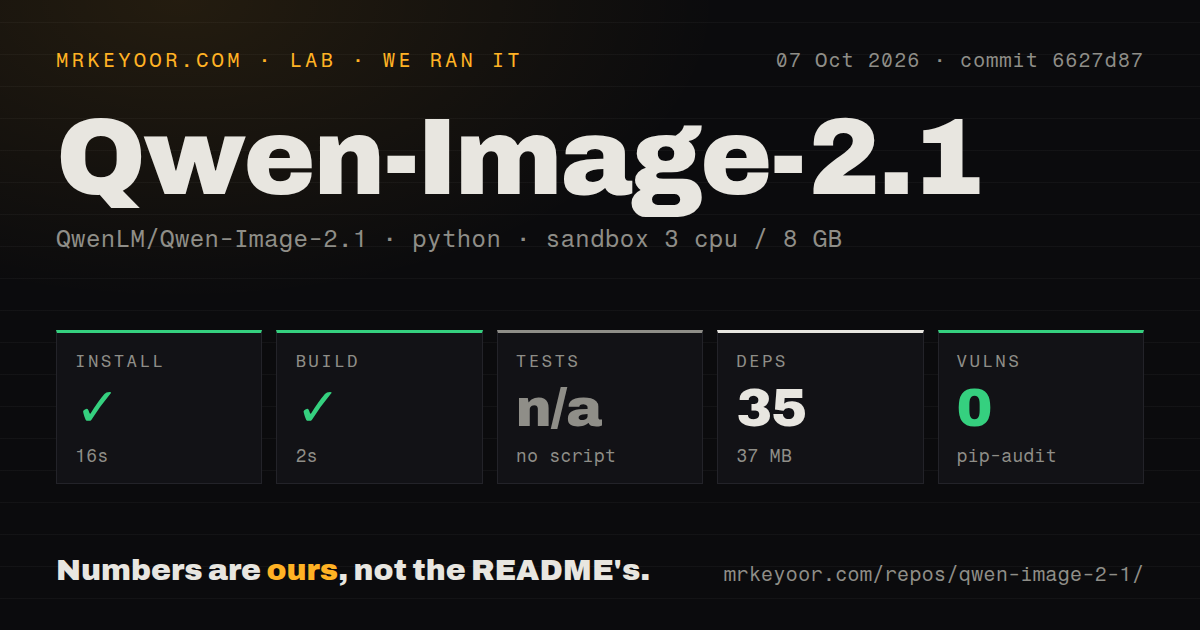
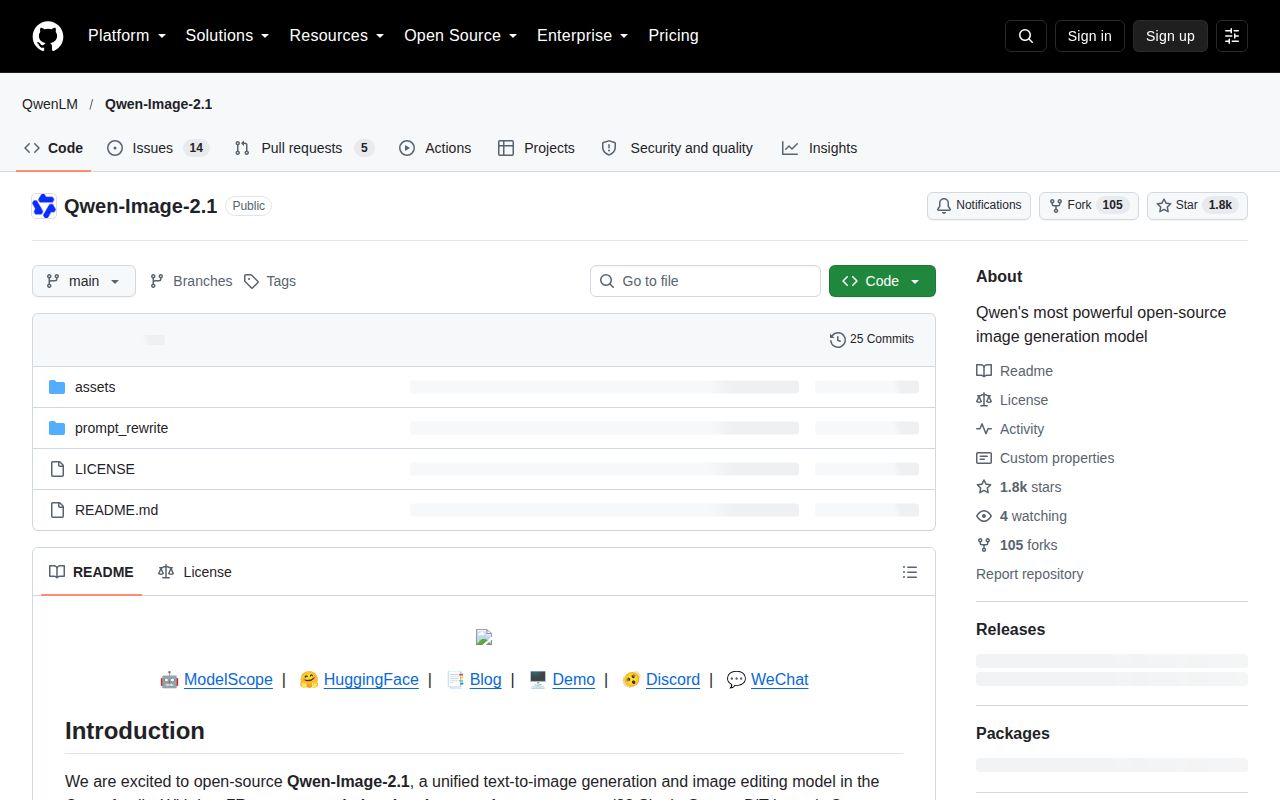
Lab card: what happened when we ran Qwen-Image-2.1Screenshot of Qwen-Image-2.1 (github.com/QwenLM/Qwen-Image-2.1)
Install✓ · 16s35 packages · 37 MB
Build✓ · 2s
Testsn/ano test script
Known vulns0(pip-audit)
Repo21 files~969 lines of source · 13.2 MB · 0 CI workflows

Answers from our run

Does Qwen-Image-2.1 build from source?

Dependencies installed in 16 seconds (35 packages), and the build succeeded in 2 seconds. We cloned commit 6627d87 into a clean Debian container with 3 CPUs and no project-specific setup.

Does Qwen-Image-2.1 have tests you can run?

Not through a standard command: the project exposes no test script or target that our harness could run.

Does Qwen-Image-2.1 have known vulnerabilities in its dependencies?

pip-audit found none in the dependency tree at the time of our run.

Who should not use Qwen-Image-2.1?

Commercial products without a separate agreement: the bundled research license limits its grant to non-commercial use, and open issue 10 reports that the listed commercial contact address bounced.

What are the alternatives to Qwen-Image-2.1?

Qwen-Image, FireRed-Image-Edit, FLUX. Our prompt-rewriter run installed 35 packages in 16 seconds and built in 2 seconds, but the repository supplied no tests, so it proves packaging rather than image quality.

Setup3/537 MB utility install; model weights and GPU setup come later
Docs4/5Many runnable examples, but no main-model VRAM baseline
Community4/51,769 stars and 19 active issues and PRs within weeks
Maturity2/5No tagged release, CI, Dockerfile, or repository test target

Who it’s for

Researchers evaluating native transparent image generation or edits guided by several reference images.
GPU teams already using Diffusers, ComfyUI, vLLM-Omni, SGLang, or LightX2V.
Non-commercial users who can accept the Qwen Research License and its attribution conditions.
Pipeline builders who want a separate 9B prompt rewriter that emits parsed JSONL records.

Who it’s NOT for

Commercial products without a separate agreement: the bundled research license limits its grant to non-commercial use, and open issue 10 reports that the listed commercial contact address bounced.
Small-GPU users expecting a documented minimum for the main image model: the README gives offloading advice but no baseline VRAM figure, while open issue 20 reports that one RTX 4090 could not run it.
Apple Silicon teams shipping image editing without their own regression test: open issue 6 documents silent VAE corruption on MPS at image sizes of 512 by 512 and above.
Release processes that require tagged artifacts, CI, and repository tests: GitHub had no release, our scan found 0 CI workflows and no tests directory, and the lab found no test command.

Setup reality

Our sandbox installed commit 6627d87's prompt_rewrite/ project in 16 seconds: 35 packages used 37 MB on disk. Its build passed in 2 seconds. There was no test script or target, so tests were skipped; pip-audit reported 0 known vulnerabilities.

That small result covers the prompt rewriter, not the image model. Real rewriting needs one of two Qwen3.5-VL 9B checkpoints, and image generation separately downloads Qwen-Image-2.1 weights through Diffusers or another supported runtime. Public model downloads need network access; serving adds GPU and port configuration.

The repository has no Dockerfile, no tests directory, and 0 CI workflow files. The rewriter documentation says its weights are about 20 GB and calls a 40 GB GPU comfortable, while the main model README offers CPU offload but no minimum hardware table.

A 7B generator handles creation and editing in one pipeline

Qwen-Image-2.1 combines a 7B visual generator with a Qwen3-VL 8B text encoder. The image side uses 32 transformer layers and a 64-channel RGBA autoencoder with 16x spatial compression. In practical terms, one Diffusers pipeline accepts a text prompt, a source image, or a list of images. The model can generate ordinary RGB output or transparency rather than asking a later tool to cut out the subject.

The README sets native output around 2K and shows seven recommended aspect ratios. Editing accepts up to 10 reference images, including people, products, clothing, and a scene in one composition. Circle marks, painted annotations, and masks can identify local changes. The examples use 40 denoising steps, but they are usage defaults, not a speed or quality result from our lab.

The 21-file repository relies on external model runtimes

commit 6627d87 contains 21 files and about 969 lines of source in the lab inventory. The main quick start installs PyTorch 2.4 or newer, Transformers 5.17 or newer, a development checkout of Diffusers, Accelerate, and Pillow. The weights come from Hugging Face or ModelScope. Diffusers supplies the QwenImage21Pipeline; the repository does not contain that implementation or the model weights.

Several serving routes reduce integration work if you already operate them. ComfyUI has generation and editing workflows, vLLM-Omni exposes an image endpoint, and SGLang supplies its own generation command. CPU offload is documented for limited memory. The main README does not state minimum VRAM, and open issue 20 is a user report that a single RTX 4090 could not run the model. Treat hardware sizing as an evaluation task, not a footnote.

What happened when we ran it

Our sandbox installed the Python project under prompt_rewrite/ in 16 seconds. The run pulled 35 packages and added 37 MB on disk in a fresh Debian container with 3 CPUs and 8 GB of RAM. The build then completed in 2 seconds, and pip-audit found 0 known vulnerabilities. Those figures describe the checked-out utility at commit 6627d87.

Tests did not fail because none ran. The project exposes no test script or target, so the lab skipped that step. Our scan also found 0 CI workflow files, no Dockerfile, and no tests directory across the 13.2 MB checkout. We did not load the image weights, measure GPU memory, time generation, or judge output fidelity in this run.

The separate 9B rewriter is the code we could inspect

Two Qwen3.5-VL 9B checkpoints expand short requests before image generation: one handles text-to-image and the other handles edits with source images. The shared code writes JSONL with the rewritten prompt, parsing status, and either a selected aspect ratio or the input image whose ratio should be preserved. That contract is useful because a wide composition can be ruined if the renderer blindly keeps a portrait canvas.

This helper is much heavier at runtime than its 37 MB environment suggests. Its documentation puts each checkpoint near 20 GB in bfloat16, describes a 40 GB GPU as comfortable, and suggests reducing context length on a 24 GB card. Offline vLLM batches are the documented reproducible path. Server batches can vary even with the same seed because concurrent request composition changes sampling.

The research license rules out unapproved commercial use

The included Qwen Research License grants use, modification, and distribution for non-commercial purposes only. Commercial use requires a separate license from Qwen. It also requires a notice on redistributed materials and a 'Built with Qwen' or 'Improved using Qwen' label when outputs train or improve another distributed model. This is not Apache-2.0, despite the repository description calling the model open source.

The contact path needs scrutiny before a product evaluation. Open issue 10 says the only commercial-license email in section 2(b) bounced for several users and asks for another route. Issue 13 asks Qwen to restore Apache-2.0 licensing. Both remained open on October 8. A company should obtain written terms before building a launch date around the model, not assume public weights permit commercial deployment.

Apple Silicon and GGUF have specific open artifact reports

Open issue 6 reports that the VAE encoder on Apple Silicon MPS silently corrupts image-conditioned edits at 512 by 512 or larger. The reporter traced the first divergence to a five-dimensional padding operation and supplied a workaround. Text-to-image uses the decoder path and was reported as unaffected. The issue remained open, so an MPS editing deployment needs an image regression suite rather than a successful process exit.

Open issue 14 separately reports persistent vertical and horizontal bands from a GGUF build in Unsloth on Apple Silicon at 1024 by 1024 and 1056 by 1056. That report concerns a particular quantized build and runtime, not the official bfloat16 path. Our run did not reproduce either image defect. They still matter because both can return a valid file while making the picture unusable.

September activity is fast, but release engineering is thin

The repository was created on September 14, announced the model on September 20, and last pushed on September 30. GitHub showed 1,769 stars, 105 forks, 14 open issues, and 5 open pull requests on October 8. Recent discussions covered licensing, memory use, local-edit examples, MPS corruption, and quantized artifacts. That is active attention around a very young project.

There was no GitHub release tag to anchor a deployment, and the 0 CI workflows or test targets give contributors little visible proof for changes. The broad runtime support is still useful, especially if your team already validates models through ComfyUI or a serving stack. Adopt Qwen-Image-2.1 as a pinned experiment first. The license, hardware fit, and actual image corpus should decide whether it goes any further.

Alternatives

ProjectWhat it isPick it when
Qwen-ImageThe earlier Qwen image generation and editing model under Apache-2.0.pick this instead when permissive commercial use matters more than the 2.1 model's transparency and multi-reference changes.
FireRed-Image-EditAn Apache-2.0 image-editing model focused on instruction following and identity consistency.pick this instead when editing is the whole job and a permissive repository license is required.
FLUXReference code and sampling tools for the FLUX family of image models.pick this instead when an established FLUX workflow fits your model and tooling requirements better.

What people are saying

  1. [hf-trending] Viggle/Qwen-Image-2.1-viggle-turbo (trending model on Hugging Face)
  2. [hf-trending] abenzerps/Qwen-Image-2.1-Uncensored-GGUF (trending model on Hugging Face)
  3. [hf-trending] Comfy-Org/Qwen-Image-2.1 (trending model on Hugging Face)
  4. [hf-trending] abenzerps/Qwen-Image-2.1-GGUF (trending model on Hugging Face)
  5. [velocity-scout] QwenLM/Qwen-Image-2.1
  6. [hf-trending] Qwen/Qwen-Image-2.1 (trending model on Hugging Face)

Sources

  1. Qwen-Image-2.1 README at commit 6627d87
  2. Prompt rewriter documentation
  3. Qwen Research License Agreement
  4. Apple Silicon VAE corruption report
  5. Commercial license contact report
  6. GGUF line artifact report

More ai tools reviews

universal-modder · DeepEP-Ascend · DeepGEMM-Ascend · hypoarena · jeeves · faster-whisper · the whole board →