quiche supplies the protocol engine and leaves the server to you
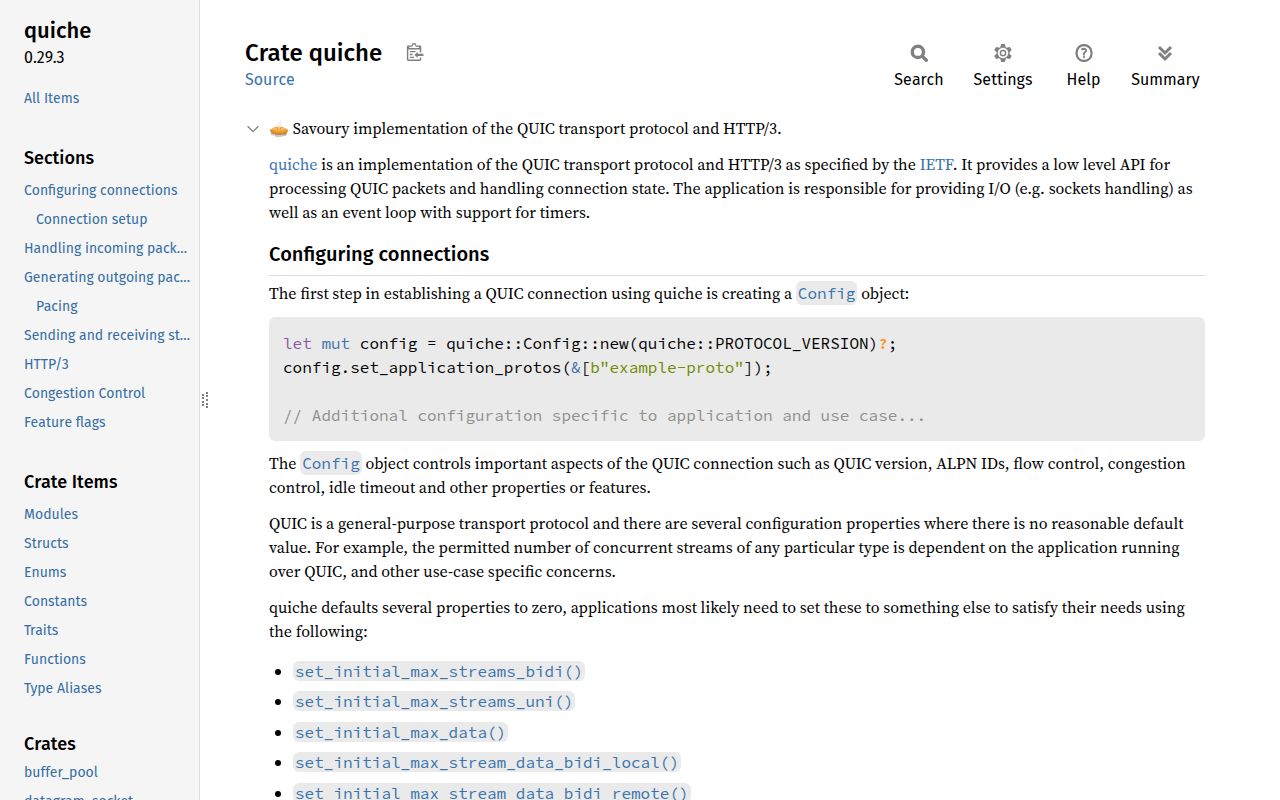
Version 0.29.3 keeps a deliberate boundary: your application owns UDP sockets, I/O, an event loop, and timers. quiche accepts incoming packets, advances connection state, exposes readable streams, and produces outgoing packets with pacing hints. That boundary is the main decision. You get the transport machinery behind QUIC and HTTP/3, while connection dispatch, scheduling, certificates, and operational behavior remain part of the product you build around it.
The codebase is large enough to reward that separation. We cloned commit 0b1a89a, whose checkout had 2,146 files and about 143,391 lines of source in 7.8 MB. It covers the Rust API, an HTTP/3 layer, recovery and congestion work, command-line examples, and a thin C interface. The BSD-2-Clause license is friendly to commercial integration, but the amount of protocol code makes upgrading and regression testing an engineering job, not a casual crate bump.
Six zero defaults put transport policy in your application
In version 0.29.3, the configuration guide lists six stream and flow-control setters that applications will usually need because several defaults are zero. Those values decide how much data and how many streams a peer may use. QUIC version, application protocols, idle timeouts, congestion control, and TLS settings also sit in the configuration object. A successful handshake therefore says little about whether the connection policy suits your service.
The 0.29.3 security notes made one such policy visible by setting the default maximum HTTP/3 field section to 32 KiB. The release also bounded path events and tightened frame parsing after memory-exhaustion risks were found. These are sensible fixes, and they show why applications need explicit limits. Our 434-package install succeeded, but dependency resolution cannot choose safe request sizes or stream counts for your traffic.
What happened when we ran it
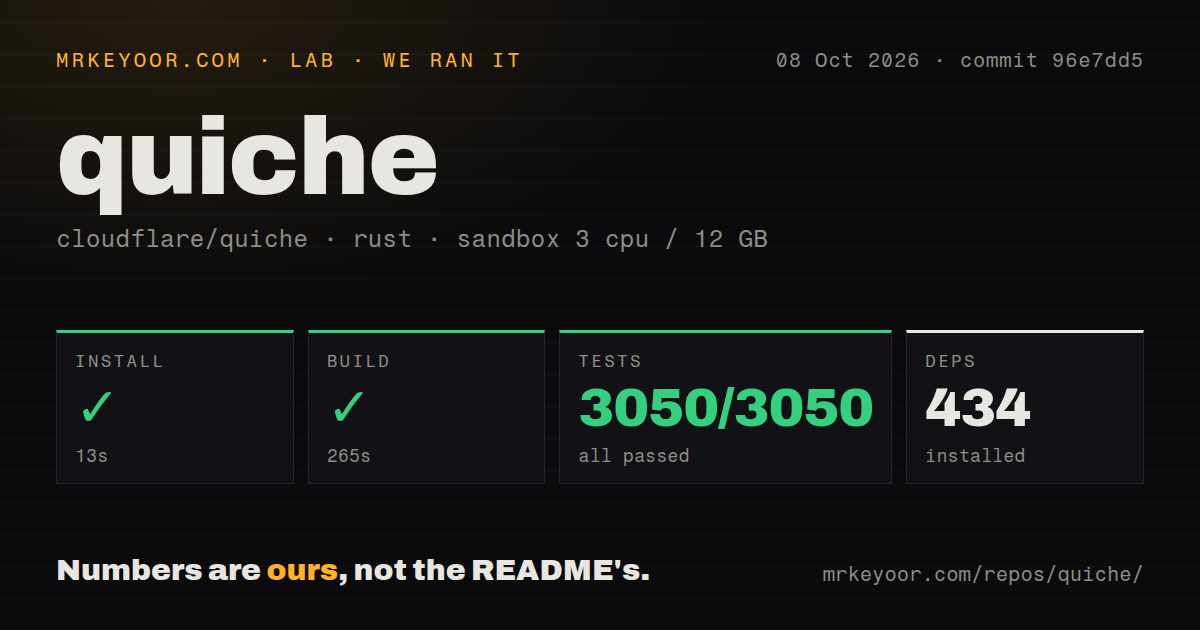
Our sandbox installed quiche in 77 seconds and pulled 434 packages. The build then completed successfully in 216 seconds. Our measurement setup used commit 0b1a89a in an unprivileged container with 3 CPUs and 12 GB of RAM, without secrets. Nothing in the recorded install or build log failed.
Cargo test finished in 167 seconds with 1,386 passed and 0 failed. That is unusually persuasive evidence for a protocol library because the suite exercised far more than a smoke test. It is still repository evidence, not a latency or throughput benchmark. We did not measure requests per second, packet loss recovery, memory use, or interoperability under production traffic, so the result should not be stretched into those claims.
Rust 1.88 and CMake are the real build floor
Current documentation requires Rust 1.88 or newer. CMake must also be present because Cargo builds and links BoringSSL for the QUIC TLS handshake. Windows adds NASM. Mobile builds branch into separate toolchains: Android needs an NDK and cargo-ndk, while iOS needs Xcode tools, target toolchains, and cargo-lipo. The basic Cargo command is accurate, though each target brings its own native build chain.
The C and C++ path has another switch. Cargo produces a static library, but consumers must enable the ffi feature because it is off by default. That is manageable in a controlled build, yet the 216-second sandbox compilation is a warning for CI design. Cache the Rust and BoringSSL outputs, pin the toolchain, and budget rebuild time before this library sits under several applications.
The bundled apps are demonstration tools
Release 0.29.3 includes a QUIC client and server, plus example certificates, so you can make a connection before writing an integration. The README says those programs provide no production performance, security, or reliability guarantees. The server certificate is self-signed. Treat the apps as executable API documentation and interoperability aids, not as a service you can put behind a load balancer.
Our scan found 5 CI workflow files and a Dockerfile, but no conventional tests directory. That last detail does not mean quiche lacks tests because Cargo ran 1,386 of them successfully. It means the tests live elsewhere in the Rust project structure. The Docker images and examples lower the cost of evaluation, while production still needs certificate handling, connection routing, observability, graceful shutdown, and limits chosen for the application.
September commits and July security fixes show active maintenance
GitHub recorded a push on September 16, 2026, one day before this review. Release 0.29.3 arrived on July 14 with three security fixes plus connection-ID, flow-control, and timeout work. GitHub search returned 134 open issues and 180 open pull requests on September 17. That is a busy queue, so judge it alongside the fresh push and detailed release work rather than reading the combined count as a bug total.
Two September reports also show the kind of validation adopters need. The issue 2696 flow-control report describes double-counting on commit 0b1a89a after a 32-stream, roughly 700 Mb/s lossy-WAN soak. The issue 2698 BBRv2 report describes a state that can remain in PROBE_RTT under a specific window configuration. Neither report changes our 1,386 passing tests. They identify traffic patterns that a unit suite did not settle.
Quinn is the easier Rust choice when async ergonomics matter
Quinn describes itself as an async-friendly Rust QUIC implementation, which fits applications already built around async tasks and streams. MsQuic is a cross-platform C library with C++, C#, and Rust surfaces. ngtcp2 is another C implementation and gives integrators choices around TLS. All three are active repositories, so language, runtime shape, HTTP/3 needs, and operating environment should decide the shortlist.
Pick quiche when packet-level control, its HTTP/3 module, or compatibility with an existing quiche integration justifies owning the surrounding network service. Our 216-second build and 167-second test run bought a clean result across all 1,386 tests. The remaining work is the part the README assigns to you: set the limits, drive the timers, test long connections under your loss profile, and ship a server around the library rather than mistaking the examples for one.