Two finished nights teach one Databricks sales pipeline
The repository is course material for a fictional B2B distributor of Arabic perfume. Night 1 introduces Databricks SQL, uploads raw CSV files, creates bronze tables, and asks revenue and customer questions. Night 2 turns the exercise into a scheduled Asset Bundle with raw, bronze, silver, and gold layers, then adds a versioned dashboard and Genie space. The main README marks night 3 as unfinished. It says the original fourth night was removed because deployment now happens throughout night 2.
Our checkout at commit b4035d2 held 69 files, about 1,312 source lines, and 44.1 MB. Much of that footprint comes from course assets such as slide decks and a zipped dataset rather than application code. Each lesson directory stands alone with a README, solved examples, and supporting files. Students can enter at the lesson level instead of decoding a generic scaffold.
Seed 42 turns dirty data into repeatable exercises
A local generator creates the same fictional dataset for every learner. It includes ERP and CRM tables with inconsistent dates, formatted tax IDs, duplicate customers, returns stored as negative quantities, and active accounts assigned to former salespeople. Bronze preserves incoming text. Silver cleans and labels anomalies. Gold produces dimensions, sales facts, marts, business views, and audit queries. Expected row counts and financial totals help students catch a wrong transformation.
The repo measured 44.1 MB before generation, while the README says the generated CSV set is roughly 14 MB. One local Python script calculates revenue without Databricks if the workshop workspace is unavailable. The business domain is specific enough to feel coherent, though all names, columns, currency, and explanations assume a Brazilian Portuguese audience.
Six deploy cycles expose Databricks-specific failure modes
Night 2 uses six prompts and six validate, deploy, and run loops. The final job has 12 tasks across ingestion, four silver transformations, dimensions, facts, marts, tests, business metrics, and metadata audit. Students create the catalog once, deploy the bundle, upload raw files after the volume exists, and run the pipeline through an explicit named profile.
The lab build step finished in 3 seconds, but we did not connect to Databricks or claim the course's cloud outputs as our measurements. The guide documents Free Edition catalog creation failing through the bundle API, development mode prefixing schema names, ANSI date parsing aborting on malformed values, and schema inference stripping leading zeros. These warnings explain failures learners are likely to see.
Claude Code is part of the lesson, not an optional aside
The course asks learners to install Claude Code, project-scoped Databricks AI Dev Kit skills, and an MCP connection. Six stored prompts create successive pipeline parts. Git is initialized first so students can inspect diffs and revert mistakes. The guide recommends denying bundle destruction, production deployment, recursive deletion, and force pushes, plus a deterministic hook against unsafe SQL mutations.
That adds prerequisites beyond the 35 packages installed in our sandbox. Students need the Databricks CLI, Python 3.10 through 3.12, uv, GitHub CLI, Claude Code, a browser-authenticated profile, and working MCP configuration. The README tells users to search for the AI Dev Kit rather than pinning an installer. A solo learner may spend time reconciling tool versions and account screens.
What happened when we ran it
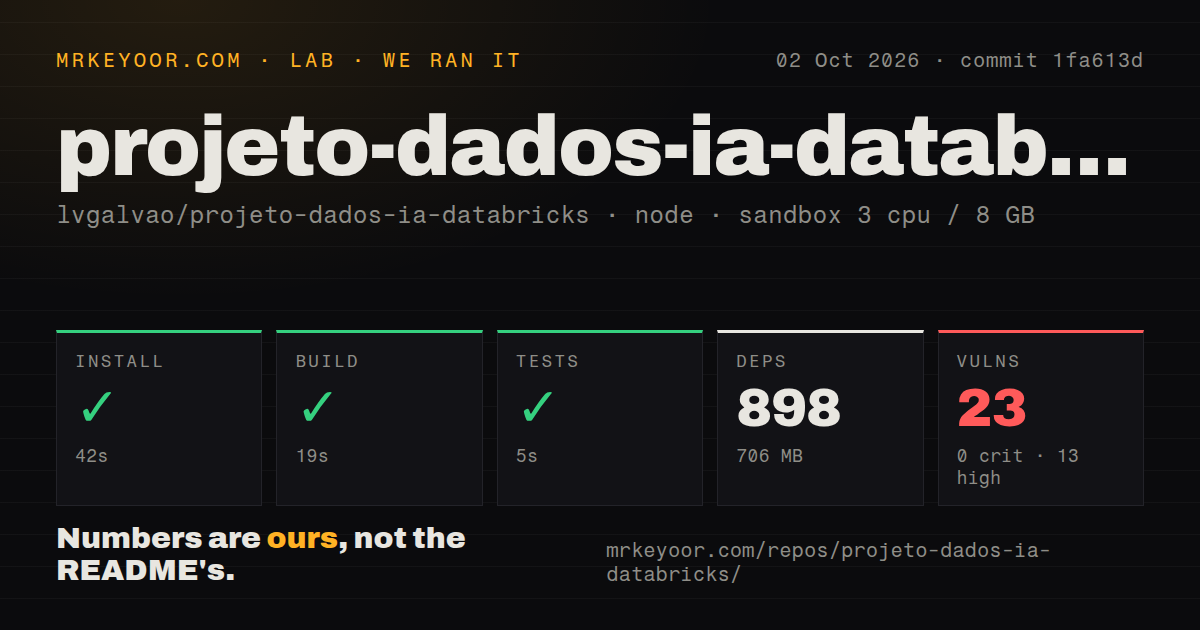
Our run at commit b4035d2 installed 35 packages in 11 seconds, consuming 37 MB on disk. The build completed in 3 seconds, and pip-audit reported 0 known vulnerabilities. Tests were skipped because the repository has no test script or target. The unprivileged Python 3.12 Debian container had 3 CPUs, 8 GB of RAM, and no secrets.
The repository had 0 CI workflow files, no Dockerfile, and no tests directory. It does contain SQL quality checks inside the teaching pipeline, including reconciliation between silver and gold outputs. Those checks run in Databricks, apart from an automated repository suite. A typo in the generator, runner, bundle YAML, or dashboard asset has no checked-in CI gate in the version we measured.
Portuguese detail is excellent, while English coverage is zero
Both lesson guides include prerequisite versions, commands, expected errors, corrections, blank notebooks, solved SQL, dashboard JSON, slides, recordings, and a reset script. Night 2 explains why a plausible nonnegative revenue constraint failed on legitimate returns. The example shows that a quality rule can encode a false business assumption.
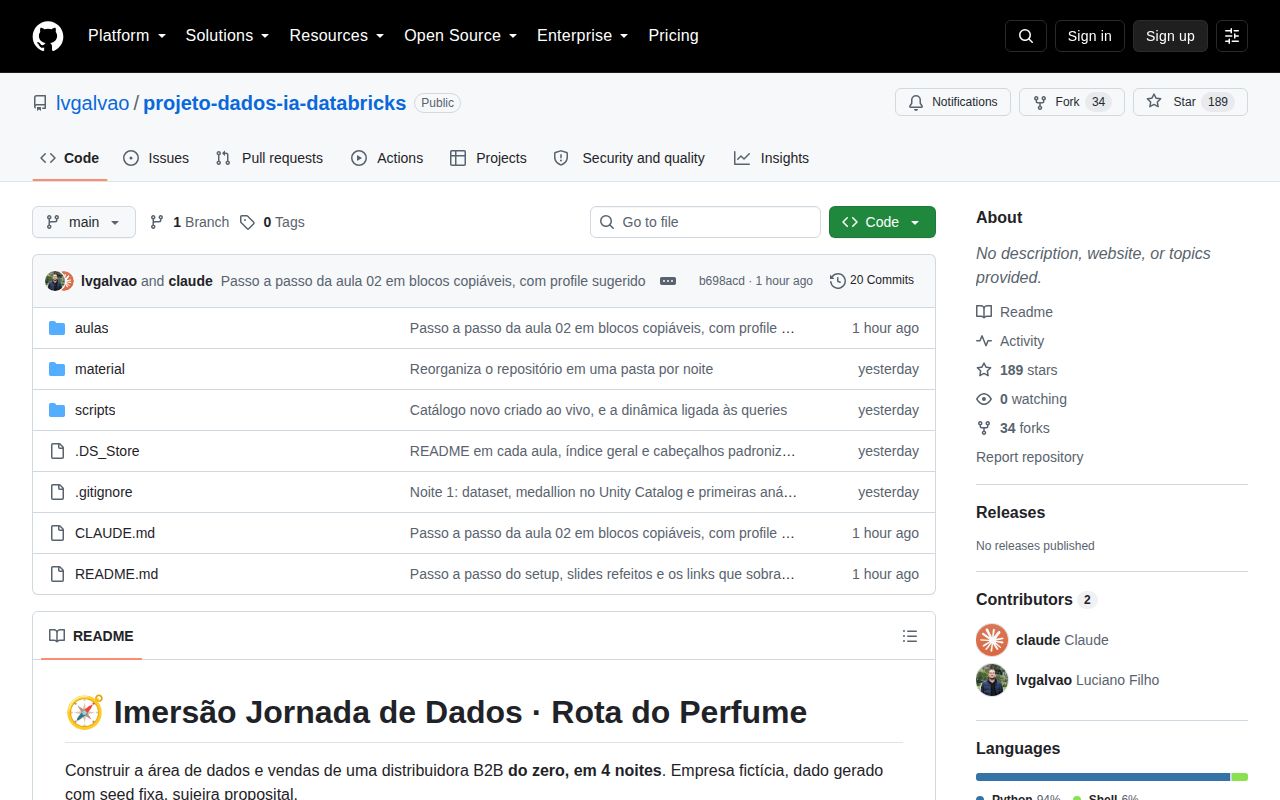
There is no English README, translated lesson, or glossary. GitHub showed 189 stars, no open issues or pull requests, a push on August 25, 2026, and no release. The repository also has no declared license. The fresh push supports its current workshop, while the unfinished third night and absent license argue against repackaging it as a settled curriculum.
Use it as a workshop, not as a production starter
The 11-second install and 3-second build make local inspection cheap. Databricks Free Edition, the tool chain, and careful cloud execution are the larger commitment. Choose official bundle examples for a concise reference or Data Engineering Zoomcamp for a broader English course. Choose this repository when its Portuguese classroom pacing fits, and accept that night 3 is not there yet.