The 9-week course connects 7 modules through one pipeline
Data Engineering Zoomcamp starts with GCP, Docker, PostgreSQL, and Terraform, then moves through orchestration and data ingestion. Later modules cover BigQuery warehousing, dbt analytics work, a data platform project, Spark batch processing, and Kafka streaming. That sequence is useful because learners see where each tool sits in a pipeline instead of collecting unrelated tutorials.
Every lecture is pre-recorded. The January 2027 live cohort adds deadlines, scored homework, a leaderboard, peer review, and certificate eligibility rather than live classes. Self-paced learners can start at any time and use the same videos, materials, and homework, but their work is not scored. The distinction is stated clearly in the README and matters if a credential or external deadline is the reason you finish courses.
The final project requires 2 dashboard tiles and 3 peer reviews
The capstone asks for an end-to-end pipeline built around a dataset other than the NYC taxi data used in lessons. Learners choose batch or streaming ingestion, move data through a lake and warehouse, transform it, and publish a dashboard with at least 2 tiles. The rubric awards points for cloud use, infrastructure as code, orchestration, warehouse design, transformations, dashboard output, and instructions that let another person reproduce the work.
Live-cohort participants must review 3 peer projects to receive project points. The guide encourages a separate repository with a detailed README and an accessible dashboard. It also describes tests, Make, and CI/CD as optional work outside the graded material. That is an honest course boundary, though teams evaluating a portfolio project should check whether the student added those engineering controls instead of assuming the course required them.
What happened when we ran it
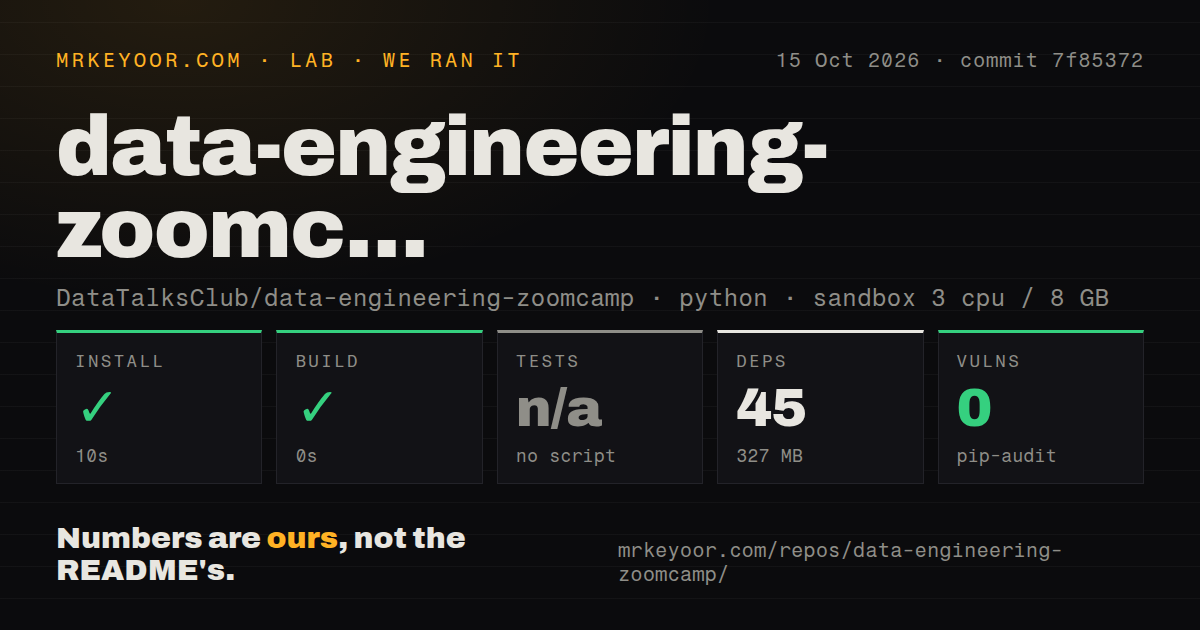
Our run cloned commit 2de2a81 into an unprivileged Debian container with 3 CPUs and 8 GB of RAM. The 106.9 MB checkout held 1,240 files and about 12,773 lines of source. The Python project selected by the harness lives under 03-data-warehouse/extras/, where installation completed in 21 seconds with 34 packages and 37 MB on disk.
The selected helper built successfully in 4 seconds. Pip-audit reported 0 known vulnerabilities in the installed dependency set. The repository had 0 CI workflow files, no Dockerfile, and no directory named tests in our scan. Those are repository signals, not proof that every notebook or course command is broken. They show that this teaching collection does not present one root-level build and verification path.
There was no test script or target for the selected Python project, so our harness skipped tests. We did not execute the 9-week curriculum, provision cloud infrastructure, upload the taxi dataset, run a Spark job, or assess homework answers. The measured result only says that the small GCS helper's dependencies installed and its build step passed in the stated sandbox. It does not validate every module.
Two environment values are needed for the GCS helper
The measured extras project downloads NYC taxi CSV files, converts them to Parquet, and uploads them to Google Cloud Storage without Airflow. Its .env-example asks for GCP_GCS_BUCKET and GOOGLE_APPLICATION_CREDENTIALS, with the second value pointing to a service-account key file. The short README gives uv sync and two script choices, including one with a progress bar. It does not describe bucket creation or service-account permissions.
Course-wide setup is much larger than the 37 MB helper environment. Module 1 introduces a GCP account, Docker, PostgreSQL, and Terraform. Later work adds Kestra, BigQuery, dbt with DuckDB or BigQuery, Bruin, Spark, Kafka, KSQL, and Avro. A learner can follow sections independently, but completing the capstone means keeping cloud configuration, credentials, datasets, and several tool-specific projects organized across weeks.
Python 3.14 in one helper shows why lesson versions need checking
The 03-data-warehouse/extras/pyproject.toml at measured commit 2de2a81 declares Python 3.14 or newer and six direct dependencies. Our provided lab image was tagged python3.12-bookworm, yet the 34-package install succeeded. The supplied measurements do not explain how uv resolved that version difference, so a learner should run uv python find and inspect the selected interpreter rather than assume the container tag describes the executed Python.
Open pull request #858 gives another concrete version-drift example. It proposes adding --no-package to a lesson's uv init command because uv 0.12 changed the default project layout and caused uv sync to expect a package directory the tutorial does not create. This kind of mismatch is normal in a tool-heavy course. It still costs study time, particularly when an error appears before the lesson's actual data engineering task.
September 2026 changes are active without formal GitHub releases
GitHub recorded 45,405 stars, 4 open issues and pull requests, and a last push on September 9, 2026. All 4 open items returned by the issues endpoint were pull requests, including documentation changes for uv and optional Docker Compose material. The latest-release endpoint returned no release, so the repository appears to update course files directly rather than package named GitHub versions. Current pushes and PRs are better health signals here than a missing tag.
The community path is built into the course. Learners can ask in a dedicated Slack channel, follow Telegram announcements, and use a projects gallery for examples. Peer review gives the live cohort feedback without turning every assignment into instructor grading. Self-paced students retain the public material and discussion access, but they give up scoring, the leaderboard, formal peer-review requirements, and the certificate tied to a scheduled cohort.
A handbook or practice set is faster when you do not need 9 weeks
Zoomcamp is best when the outcome is a deployed portfolio pipeline and the weekly scope keeps you moving. Data Engineer Handbook is a broader reference collection for someone choosing topics independently. Data Engineering Cookbook suits reading and interview review, while Data Engineering Practice supplies focused exercises. None recreates the January 2027 cohort mechanics. They are better choices when Docker, GCP, BigQuery, Spark, and Kafka are already familiar and another full curriculum would repeat too much.