mrkeyoor.com_
Fri 25 Sept 04:42 UTC
Self-Hostedevaluationupdated 25 Sept 2026

probo review

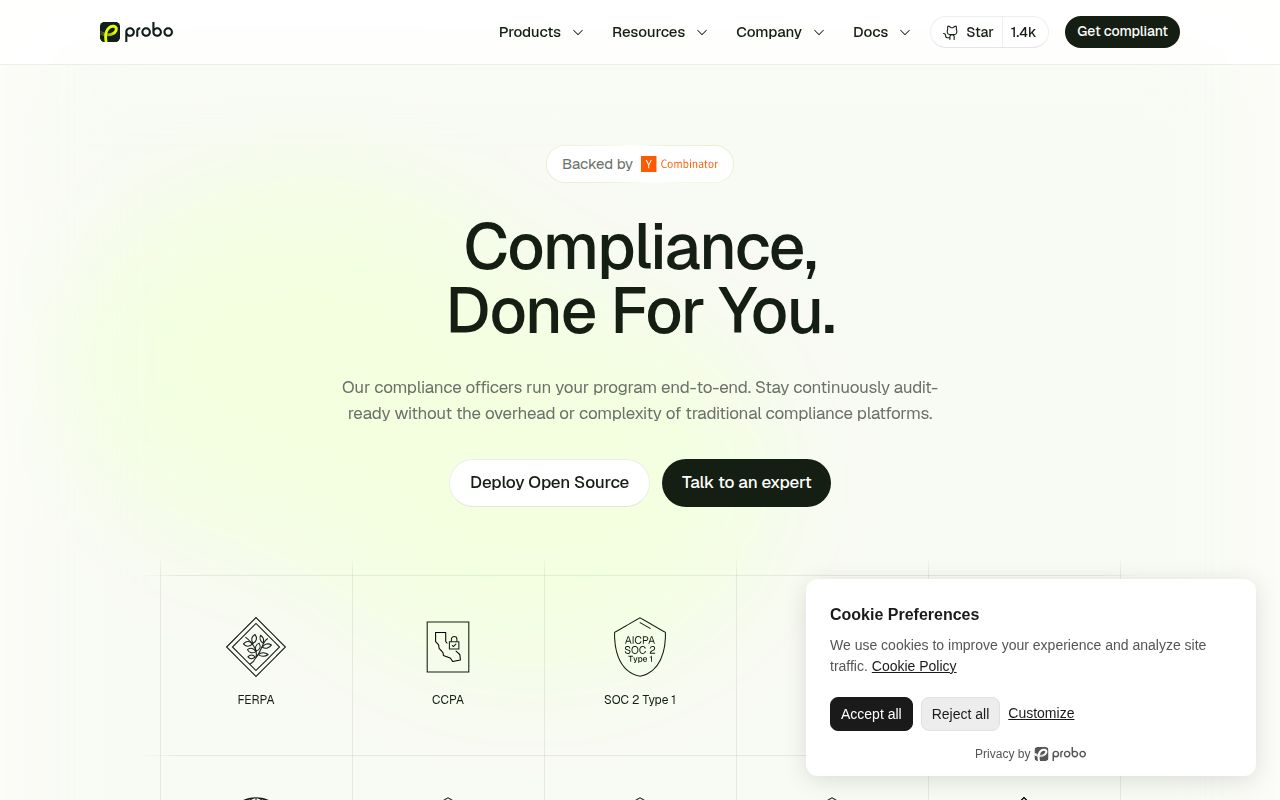
Probo is a self-hosted governance, risk, and compliance system for engineering and security teams. It keeps risks, controls, vendors, privacy work, audits, evidence, and policy approvals in one record, with access through a web console, CLI, GraphQL API, MCP server, and n8n node.

Verdict

Our Probo install pulled 1,432 packages and used 1,420 MB, then the build failed in the employee portal, so this commit is a trial for teams willing to debug a fast-moving GRC platform. Its broad record model and 270+ MCP tools make sense when compliance work already spans several departments and APIs. Wait for a clean build and retest the connectors you depend on before putting audit evidence behind it.

We ran it

Lab card: what happened when we ran proboScreenshot of probo (www.probo.com)
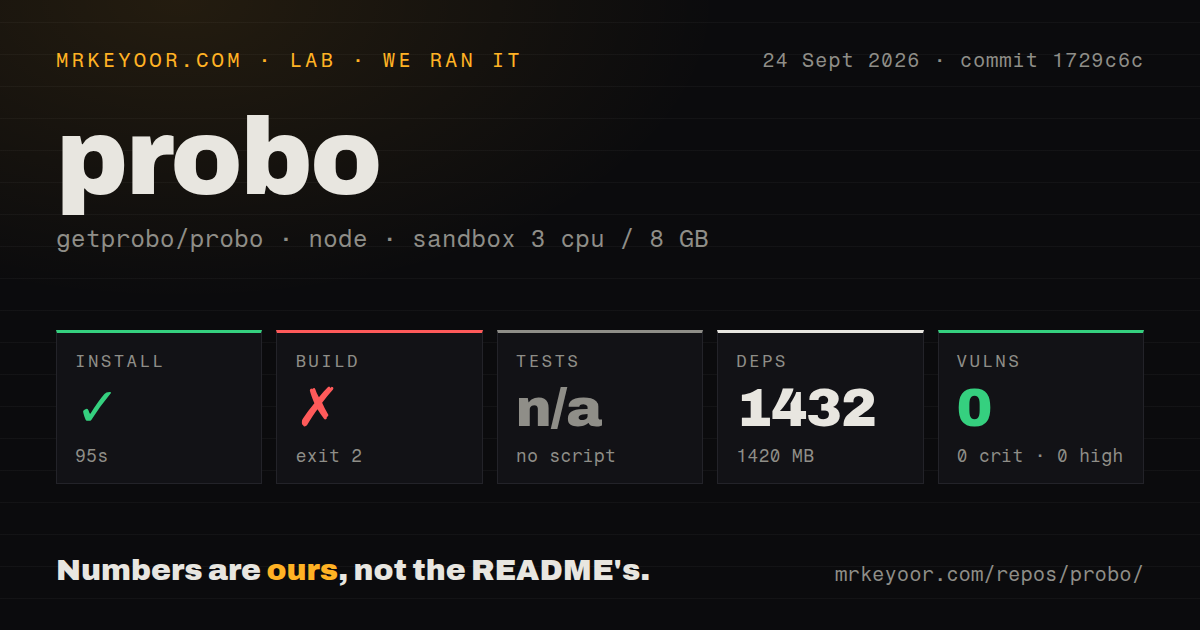
Install✓ · 95s1432 packages · 1420 MB
Build✗ · 47s
Testsn/ano test script
Known vulns00 critical · 0 high · 0 moderate · 0 low (npm audit)
Repo6638 files~912,549 lines of source · 39.3 MB · 17 CI workflows · Dockerfile

Answers from our run

Does probo build from source?

Dependencies installed in 95 seconds (1432 packages), and the build failed. We cloned commit 1729c6c into a clean Debian container with 3 CPUs and no project-specific setup.

Does probo have tests you can run?

Not through a standard command: the project exposes no test script or target that our harness could run.

Does probo have known vulnerabilities in its dependencies?

npm audit found none in the dependency tree at the time of our run.

Who should not use probo?

Small teams seeking a single-container compliance tracker: the production Compose file also runs PostgreSQL, SeaweedFS, and headless Chrome, while Helm requires external PostgreSQL and S3-compatible storage.

What are the alternatives to probo?

CISO Assistant, SimpleRisk, DefectDojo. Our Probo install pulled 1,432 packages and used 1,420 MB, then the build failed in the employee portal, so this commit is a trial for teams willing to debug a fast-moving GRC platform.

Setup2/595-second install; source build failed in the employee portal
Docs4/5Clear local and Helm steps, though production has many moving parts
Community4/5Pushed September 24 with active releases, issues, and PRs
Maturity3/5Wide GRC scope, but build and connector defects need checking

Discussed on

  1. hnShow HN: Fed up with compliance tools? Help us make SOC-2 OSS30 points
  2. hnSOC2 without the usual paywall – it is free and open source7 points
  3. hnProbo - Compliance for Startups3 points
  4. hnOpen-source database of vendor compliance information (SoC 2/ISO 27001)3 points

Who it’s for

Engineering-led security teams replacing compliance spreadsheets with a shared system.
Organizations that want risk, evidence, vendor review, privacy, and audit records on their own infrastructure.
Platform teams prepared to connect PostgreSQL, object storage, mail, identity, and external account sources.
MCP users who want an agent to read or change compliance records under defined access controls.

Who it’s NOT for

Small teams seeking a single-container compliance tracker: the production Compose file also runs PostgreSQL, SeaweedFS, and headless Chrome, while Helm requires external PostgreSQL and S3-compatible storage.
Buyers who require a clean source build before evaluation: our commit 1729c6c build stopped in the employee portal with exit code 2.
1Password customers relying on access reviews today: open issue 1899 reports that the Users API driver decodes the wrong response key and returns zero accounts in v0.282.0 and v0.286.0.
Teams that cannot tolerate duplicate register entries: open issue 1940 reproduces two measures created 32 ms apart after a double click in v0.291.0.
Organizations unwilling to let an LLM-facing interface reach compliance data: the README says its 270+ MCP tools can read and write platform entities.

Setup reality

Our sandbox install succeeded in 95 seconds, adding 1,432 packages and using 1,420 MB. The build failed with exit code 2 after 47 seconds: @probo/employee-portal exited during tsc -b && vite build, and the n8n node TypeScript build was canceled. No test script or target existed, so tests were skipped. Npm audit found 0 known vulnerabilities.

Local development requires Go 1.27+, Node.js 24.15+, npm 12.0.2+, Docker, and mkcert. The documented stack starts PostgreSQL and object storage, generates a config plus two RSA signing keys, then runs the API and frontend separately. Production also needs four application secrets, a PostgreSQL database, S3-compatible storage, SMTP settings, and optionally headless Chrome for PDFs.

The Helm route expects Kubernetes 1.23+ and Helm 3.8+. Database migrations need four PostgreSQL extensions, and the chart notes known metadata trouble when Azure Blob sits behind an S3 compatibility proxy. The README's quick start is accurate about the sequence, but it understates how many services and secrets the production system owns.

270+ MCP tools make Probo an automation-heavy GRC system

Probo exposes more than 270 MCP tools alongside a web console, GraphQL API, n8n node, and a CLI with over 44 command groups. The data model covers risks, controls, evidence, vendors, privacy assessments, access reviews, audit programs, documents, and a public compliance page. That breadth is the reason to consider it: one control can sit near its evidence, owner, policy, vendor record, and audit work instead of being copied through several spreadsheets.

The same breadth changes the buying decision. An MCP client can read and write compliance records, draft policies, run risk assessments, and assemble evidence packs. Probo also records immutable audit logs and supports policy-based access control, but an agent connection still needs the same care as any privileged integration. Decide which identities can change records, which actions need review, and how you will inspect agent activity before connecting a general-purpose assistant to the 270+ tool surface.

Four production services turn self-hosting into platform work

The supplied production Compose file defines 4 services: Probo, PostgreSQL, SeaweedFS, and headless Chrome. Probo needs an encryption key, cookie secret, password pepper, trust token secret, base URL, database details, object-storage credentials, and mail settings. Chrome handles PDF generation. The repository includes sensible local defaults, yet those defaults are not a production security plan. Backups, TLS, secret storage, mail delivery, and recovery remain yours.

Kubernetes users get a Helm chart, but the chart assumes Kubernetes 1.23+, Helm 3.8+, external PostgreSQL, and S3-compatible storage. Database startup also depends on citext, pgcrypto, unaccent, and pg_stat_statements. The chart calls out metadata compatibility problems with Azure Blob behind S3 proxies and recommends a native S3-compatible backend. This is deployable software for an existing platform team, not a sidecar an auditor can own alone.

What happened when we ran it

Our sandbox installed commit 1729c6c in 95 seconds, pulling 1,432 npm packages and occupying 1,420 MB on disk. Npm audit reported 0 known vulnerabilities across critical, high, moderate, and low severity. The repository itself was also substantial: 6,638 files, about 912,549 source lines, and 39.3 MB checked out. It contained 17 CI workflow files, a Dockerfile, a Compose file, and npm workspaces.

The build failed after 47 seconds with exit code 2. Its final output named @probo/employee-portal#build; that workspace was running tsc -b && vite build. The n8n node's TypeScript build then showed as canceled. Turbo reported 6 successful tasks out of 10 before ending the run. The log tail does not identify the compiler diagnostic, so it supports one narrow conclusion: this checkout did not complete its full build in our 3-CPU, 8 GB Debian container.

There was no test script or target for our harness to run, and the checkout had no tests directory, so we skipped tests rather than reporting a pass. That matters in a 912,549-line monorepo because a successful dependency install says little about application behavior. Probo does have 17 CI workflow files, which is useful evidence of automation in the repository. It does not change the result of the commands we ran on the supplied commit.

Access-review connectors need per-provider acceptance tests

Open issue 1899 reports a specific 1Password failure in v0.282.0 and v0.286.0. The driver expects user records under a users key, while the reported API response places them under results. Decoding then returns an empty list without an authentication error, so an access review can appear to have zero accounts. If a connector feeds audit evidence, a plausible empty result is more dangerous than a loud request failure.

Open issue 1940 describes another data-quality problem in v0.291.0: double-clicking Create measure submitted two mutations and produced duplicate rows 32 ms apart. Neither report proves every provider or form is unreliable, and the latest release is newer than both cited versions. They do show what an evaluation must include. Seed known accounts, compare source totals, create and edit sample records, and verify that repeated clicks or retries do not multiply compliance data.

Version 0.296.0 shows fast work, with 55 open issues to inspect

GitHub recorded the last push on September 24, 2026, and release probod/v0.296.0 was published the same day. That release added multi-account cloud connectors, task webhook events, page search, and audit filtering for findings. The repository had 1,385 stars, 88 combined issues and pull requests, and 55 open issues when checked. Those numbers describe an active project with a live queue, not a settled appliance.

Probo is worth a controlled trial when your compliance program already has enough moving parts to justify one shared system. Begin with a disposable organization and the exact connectors you need, then make the source build part of the acceptance gate. A team that cannot staff PostgreSQL, object storage, identity, backups, and integration checks will spend less effort with a hosted GRC product or a narrower risk tool.

Alternatives

ProjectWhat it isPick it when
CISO AssistantA GRC and cybersecurity management suite with a large built-in framework catalog.pick this instead when framework breadth and a Docker Compose starter matter more than Probo's MCP-first automation surface.
SimpleRiskA released-source risk management platform whose public repository is a read-only mirror.pick this instead when risk management is the main job and contributing through the public repository is not required.
DefectDojoAn application security and vulnerability management system for scan findings and remediation.pick this instead when the work centers on security findings and scanner output rather than organization-wide GRC.

What people are saying

  1. [github-trending] getprobo/probo

Sources

  1. Probo repository and README
  2. Probo development setup
  3. Probo Helm deployment guide
  4. Probo v0.296.0 release
  5. 1Password access review issue
  6. Duplicate measure issue

More self-hosted reviews

wg-easy · v2ray-core · autobrr · AgentENV · LibreChat · hosts · the whole board →