PraisonAI puts the whole agent stack in one repository
PraisonAI covers much more than a model call with tools. Its README divides an agent system into prompts, context, tool execution, loops, graphs, and managed runtimes. The Python SDK can run one agent or coordinate several through routing, parallel branches, repetition, and handoffs. Memory, retrieval, structured output, guardrails, approval, hooks, model routing, tracing, and schedules sit around that core.
Breadth is the product decision. A team can begin with praisonaiagents, then add a CLI, visual flow builder, chat interface, or integrations for messaging and voice. The project also advertises Python and JavaScript packages and support for many model providers. That can reduce glue code during exploration. It also means buyers must identify which package and execution path they are actually evaluating.
The README's smallest Python example installs the core package, sets an OpenAI credential, and starts one agent. Other providers need their own credentials, while a documented Ollama route points the OpenAI-compatible base URL at a local service. Memory can be file based or backed by a database. Remote tools and full-agent runtimes introduce Docker or external sandbox services.
What happened when we ran it
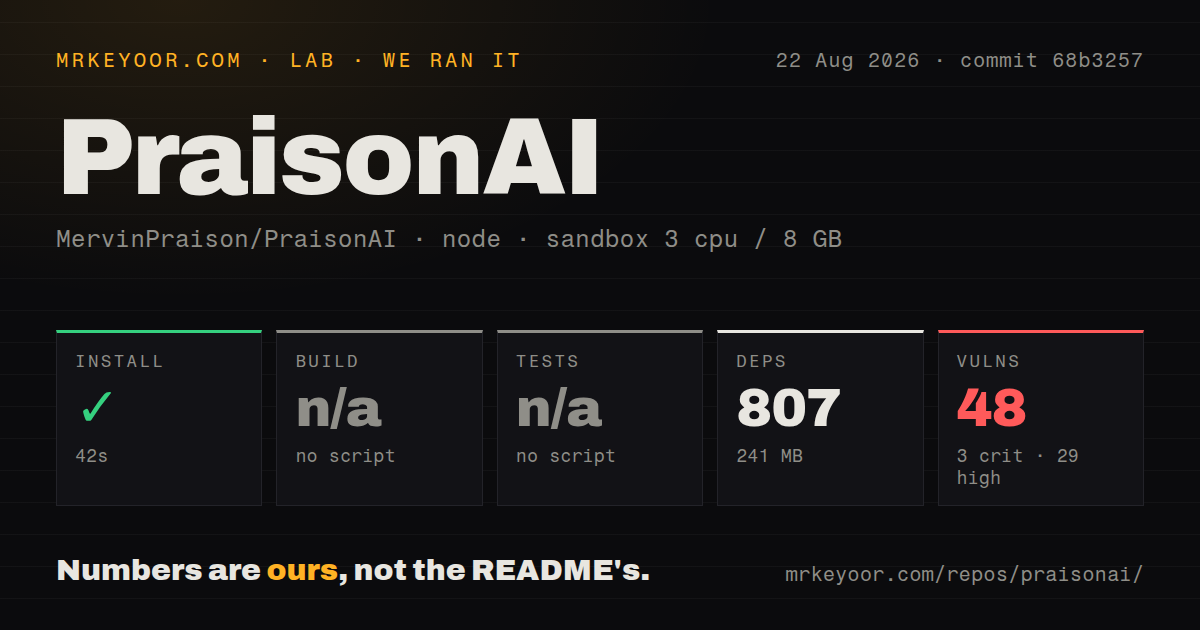
Our sandbox cloned commit 68b3257 into an unprivileged Node 22 Debian container with 3 CPUs and 8 GB of RAM. The repository contained 5,706 files, about 1,183,384 lines of source, and occupied 80.6 MB. Inside ./src/praisonai/, npm installation succeeded in 42 seconds, adding 807 packages and using 241 MB on disk.
The measured Node subproject exposed no build script or target, so the harness skipped build. It also exposed no test script or target, so tests were skipped. These are unavailable checks, not passes or failures. The repository scan found 37 CI workflow files, no Dockerfile, and a tests directory elsewhere in the checkout.
Npm audit reported 48 known vulnerabilities in the installed tree: 3 critical, 29 high, 15 moderate, and 1 low. We did not change versions or run an automatic fix, so this review does not say which upgrades are safe. We also did not run the Python SDK, contact a model provider, start an agent, or execute an MCP tool.
The 48 audit findings stop a casual production rollout
A dependency audit is a lead, not proof that every application path is exploitable. Severity, reachability, patched versions, and upgrade compatibility all need inspection. Still, 3 critical and 29 high findings are too many to wave through for software designed to call tools, process credentials, and expose optional services. The chosen package should reach a reviewed lockfile before it handles production data.
The missing npm scripts add uncertainty. A tests directory and 37 workflows show that validation exists somewhere in the monorepo, but our selected package offered no command for the harness to run. A JavaScript buyer should locate its maintained entrypoint, reproduce the upstream CI commands for that package, and add a small application test that makes one deterministic tool call.
Python users should run a separate evaluation of praisonaiagents; the 42-second npm result does not describe its dependency tree or tests. This distinction matters because the README moves freely between Python SDK, JavaScript SDK, CLI, API, dashboard, and remote-runtime examples. Similar names do not make those surfaces interchangeable.
Open issue 3866 questions the safety controls
The README presents approval, permissions, hooks, guardrails, budget ceilings, iteration limits, and sandbox execution as ways to constrain agents. Open issue 3866 reports three gaps in the Python core: command deny patterns that are not checked against live arguments, an approval configuration that can lose a default deny set, and before-tool hooks that allow execution after certain failures. The report includes code paths and reproductions, but our lab did not reproduce them.
That issue should change adoption behavior now. Do not rely on an agent framework as the only barrier around shell commands, file deletion, deployment, billing, or secrets. Put high-consequence actions behind a separate service that validates identity and arguments, use short-lived credentials, constrain the operating-system account, and require a human decision where reversal is difficult. Framework approval can remain a user-interface aid after the external boundary exists.
MCP needs the same fail-closed treatment. Open issue 4375 reports that an npx-based MCP server on Windows returned zero tools, after which the model answered as if it had used one; a later construction ended with a native access violation. The report is Windows-specific. Every platform should still assert that the expected tool names were discovered before accepting an answer that claims tool use.
Release activity is fast, while the surface remains unsettled
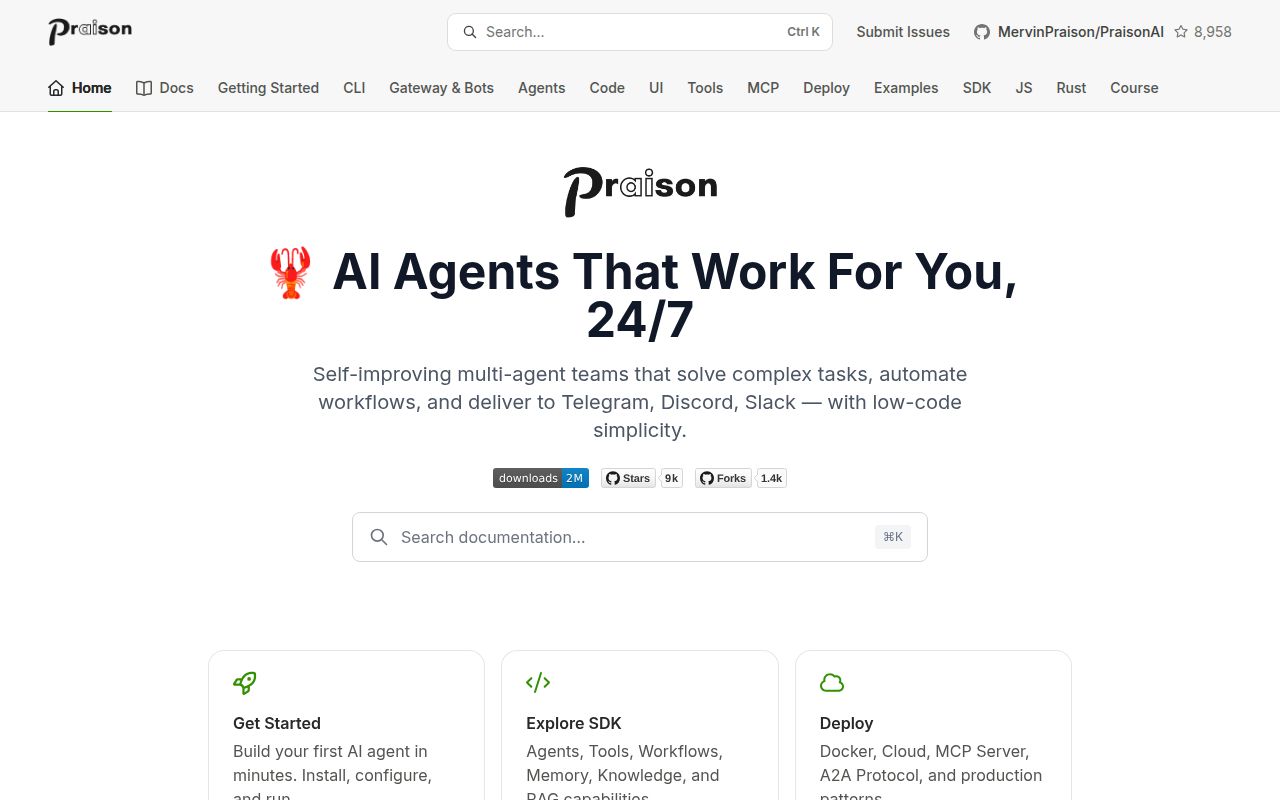
GitHub recorded the last push on August 25, 2026, with 8,958 stars and 60 open issues and pull requests combined. Release v4.7.1 was published August 24 with only a one-line release description. Push and release dates show active maintenance, while the thin release note gives an operator little help deciding what changed or which migration checks to run.
PraisonAI is easiest to justify as a laboratory for agent patterns: start with one provider, one read-only tool, a fixed iteration cap, and recorded outputs. Its graphs, handoffs, context controls, and MCP adapter can then be compared with LangGraph, CrewAI, or AutoGen on the same task. A broad demo should not become a production platform by inertia.
The framework may fit a team willing to audit and narrow it. The measured Node dependency tree and current safety report make a default install too risky for autonomous production work today. The right trial proves the exact package, model, tool boundary, budget stop, and failure path the application will use, with destructive capability still controlled elsewhere.