Why this project exists
Pentest Swarm AI targets an awkward gap in security work. Conventional scanners can cover large surfaces quickly, but their output often needs human verification. Skilled consultants can validate and exploit findings, but they are expensive and periodic. This project tries to combine machine-scale coverage with agents that investigate, attempt exploitation, preserve evidence, and produce a report. It is explicitly for authorized targets, bug bounties, CTFs, and research. That boundary is central, because the software is intended to do more than passively list possible weaknesses.
The distinctive claim is architectural. Instead of one planner sending specialists through a fixed recon, classify, exploit, report sequence, agents read and write to a shared Postgres-backed blackboard. Findings carry weights that decay, and each agent has its own trigger predicate. A new discovery can wake whichever specialist considers it relevant. In theory, this allows work to branch and converge without forcing every target through the same pipeline. That is a meaningful design to investigate, even if the README's claim that the category was empty should be treated as positioning rather than independently established fact.
What happened when we ran it
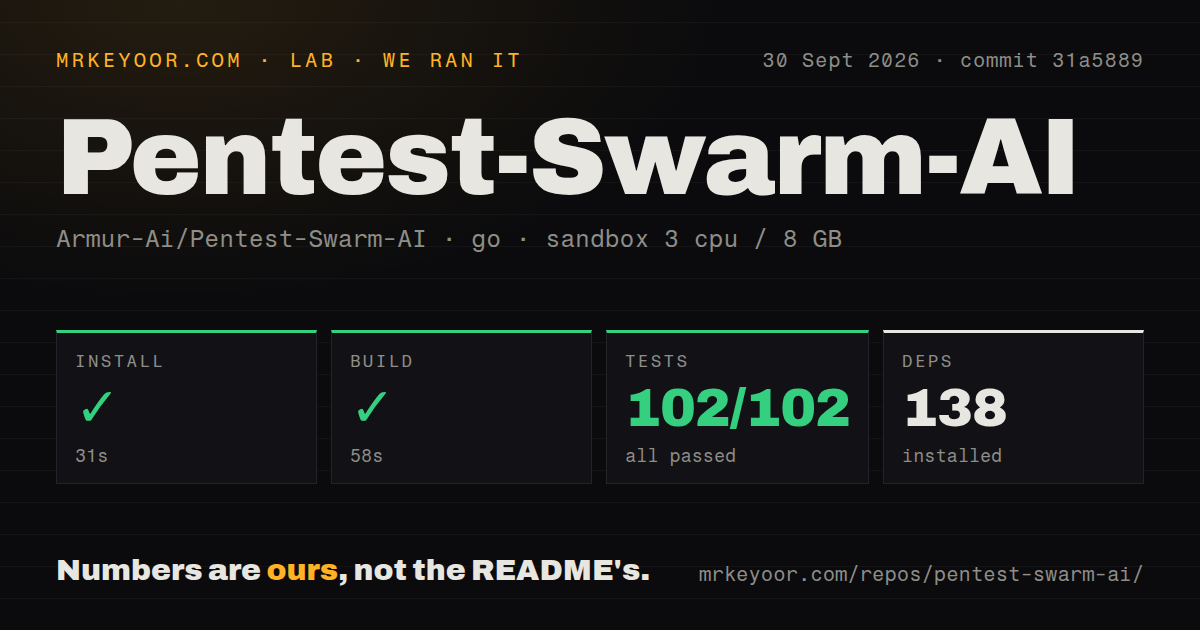
We cloned commit ca13d34 into an unprivileged sandbox with three CPUs, 8 GB of RAM, no secrets, and the golang:1.24-bookworm image. The repository contained 434 files, about 40,145 lines of source, and occupied 7.1 MB when checked out. Installation succeeded in 17 seconds and installed 138 packages. The build then succeeded in 43 seconds.
The test run also completed successfully in 31 seconds: go test reported 78 passed and zero failed out of 78. We found three CI workflow files, a Dockerfile, and a tests directory. These results show that the checked-out revision installs, compiles, and passes its included Go tests in a clean Debian environment. They do not measure finding quality, exploit success, model accuracy, campaign speed, false positives, or behavior against a real target. We did not run a live campaign, so claims such as finding a vulnerability in two minutes remain README claims, not our benchmark.
What it gets right
The onboarding surface is unusually clear for an alpha offensive-security project. The README offers Homebrew, go install, and Docker paths, then separates a bundled lab command from commands aimed at real targets. The lab uses OWASP Juice Shop, according to the documentation, and is presented as a local target that is torn down afterward. There is also an offline pentestswarm demo, which should help users understand the flow without immediately granting an agent access to infrastructure.
Provider choice is another practical strength. The documented options include Claude, OpenAI-compatible endpoints, Ollama, and LM Studio. Local execution matters for sensitive assessment data, air-gapped environments, and teams that do not want prompts or findings leaving their network. The project also frames itself as the harness around a model: tools, coordination, scope controls, and evidence-backed reporting. That separation is sensible because model quality and orchestration quality are different concerns.
The blackboard model is more interesting than simply renaming sequential agents a swarm. Independent predicates and shared state create an extension point: a specialist can join by reacting to findings rather than requiring a central workflow rewrite. Pheromone-style weighting and decay also provide a stated mechanism for prioritizing fresh paths and letting stale ones lose attention. The README links an implementation plan for readers who need the technical rationale, and the repository includes CI and container support rather than stopping at an architecture diagram.
Weaknesses and rough edges
The biggest concern is maturity. The project labels itself alpha, and the latest listed release is only v0.1.0, published on May 7, 2026. A successful build and 78 passing tests are encouraging, but they do not establish safe autonomous behavior, accurate scope enforcement, reliable exploit decisions, or report quality. Those are the properties that matter most when software can touch production systems.
The README is confident and promotional. Statements about being the first or only real open-source swarm, machine-speed work, and proving findings need independent evaluation on representative engagements. No measured comparison in the supplied evidence shows better coverage, fewer false positives, faster completion, or stronger reports than the credited alternatives. Users should also expect model-dependent behavior: a provider being supported does not mean every model will reason equally well about security tasks.
Operationally, local models do not remove risk. Tool execution, stored evidence, target credentials, network reach, and the Postgres blackboard all need controls. Run it in an isolated environment, use allowlisted scope, keep secrets minimal, log actions, and require a human to confirm consequential steps. The AGPL-3.0 license also deserves review if a company plans to modify, host, or integrate the software into a service.
Community and project health
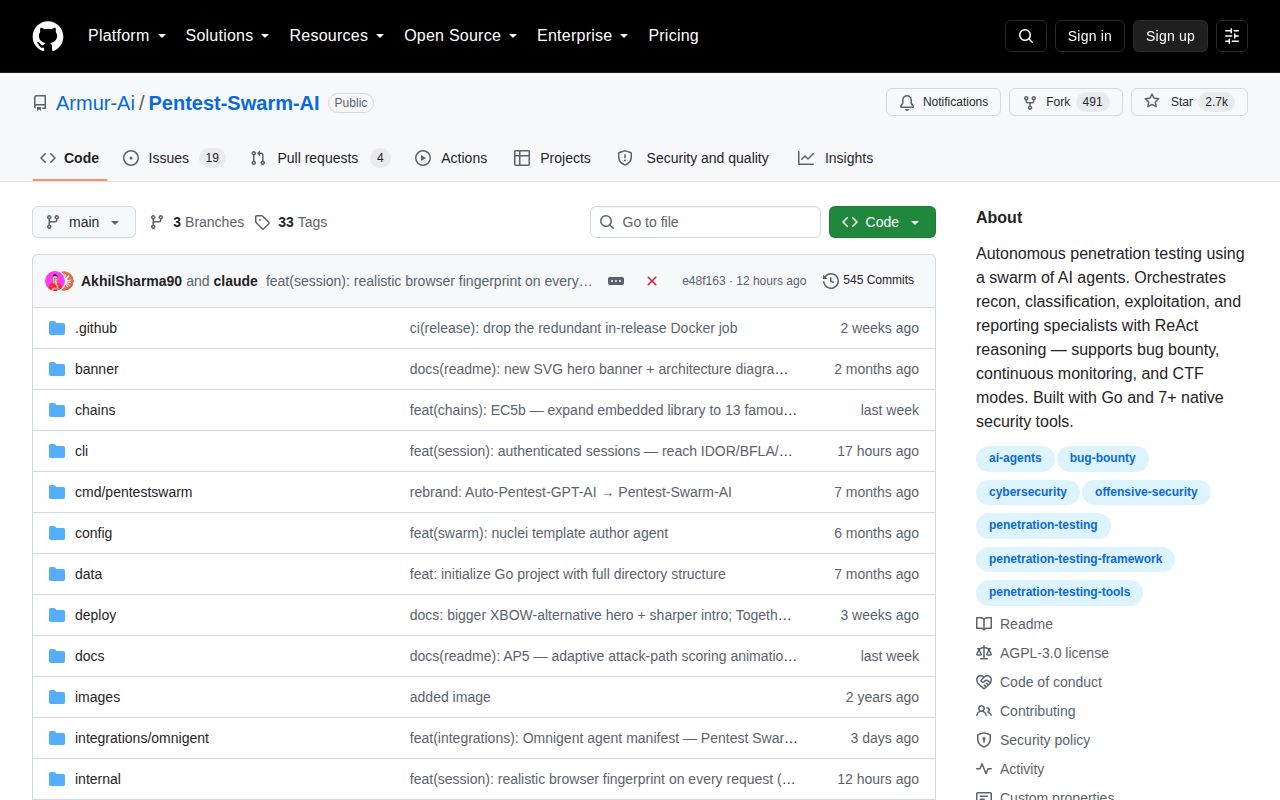
The repository has 2,355 stars and 12 open issues, which indicates strong attention with a currently modest visible issue queue. More importantly, it was pushed on August 25, 2026, the day of our review. That recent activity matters more than the absence of a newer release tag and argues against calling the project stale. Still, one v0.1.0 release is a thin cadence from which to infer compatibility or maintenance discipline. Watch issue response quality, security disclosures, release notes, and whether contributors beyond the core maintainers become active.
Where it fits
Treat Pentest Swarm AI as a supervised assessment layer, not the authority on risk. Feed it only authorized targets, place it behind strict network and credential boundaries, and send its evidence into the same triage process used for scanners and human findings. A security engineer should reproduce important results, assess impact, remove duplicates, and control remediation tickets.
For labs, CTFs, agent research, and carefully bounded internal pilots, it is a compelling project to evaluate now. For recurring production assessments or compliance evidence, wait for deeper release history and validate it alongside established scanners and human testers. The architecture is the reason to try it; disciplined supervision is the condition for using it responsibly.