OpenSRE investigates incidents, but it does not replace observability
OpenSRE has 3 main entry points for investigations: an interactive shell, headless commands, and a Python API. An agent can pull alerts, logs, metrics, traces, deployment history, and runbooks, then produce a root-cause report linked to evidence. None of those modes creates telemetry data, so teams still need working sources such as Grafana, Datadog, CloudWatch, Kubernetes, or Sentry.
We cloned commit e553d39 and ran it in a fresh, unprivileged Debian container. The checkout contained 5,165 files, about 611,108 lines of source, and 184.9 MB. The repository includes 20 CI workflow files, a Dockerfile, and a tests directory. This is closer to an incident-response platform than a weekend CLI. A buyer should assign an owner for upgrades, integrations, secrets, and response policy before connecting it to production.
Sixty-plus integrations turn configuration into permission design
OpenSRE documents more than 60 tools across LLM providers, observability systems, clouds, databases, incident services, messaging products, and MCP. It can mask identifiers before an external model call, keep transcripts locally by default, suggest actions, and optionally execute remediation. Optional masking and action execution make the permission model a deployment decision. Read-only credentials are the sensible starting point.
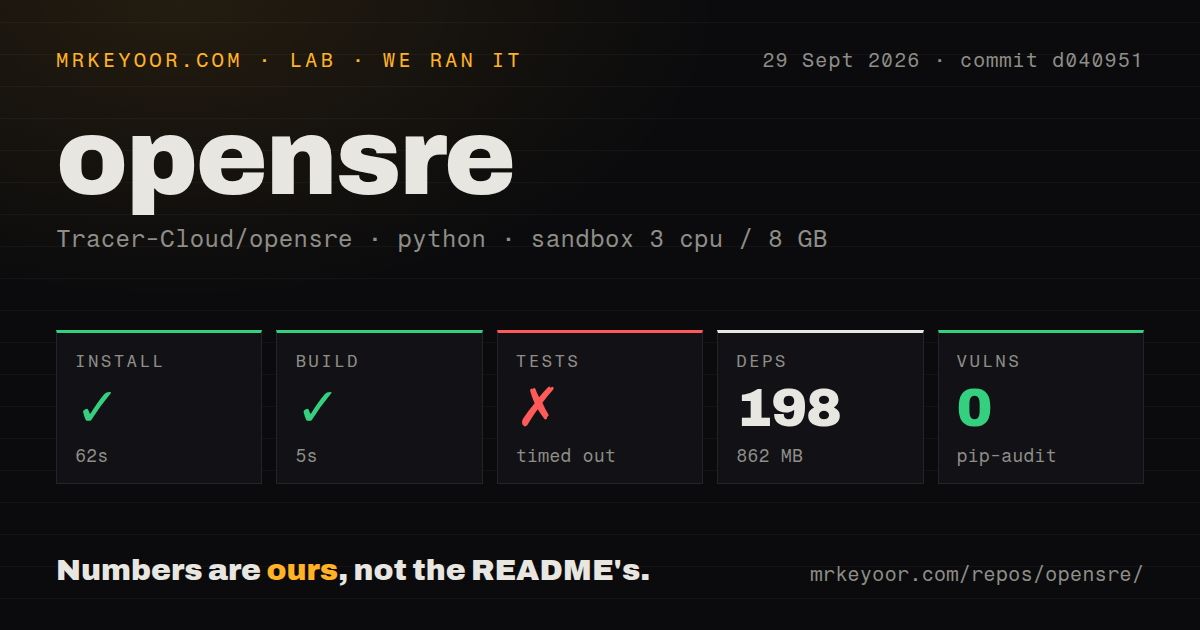
Our 3-CPU, 8 GB Debian sandbox needed 201 Python packages and 863 MB on disk after installation. That result covers the repository environment, not the accounts needed for a useful investigation. Hosted layouts may also need DATABASE_URI and REDIS_URI. An EC2 Telegram gateway needs AWS permissions, a bot token, and an LLM provider key. Every added integration expands the secret inventory and the data the agent can inspect.
What happened when we ran it
Our sandbox installed OpenSRE in 96 seconds and built it in 13 seconds. Pip-audit reported 0 known vulnerabilities in the installed dependencies. The test step ran for 823 seconds and exited with code 1: pytest recorded 15,768 passed, 23 failed, 121 skipped, and 1 expected failure. A high pass count is encouraging, but a red exit is still a red exit.
The log tail named several distinct failures. A groundcover probe returned failed where the test expected passed. Cursor adapter tests raised RuntimeError: Could not determine home directory. A GitHub MCP validation assertion, a Windows boot import-safety check, and a parallel Slack dispatcher test also failed. The supplied log does not establish one shared cause, so we would not dismiss all 23 as a container quirk.
The 23 failed tests touch production-facing boundaries
The 23 failures included integration seams: provider login detection, observability probing, GitHub MCP validation, Windows startup, and concurrent Slack actors. These do not prove that every corresponding feature is broken. They do show that commit e553d39 did not meet its own complete test expectation in the fresh environment we used. Re-run the relevant subsets on your target operating system before a pilot.
The repository still shows substantial engineering investment. We counted 20 CI workflow files, and 15,768 tests passed during a 793.02-second pytest session inside the broader 823-second test step. That is much better evidence than a demo screenshot. It also makes the remaining failures harder to ignore: the project has enough test coverage to identify precise boundary problems, and adopters should use those failures as a checklist.
The documentation is stronger than the evidence for agent quality
Setup guidance covers Python 3.12+, uv, Windows, a development container, hosted deployment, telemetry switches, and common missing-shell capabilities. The .env.example is long because the integration surface is long. Product analytics and error reporting are opt-out, with OPENSRE_NO_TELEMETRY=1 disabling both. The privacy guide says alert contents, files, hostnames, credentials, raw CLI arguments, and personal data are excluded by design.
What the project does not publish yet is just as important. The README's benchmark section says there are no benchmark results. Our run measured installation, build integrity, tests, and dependency vulnerabilities on 3 CPUs with 8 GB of RAM. We did not measure root-cause accuracy, model cost, time to diagnosis, or remediation safety. Those are the outcomes that decide whether the agent helps during an incident.
Daily releases show activity, while v0.1 behavior keeps moving
GitHub showed 10,939 stars, 316 combined issues and pull requests, and an Apache-2.0 license when fetched. The repository was pushed on August 26, 2026, and release v0.1.2026.8.26 shipped that day. Current issue and pull-request updates from the same date show real maintenance activity. The combined open count is not a defect count, especially in a repository receiving many contributions.
Fast change has an operating cost in a 611,108-line source tree. The latest release notes include agent-path refactors, prompt changes, packaging fixes, and removal of LLM OAuth in favor of API keys stored in .env. Open issue 5768 reports that Ollama selection does not verify whether a chosen model is installed. Open issue 5294 says HTTP clients cannot yet receive investigation progress before the final result. Pin a release and rehearse upgrades.
HolmesGPT is the narrower choice for Kubernetes-first teams
OpenSRE earns a trial when one team must investigate across several clouds, data stores, observability systems, and chat surfaces. Its own sandbox result sets the caution level: 201 installed packages, 863 MB, and 23 failed tests. Start with read-only integrations, disable outbound telemetry if policy requires it, and compare the agent's conclusions with a known incident set before it can propose or run changes.
HolmesGPT is the more focused comparison for Kubernetes investigation. Keep addresses a different problem, alert collection, correlation, and workflow, which may be the missing layer if responders already know how to investigate. OpenSRE is the better candidate when the investigation loop itself is fragmented. Its 13-second successful build makes a trial cheap enough; the blank benchmark and failed full suite make unattended production authority premature.