The overlay sends voice and screenshots to Gemini
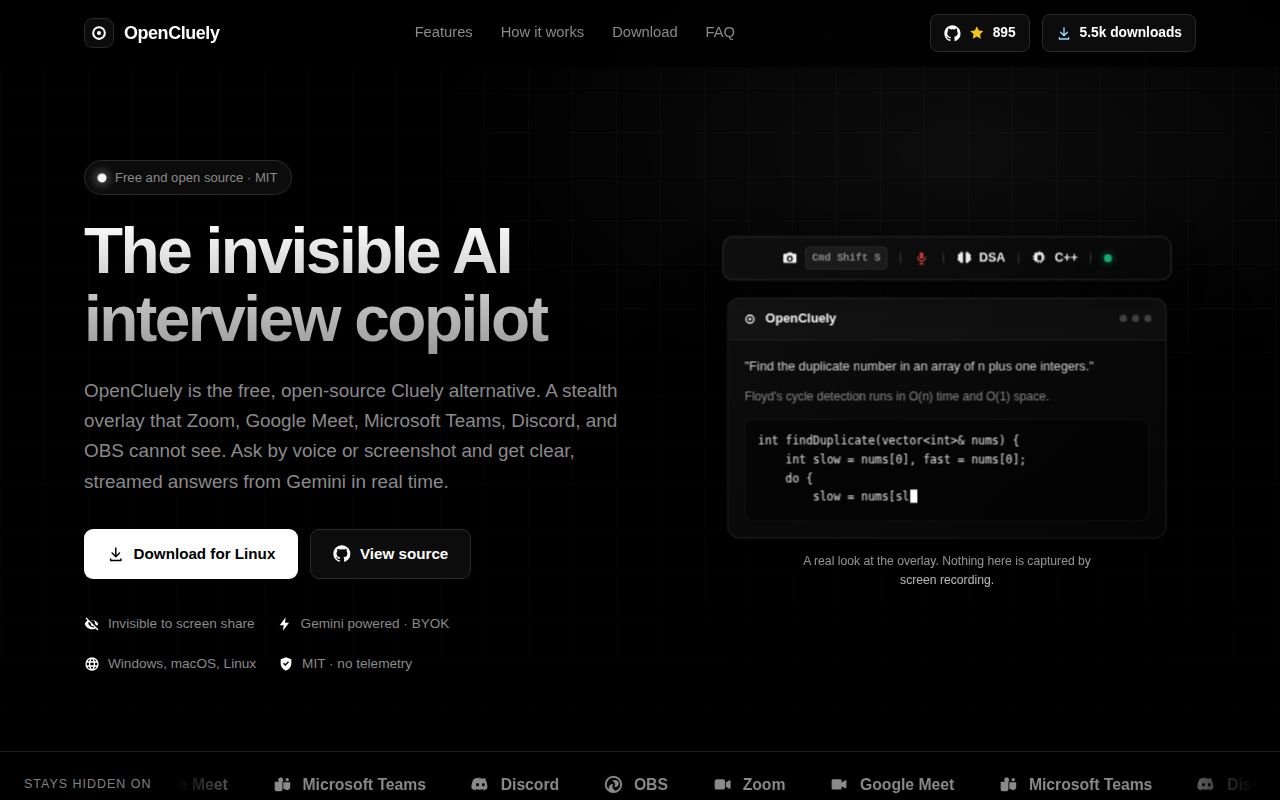
OpenCluely v1.8.7 is an Electron assistant built around a floating answer window. A user can capture a screen region, speak through manual or voice-activity capture, and continue a session through chat. Gemini handles image and answer generation. Local Whisper or Azure Speech can supply transcription. The README says the app keeps session data locally and sends a request to the selected AI provider, so this is not an offline answer engine even when Whisper runs on the same machine.
The interface is tuned for data-structure and algorithm questions, with answer prompts for C++, C, Python, Java, and JavaScript. Our checkout had 64 files and about 15,643 source lines, small enough for an Electron developer to inspect before using it. The product's signature behavior is capture exclusion: Electron asks Windows or macOS to keep the overlay out of captured frames. The README plainly says Linux has no equivalent flag, so viewers can see the overlay during a Linux screen share.
Live-interview stealth creates a policy problem
The project calls itself an invisible interview copilot and advertises ordinary process names, automatic hiding, and capture-resistant windows. Its ethics section says the app is for learning and practice and places responsibility for interview rules on the user. That caveat matters. Using a concealed answer feed in an interview that forbids outside help misrepresents the candidate's work, regardless of whether the software succeeds at hiding itself.
A practice session is easier to defend and easier to control. Run a timed problem, ask by voice, then compare the model's answer with your own reasoning. The 550 MB installed footprint is acceptable for that isolated trial, but the assistant should not become the source of truth. It can generate a plausible explanation while missing a constraint. The repo has no automated test target for its own behavior, and it supplies no measured answer-accuracy evidence that we could verify.
What happened when we ran it
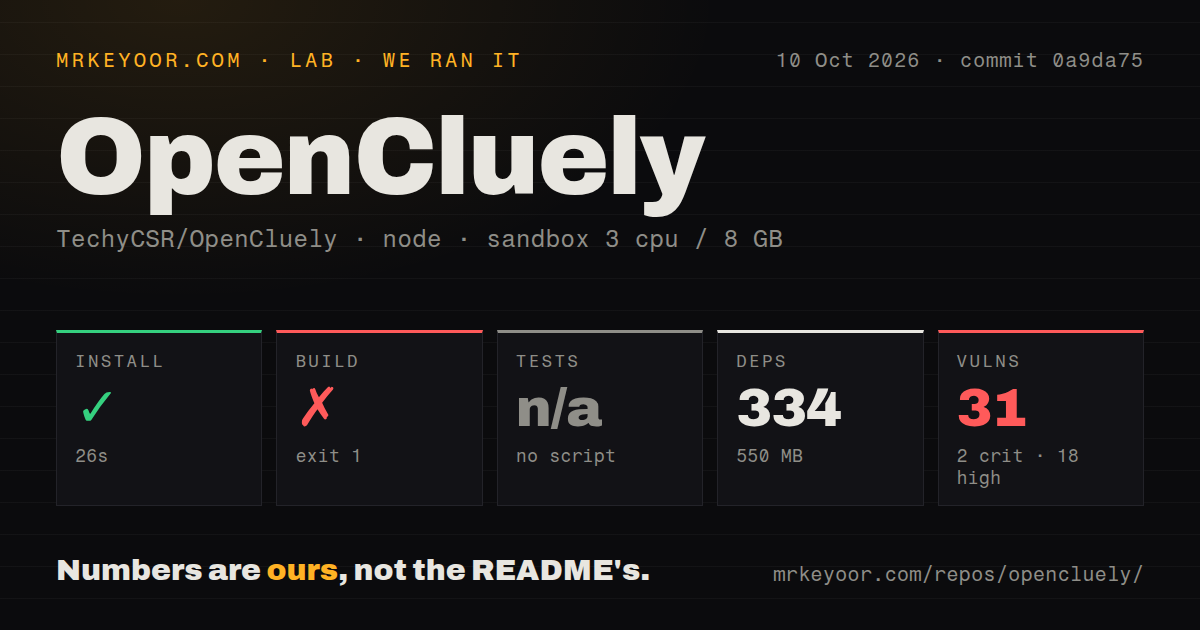
Our sandbox installed 334 packages in 27 seconds at commit 0a9da75, occupying 550 MB. Npm audit reported 25 known vulnerabilities: 2 critical, 17 high, 4 moderate, and 2 low. The checkout used 3 CPUs and 8 GB of RAM in an unprivileged Node 22 container with no secrets. We found 1 CI workflow, no Dockerfile, and no tests directory.
The project had no test script or target, so testing was skipped. Its build command ran for 156 seconds and exited with status 1. The final log showed Electron 29.4.6 packaging for Linux x64, including AppImage and Debian targets, then ended with a direct error: a GitHub Personal Access Token was not set programmatically or through GH_TOKEN. The log does not establish why a local packaging command needed publishing credentials, so we do not assign a cause.
Packaging metadata disagrees about version and license
The failed build exposed a visible version mismatch. GitHub's latest release is v1.8.7, while package.json declares version 1.0.0 and the log names OpenCluely-1.0.0.AppImage plus opencluely_1.0.0_amd64.deb. A user compiling the tagged project should inspect artifact names and update behavior before distributing anything. Our run also shows that a clean no-secret environment cannot complete the provided generic build command as measured.
Licensing needs the same attention. The README badge and final section call the project MIT licensed. The root LICENSE file contains Apache License 2.0, which GitHub's API also detects, while package.json says ISC. Those are 3 different declarations with different notice and patent terms. We cannot choose the author's intended license from that evidence. A company should get the mismatch corrected before incorporating or redistributing the code.
Voice and platform support have specific gaps
The current README requires Node.js 18 or newer. Local Whisper adds Python 3.10 or newer, creates a virtual environment, and may use ffmpeg and sox; Azure Speech requires another key and region. Windows and Linux have release artifacts. The Windows binary is unsigned and may trigger SmartScreen, while macOS has no downloadable build because Gatekeeper blocks the unsigned and un-notarized app. macOS users must build from source.
Open issues match those rough edges. Issue 25 reports that local Whisper immediately stopped recording on an M2 Mac even after the documented initialization. Other open reports cover Windows startup freezes, microphone stops, screenshot failures, and an overlay detected during a full-screen test. Each report describes one user's environment, so none proves a universal failure. Together with the absent test target and 25 audit findings, they define the checks a trial must include.
The July 29 push is older than the latest pull-request activity
GitHub showed 895 stars, 17 open issues, and 12 open pull requests. The last repository push was July 29, 2026, one day after release v1.8.7. Pull-request activity continued through September 3, including work on another model provider and permission handling. That means contributors are still proposing changes, while the default branch and release have not absorbed them. A stale release tag alone would not settle health; the open queue and last-push date tell the more mixed story.
OpenCluely is a compact experiment with a useful practice interface and too many unresolved signals for sensitive use. A 27-second install makes it cheap to inspect, but the 156-second failed packaging run, 25 audit findings, absent tests, and conflicting license labels all need owner attention. For interview preparation, Tech Interview Handbook or Interactive Coding Challenges gives you a record of your own work without building the session around concealed answers.