The 42-centimeter duck is a build project, not a kit
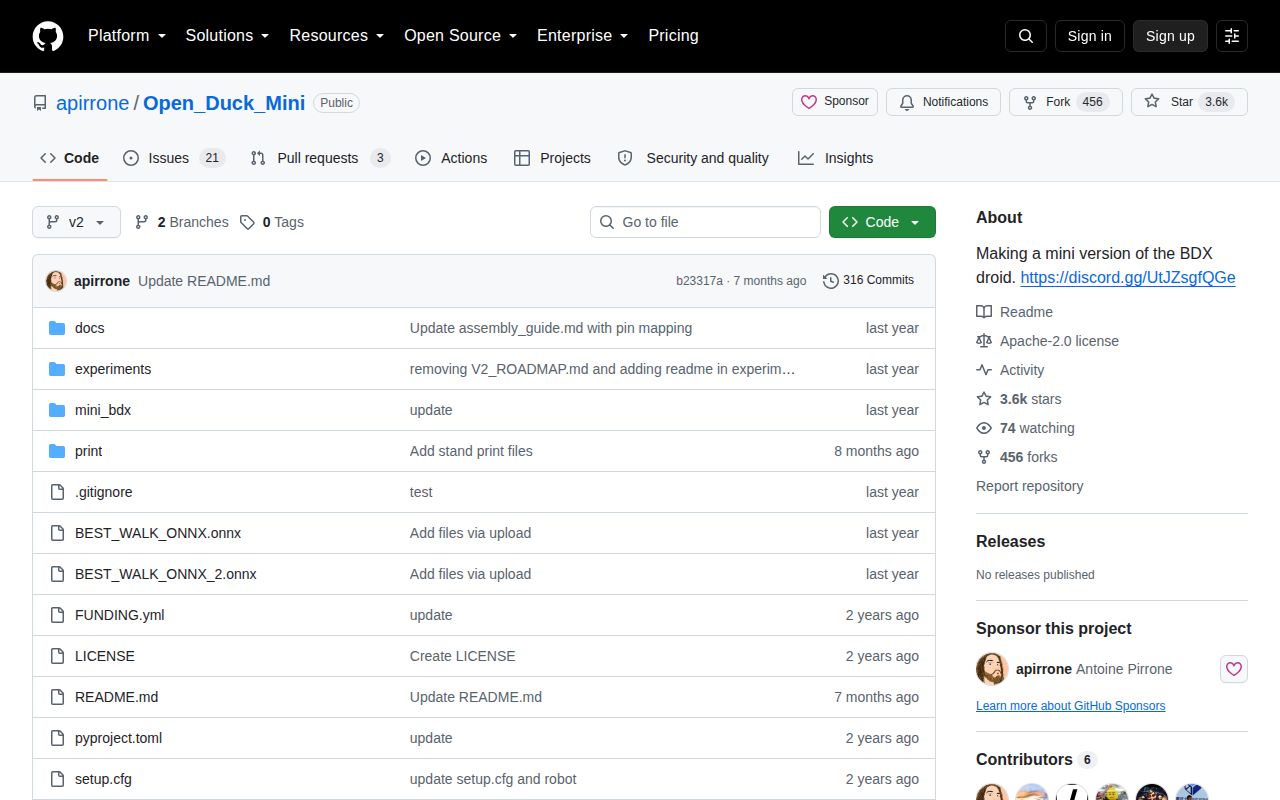
Open Duck Mini v2 is a small biped modeled after Disney's BDX droid. The README says it stands about 42 centimeters tall and sets a goal of keeping the bill of materials below $400. Printable parts, an Onshape CAD model, MuJoCo files, wiring diagrams, motor notes, and 2 ONNX walking policies are available. That is enough material to study the design before buying parts.
It is still a working repository. The maintainers say undocumented scripts remain, and the experiments folder warns that some files are old and should not be run. Onboard code lives in Open_Duck_Mini_Runtime. Training has moved to Open_Duck_Playground, while reference motion has its own repository. A builder has to keep several projects aligned.
Printing needs 2 materials and assembly needs electronics skill
The print guide lists PLA parts at 15% infill and a TPU foot bottom at 40% infill. The build uses heat-set M3 inserts, bearings, servo screws, threadlocker, wiring, and symmetric pieces that must be oriented correctly. Before assembly, each motor receives a specific ID and moves to its zero position so the horn can be fitted. Mistakes here become gait or range problems later.
The guide maps Raspberry Pi pins for eye LEDs, antenna servos, foot switches, a BNO055 sensor, and a MAX98357A amplifier. It warns builders to charge battery cells to the same voltage before installation. The runtime computer is a Raspberry Pi Zero 2 W. Anyone without safe battery, soldering, and multimeter habits should work with an experienced builder.
What happened when we ran it
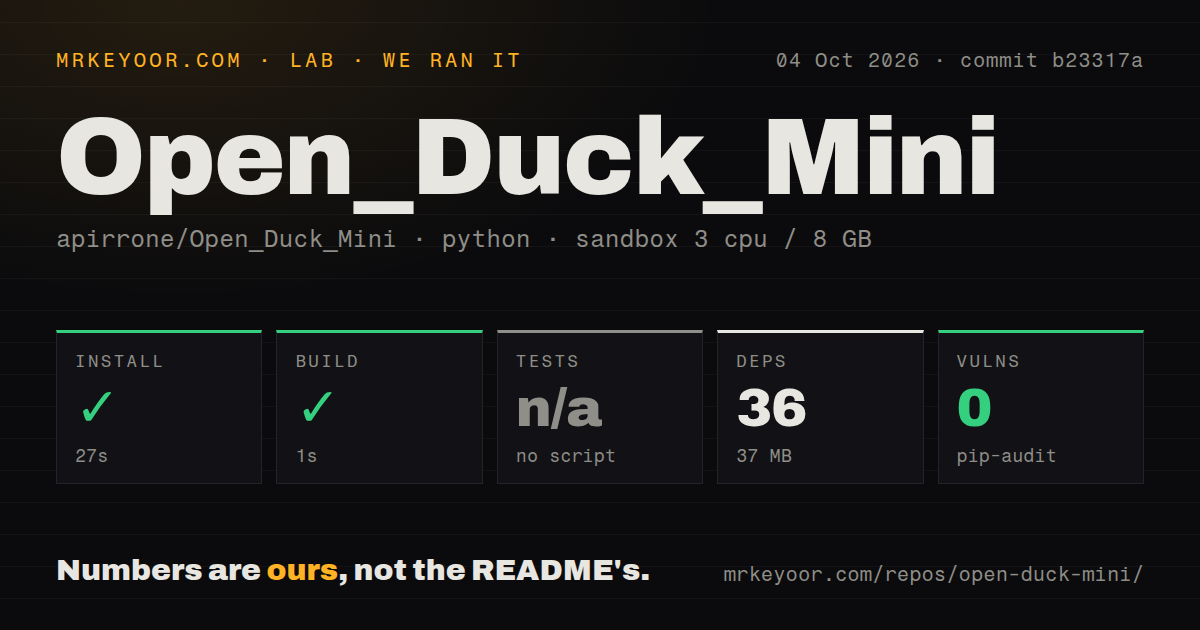
Our sandbox installed commit b23317a in 29 seconds. It added 36 Python packages and used 37 MB on disk. Building the Python distribution succeeded in 6 seconds, and pip-audit found 0 known vulnerabilities. The repository was 182.8 MB, with 410 files and about 10,698 lines of source, plus robot meshes, CAD exports, simulation assets, and ONNX files.
There was no test script or target, so our lab skipped tests. The checkout also had no tests directory, Dockerfile, or CI workflow files. A passing package build confirms that Python packaging completed. It does not check servo IDs, printed tolerances, wiring, battery behavior, simulation fidelity, policy stability, or whether the physical duck can walk.
The assembly guide still has missing measurements and photos
The assembly page has step photos for the trunk, feet, shins, hips, neck, head, wiring, and body. It also says X m3 screws with a TODO for the exact quantity. The servo-driver-board step asks for a photo, and the head section needs instructions for the camera, antennas, eye LEDs, projector, and speaker. Issue 19 asks for TODO cleanup, updated pictures, and a FAQ.
The README points to a newer Tnkr guide, a Chinese guide, a Google Sheets BOM, Discord, and Onshape. These resources may answer questions the repository does not, but revision matching is harder. No GitHub release freezes one combination of CAD, parts, runtime, and policy. Save the exact documents and branches used before ordering servos or printing the shell.
A walking policy is supplied, while training context is incomplete
Two pretrained ONNX policies can run in simulation through the documented command. The sim-to-real guide explains the route: export from Onshape, tune the MuJoCo mass and motor model, train in Open Duck Playground, generate reference motion, then use the hardware runtime. It labels itself Not finalized yet and sends readers elsewhere for current files.
Issue 43 shows why that matters. A user running BEST_WALK_ONNX_2.onnx reported that the simulated duck fell when commanded forward and asked for training data and advice on initializing 3 prior-action inputs. Issue 52 reports changed 12V knee motors and poor right-foot clearance. A policy file alone does not supply the mechanical and observation context needed for stable motion.
Motor selection can decide whether the gait is reachable
Issue 48 asks whether the BOM meant the STS3215 C046 or C044 rather than the slower C001 variant. The reporter measured a required target speed above the C001's stated limit and could not maintain the gait. The issue had 4 comments when fetched. Confirm the exact submodel and gear ratio before a bulk motor order.
The project's TODO list calls for a new battery-management system, a stronger neck part, complete screw information, updated head files, and possible 12V motors with a retrained policy. Those are proposed tasks, not shipped improvements. Changing voltage, torque, or gearing also changes the physical system the supplied policy expects.
Code paused in January, while builders stayed active in August
GitHub recorded the last repository push on January 31, 2026. The project had 3,620 stars and 24 open issues and pull requests when fetched, with new builder questions through August 20. There is no latest GitHub release. User activity has continued around a code and documentation snapshot that has not moved at the same pace.
Open Duck Mini exposes the difficult gap between a simulated gait and a real machine. Our 6-second package build removes little of that work. The right buyer wants to print, wire, calibrate, debug, and perhaps retrain the robot. Anyone who mainly wants the finished character should choose a supported kit.